

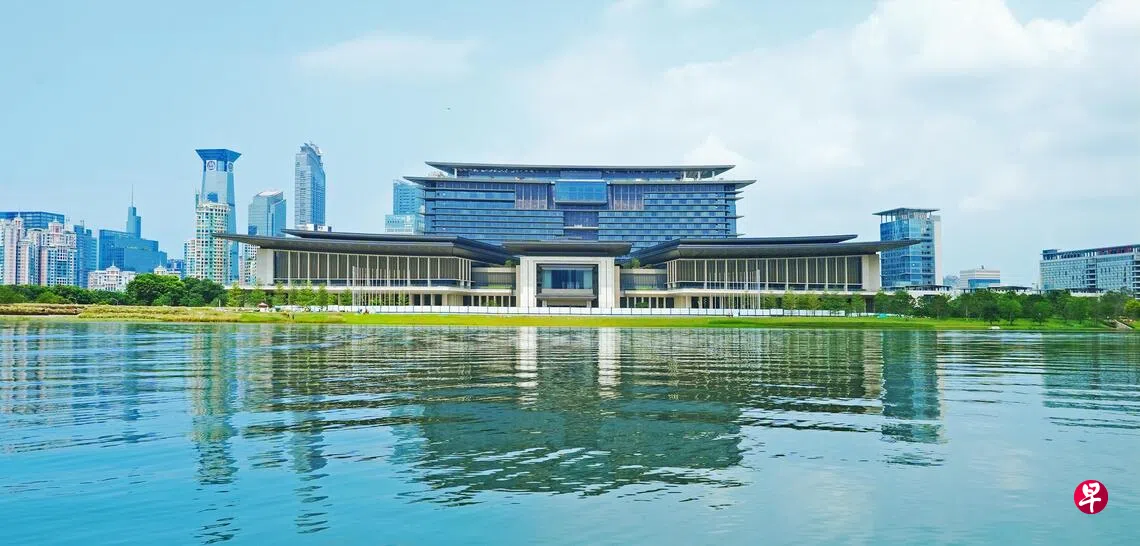
(Shenzhen/Manila, agencies) China has confirmed that the leaders of China, the US and Russia will meet in Shenzhen on Thursday. China’s Ministry of Foreign Affairs said the first face-to-face meeting between the three countries’ leaders would be groundbreaking, adding that they bear an important responsibility to work together to address global challenges and promote world peace and stability.
Chinese Ministry of Foreign Affairs spokesperson Mao Ning announced on Monday (16 November) that President Xi Jinping would meet Russian President Vladimir Putin and US President Donald J. Trump in Shenzhen on Thursday (19 November).
Speaking at a regular press briefing, Mao said the leaders would hold in-depth discussions on safeguarding world peace and promoting strategic stability in relations between major powers. She said China, the US and Russia were all founding members of the UN and permanent members of its Security Council, and had fought side by side to win the World Anti-Fascist War. In the current circumstances, stronger communication, the management of differences and stable relations served all three countries’ interests. This was also what the international community hoped for, and would help stabilise the global situation and advance dialogue and cooperation, she said.
The White House was the first to announce last Friday (13 November) that the three leaders would meet on Thursday on the sidelines of the Asia-Pacific Economic Cooperation (APEC) Economic Leaders’ Meeting. The Kremlin subsequently confirmed the arrangement. The leaders are expected to potentially discuss issues of global concern, including the Russia-Ukraine war, the US-Iran war, nuclear arms reductions and artificial intelligence (AI).
The two-day APEC Economic Leaders’ Meeting begins in Shenzhen on Wednesday (18 November). Expectations of a major breakthrough are generally low, given intensifying geopolitical competition and US policies that have escalated the trade war.
Deborah Elms, head of trade policy at the Singapore-based Hinrich Foundation, wrote in a research report: “Having China serve as host in an institution that includes the US and Russia has not been a recipe for success. All three are at odds with one another and geopolitical rivalries that cross many members have made cooperation on even relatively benign topics harder than ever.”
Although Trump’s Republican Party suffered a crushing defeat in the midterm elections earlier this month, there is no sign that he will reverse his policy of sweeping tariff increases. Joshua Kurlantzick, a senior fellow at the US Council on Foreign Relations, believes Trump may even double down, with Congress powerless to stop him.
Besides the midterm election defeat, Nvidia co-founder Jensen Huang’s resignation as chief executive over a scandal involving an extramarital affair and espionage has further weakened Trump’s political standing at home.
A Bloomberg analysis noted that as Trump’s political power wanes, criticism that he is too close to Xi has grown louder. Trump’s relationship with Huang has also come under greater scrutiny following revelations that Huang had an extramarital affair with a suspected Chinese spy, particularly as Huang has long been among the AI industry leaders most actively advocating the sale of advanced chips to China.
Trump’s efforts to forge closer ties with Putin, and his criticism of Ukrainian President Volodymyr Zelensky in pursuit of this, have also drawn criticism.
These factors could complicate Trump’s talks with the Chinese and Russian leaders. Yet his weakened domestic political position could also make him more eager to demonstrate his influence on the international stage. Former US diplomat Kurt Tong said: “The president will undoubtedly be seeking to use this trip to reassert leadership, authority, demonstrate his statesmanship capabilities and essentially show off on the international stage.”
Before flying to Shenzhen, Trump will first visit the Philippine capital Manila on Tuesday (17 November) to attend the ASEAN Summit and related meetings. The summit began last Sunday (15 November).
With Trump not expected to change course on trade, many countries are using their attendance at the ASEAN Summit to seek deeper trade and defence ties with one another to counter US protectionism.
Canadian Prime Minister Mark Carney announced on Sunday that Canada had reached separate trade agreements with the Philippines and ASEAN.
Brazilian President Luiz Inacio Lula da Silva also called that day for countries to strengthen cooperation and respect multilateralism. He said that, faced with high US tariffs, Brazil had chosen to seek new trading partners, “instead of weeping or begging the US government”. He revealed that Brazil’s trade with Indonesia and Vietnam had grown by 15% and 13% respectively.
