

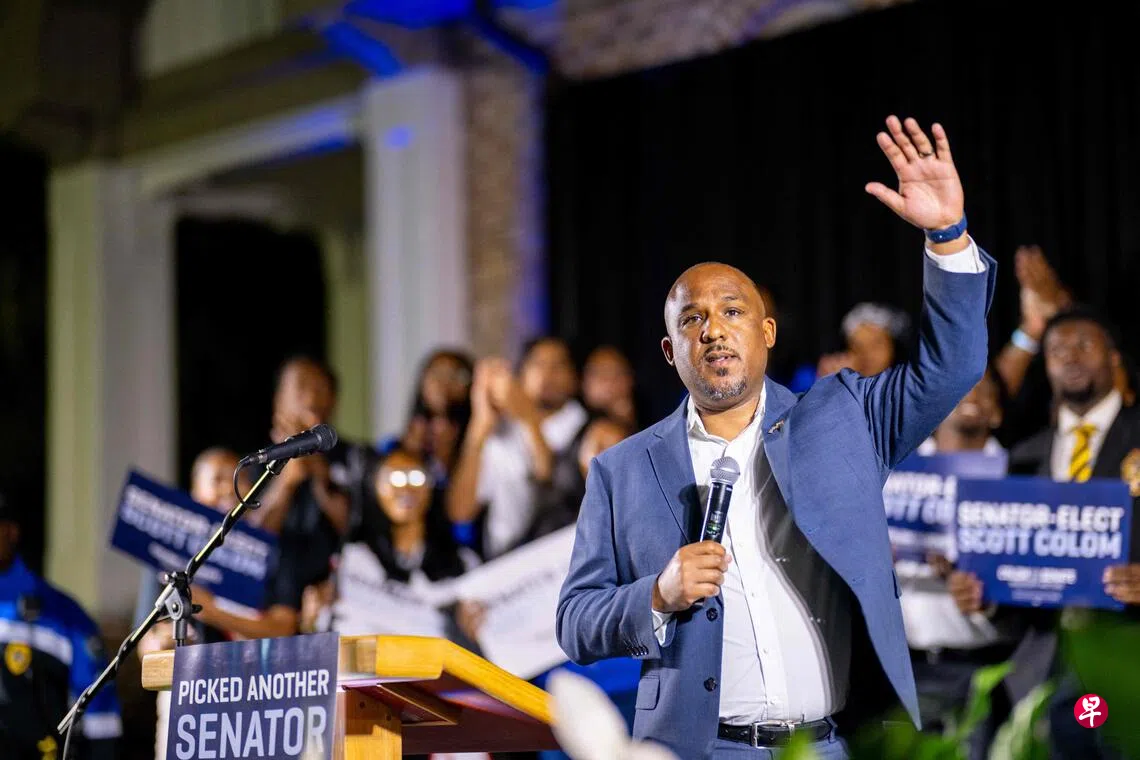
(Washington, agencies) With vote counting in the US midterm elections nearing completion, another Republican stronghold has unexpectedly flipped to the Democrats. Several media outlets have projected a narrow Democratic victory in Mississippi, further widening the party’s Senate majority. Once Democrats take control of both houses of Congress next year, they are expected to seek cuts to the Donald J. Trump administration’s US$1.5 trillion (about S$1.9 trillion) defence budget.
According to the latest media tallies on Wednesday (11 November), Democratic candidate Scott Colom led his Republican opponent Cindy Hyde-Smith by more than 4,500 votes in the Mississippi Senate race.
If the final result matches media projections, Colom will win by a slim margin of 0.5 percentage points, becoming the first Democrat to win a Mississippi Senate seat in nearly 45 years. He will also be the southern state’s first black senator in more than 140 years, since the Reconstruction era following the US Civil War.
The result marks a stunning upset in the Republican stronghold of Mississippi, dealing another heavy blow to a party already reeling from major losses.
Voters’ dissatisfaction with the Trump administration’s harsh immigration policies, the war with Iran and rising living costs helped drive a strong Democratic showing in the midterm elections, enabling the party to regain control of both houses of Congress.
With the Mississippi seat, Democrats have secured 55 of the Senate’s 100 seats, while Republicans hold 44. Only the Alaska race remains undecided. If Democrats also win there, their Senate total will rise to 56, the highest since Barack Obama was elected president in 2008.
In the House of Representatives, Democrats have now secured 254 seats, well ahead of the Republicans’ 168.
Democratic-led Congress may review decision to rename defence department
The Wall Street Journal reported that when Democrats take control of Congress next year, they are expected to target projects championed by President Trump. They may also revisit his decision to rename the Department of Defense the Department of War, and seek to block other defence priorities of his administration.
The Pentagon earlier submitted a defence budget request of US$1.5 trillion. One of its flagship projects is to build a fleet of new Trump-class battleships capable of carrying nuclear weapons. Democrats regard it as a wasteful vanity project.
Democratic Representative Adam Smith, who is highly likely to become chairman of the House Armed Services Committee, said: “We need an appropriate mix of high-end survivable systems and lower-cost attritable capabilities, not a fleet of nuclear-powered battleships as proposed by the president.”
The Department of War’s defence budget request includes a US$1.1 trillion regular budget, a separate US$350 billion budget reconciliation package, and US$67 billion for the Iran war and National Guard deployments.
If no agreement is reached on the budget, Pentagon spending could be frozen at less than US$900 billion under a continuing resolution, with no funding available for new projects.
