

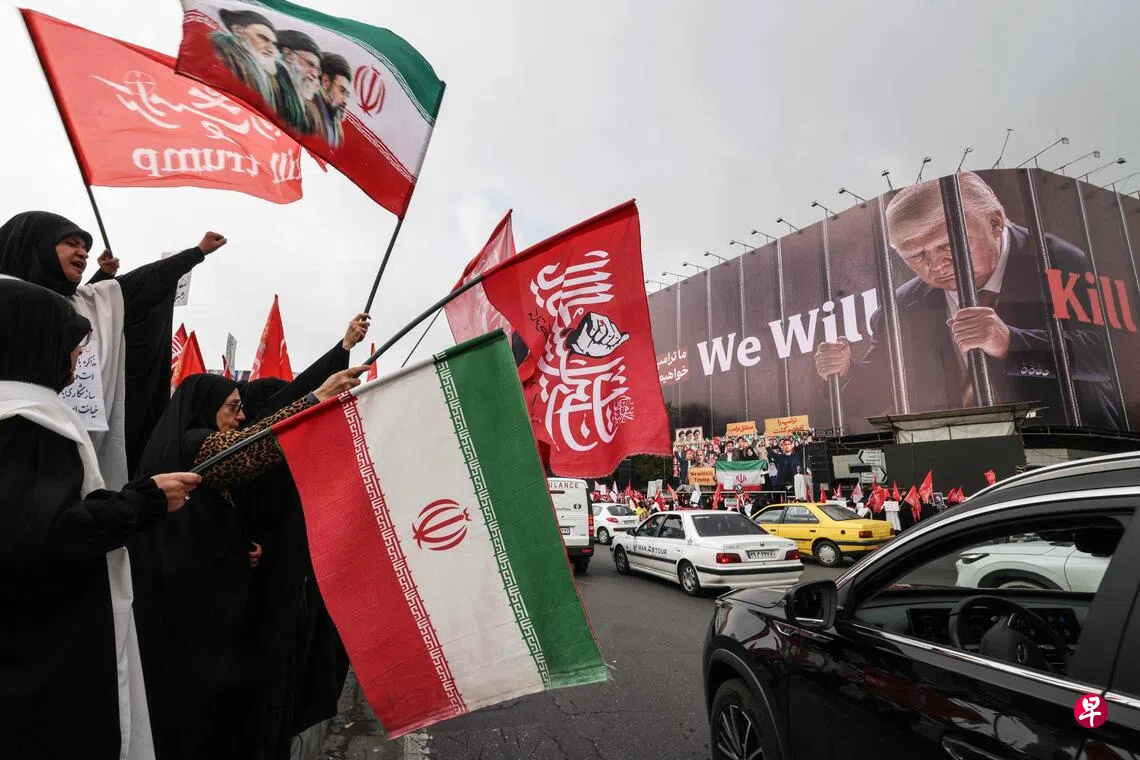
Despite previously saying he would resume military strikes on Iran after the midterm elections, US President Donald Trump has sought in recent days to play down that threat, shifting attention to whether a Qatari-mediated proposal can achieve a breakthrough. But tensions between the US and Iran remain high, with both prepared for war to break out again at any moment.
In an interview with the Financial Times on Tuesday (3 November), as voting in the midterm elections was under way, Trump said he had no immediate plans to strike Iran and was satisfied with the current standoff between the two countries. “We seem to be getting everything we want,” he said.
But he also said US forces were ready to fight at any time if necessary: “We’re locked and loaded if we need to go, but there may be no reason for it.”
The report noted that if Trump’s optimistic assessment of the Republicans’ electoral prospects proved wrong, his rhetoric on the US-Iran standoff could abruptly shift again, as it had in the past.
By the time Trump spoke to US media on Wednesday (4 November) evening, the Republicans had suffered losses in the midterm elections. He acknowledged that the war with Iran had affected the party’s performance to some extent, but said plainly that he did not regret launching it.
He told Fox News, “People understood the importance of what I’ve done with Iran… You can’t let the No. 1 state sponsor of terror have a nuclear weapon. You know, it’s the most dangerous country in the world, and we wiped them out practically. Haven’t finished a job, and maybe I will, and maybe I won’t.”
Iran’s military has repeatedly warned that the war would widen further if the US launched another attack.
Intensive US-Iran talks mediated by Qatar and Pakistan have been taking place in recent weeks. Citing diplomats familiar with the matter, Bloomberg reported that the US and Iran were reviewing a new proposal put forward by Qatari mediators, who expected to receive responses from both sides within two days.
However, major differences remain: Tehran wants Washington to lift its blockade of Iranian ports and ease sanctions, while Washington wants Tehran to make concessions on its nuclear activities.
Calls to develop nuclear weapons become mainstream in Iran
Meanwhile, as the US-Iran war drags on, calls within Iran’s political and religious circles to develop nuclear weapons and withdraw from the Treaty on the Non-Proliferation of Nuclear Weapons are moving from a fringe hardline position into the mainstream.
The New York Times cited regional analysts as saying that former Iranian Supreme Leader Ali Khamenei’s strategy had been to keep Iran’s nuclear intentions ambiguous, hoping to deter attacks without actually becoming a nuclear-armed state. But that approach failed to stop Israel and the US from going to war against Iran.
Iran analyst Mohammad Ali Shabani said this had even left Iran in a neither in nor out situation: “They paid for a bomb they didn’t have. Now, there is this sense that unless you have this ultimate weapon, you could end up at the mercy of not just the US, but Israel, at any point.”
Mohsen Rezaei, secretary of Iran’s Supreme National Security Council, acknowledged last week that Iranian leaders were discussing whether to maintain the country’s existing nuclear policy if war broke out again.
Those advocating restraint fear that such a move would provoke the US and Israel, exposing Iran to greater threats before it could successfully develop nuclear weapons.
But Sina Toossi, an Iran expert at the Washington-based think tank Center for International Policy, said these individuals faced the task of “explaining what Iran has gained from remaining below the nuclear threshold”. He also said a fresh round of US attacks could instead strengthen the case within Iran for developing nuclear weapons.
