

(Brussels/Helsinki, agencies) — The EU plans to raise tens of billions of euros in new funding to strengthen its defence autonomy and reduce its reliance on Washington, in response to the continuing threat from Russia and a gradual reduction in US military deployments in Europe. Five European countries, including Sweden, have also reached NATO’s largest-ever joint procurement agreement for land defence, purchasing more than 430 infantry fighting vehicles.
Bloomberg reported on Friday (27 November), citing unnamed sources familiar with the matter, that the EU was preparing to provide tens of billions of euros in new loans and grants. This follows the launch last year of the €150 billion Security Action for Europe (SAFE) low-interest financing programme.
The new programme is expected to launch in the second half of next year, with funding drawn from borrowing and allocations under the EU’s next seven-year budget, which begins in 2028.
The sources said the new programme would focus on filling gaps in the technological and logistical capabilities needed for large-scale conflict. Its final form will depend on consultations with member states and NATO, and will take into account reductions in US military deployments.
The EU has identified integrated air and missile defence, as well as intelligence, surveillance and reconnaissance systems, as priorities for joint investment, but insufficient funding in the current budget has held back progress.
The outlook for future budgets is also unpromising. EU Defence Commissioner Andrius Kubilius revealed on Wednesday (25 November) that the €130 billion originally earmarked for defence and space had been cut by 30% during negotiations on the next seven-year budget.
Polish Prime Minister Donald Tusk also called for more funding in a social media post on Thursday (26 November): “A cheap Europe could turn out to be a very expensive mistake. Security comes at a price.”
Europe has increased defence investment since the outbreak of the Russia-Ukraine war, but remains heavily dependent on the US for the “strategic enablers” that allow its forces to deploy, sustain and coordinate operations, and gather intelligence.
However, when the US launched a review of its military posture in Europe this summer, it made clear that European allies should assume primary responsibility for their own conventional defence as Washington shifts its strategic focus towards China.
Pentagon policy chief Elbridge Colby had said the review would be submitted to Secretary of War Pete Hegseth by 1 December. But AFP cited EU diplomatic sources as saying that publication of the findings would most likely be delayed until next year, with no announcement expected at the NATO foreign ministers’ meeting early next month.
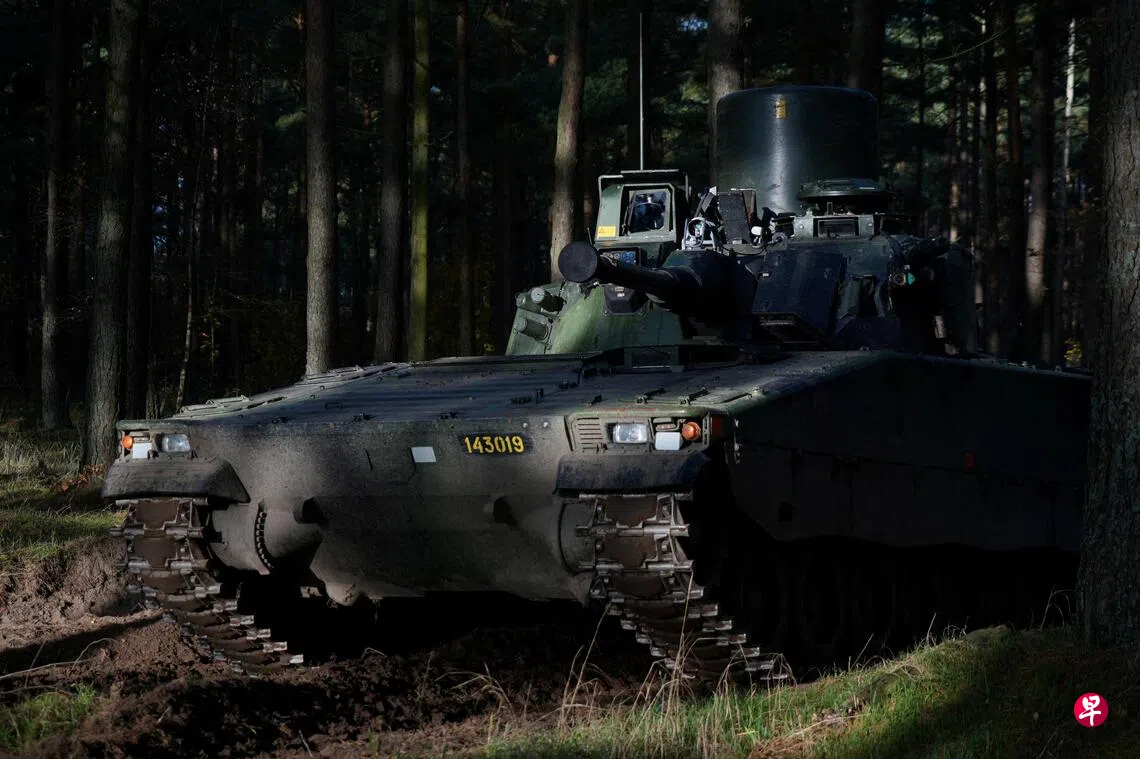
As the EU prepares its new funding programme, Sweden has also brought together Finland, Norway, Lithuania and the Netherlands to jointly purchase more than 430 CV90 infantry fighting vehicles from Britain’s BAE Systems. Representatives of the five countries signed the agreement in Stockholm on Friday (27 November).
Finnish Defence Minister Antti Hakkanen announced on Thursday that Finland would spend €2.8 billion on 160 of the vehicles, with an option to purchase up to 100 more vehicles and spare parts. If pricing for the other countries is similar, the total deal will exceed €7.5 billion.
Hakkanen described it as a major project to strengthen the defences of a “more European NATO”. Joint procurement would both lower costs and address the problem of Europe’s disparate military equipment, improving interoperability.
The new vehicles have counter-drone capabilities, and their design draws on the Ukrainian military’s combat experience. Deliveries to Finland are expected to begin in 2030.
