

International ratings agency Fitch affirmed France’s sovereign credit rating at A+ on Friday (30 October), but lowered its outlook from “stable” to “negative”, expressing deep concern over the cost of servicing the country’s huge debt.
Fitch forecast that the debt-to-gross domestic product (GDP) ratio of France, the EU’s second-largest economy, would rise from nearly 115.7% in 2025 to 124% in 2028.
Fitch said weak economic growth, a renewed deterioration in the fiscal position and rising government bond yields were making it harder for France to undertake the necessary, sustained fiscal consolidation to stem its worsening debt trajectory.
France will hold two rounds of voting in its presidential election in April and May next year. Fitch said the prospects for reducing debt after the election remained uncertain. Political divisions would make it difficult for parliament to agree on “a credible fiscal strategy”, while a wave of protests against rising prices and inadequate public services posed a further formidable social obstacle to fiscal consolidation.
French Finance Minister Roland Lescure said in a statement on Friday that Fitch’s assessment underscored the urgent need for France to pass a “responsible budget” before the end of the year. President Emmanuel Macron’s government is seeking parliamentary approval for a new budget aimed at sharply cutting spending and raising taxes. But without an absolute majority in parliament, it has struggled to advance the bill, adding to market concerns.
Shortly before Fitch released its assessment of France, the National Institute of Statistics and Economic Studies reported on Friday that French GDP had contracted by 0.1% quarter on quarter in the third quarter. This marked another contraction for the French economy this year, following a 0.2% decline in the first quarter and zero growth in the second.
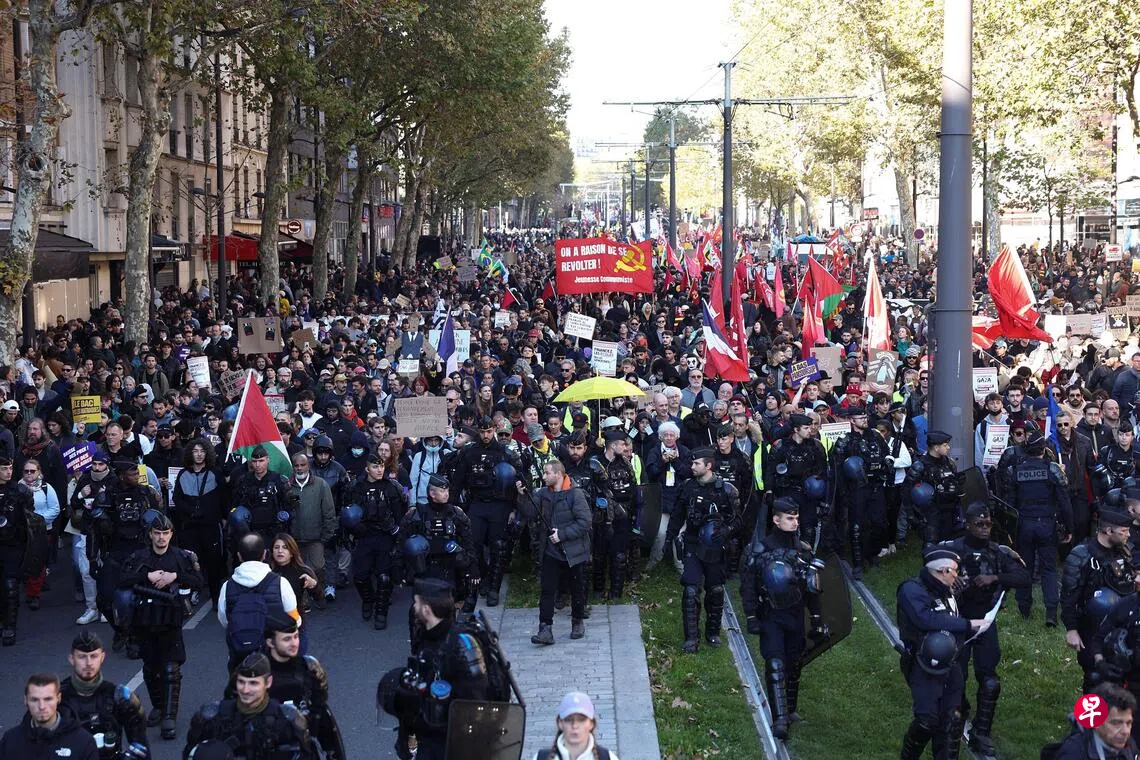
Meanwhile, protests were expected in France on Saturday for a third consecutive weekend. Shopkeepers in Paris boarded up their windows on Friday to guard against street violence and looting. Alain Di Crescenzo, president of the French chambers of commerce and industry, said businesses were deeply fearful and anxious, and “cannot wait for Saturday to be over”.
Authorities deployed about 70,000 security personnel nationwide to prevent a repeat of the chaos on 17 October, when thousands of businesses were vandalised and looted. More than 40 Paris metro stations are temporarily closed, and tram services are also affected. In central Paris, the République district around Place de la République and the busy Châtelet–Les Halles district are placed under curfew on both weekend nights, from 11pm to 6am the following morning.
With the protests coinciding with Halloween on Saturday, French Interior Minister Laurent Nuñez warned protesters not to wear masks that concealed their faces. He said authorities had found calls on social media for people to gather on Halloween night to launch a “revolution”. Some posts also urged people to dress up and spend a “night of darkness” together.
