

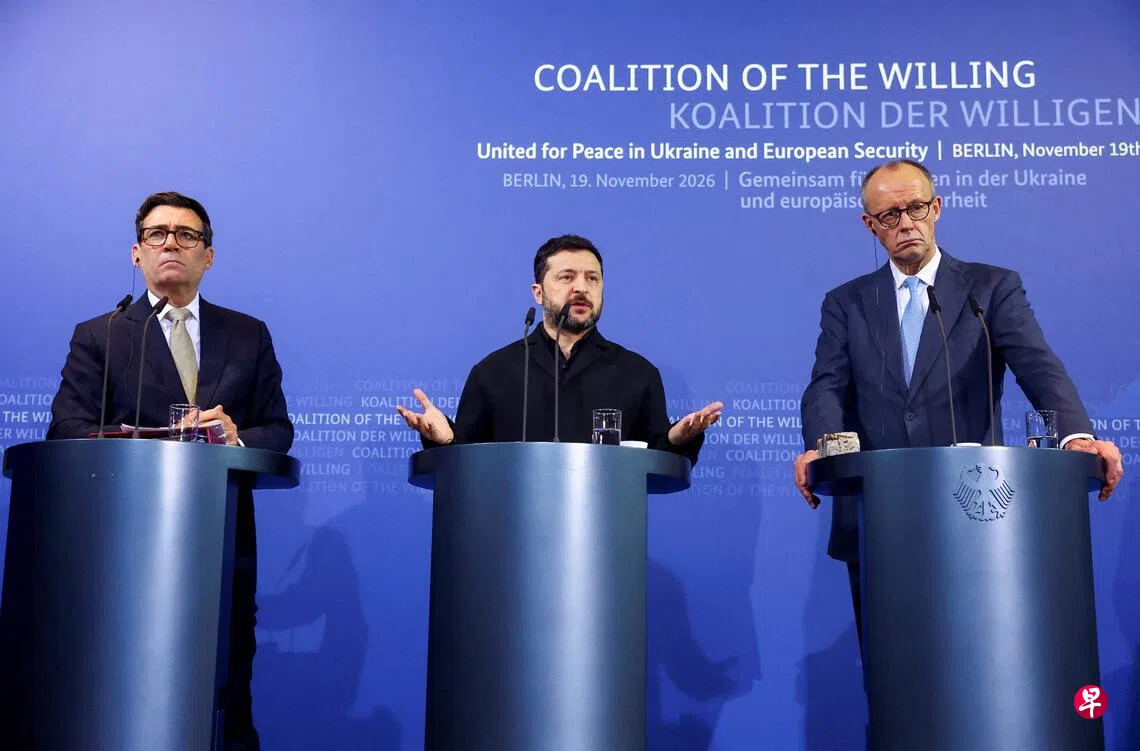
The leaders of Germany, France, the UK and Ukraine issued a joint statement in Berlin reaffirming that Russia cannot win a war of attrition as long as key allies remain steadfast in their support for Ukraine.
Earlier, US President Donald J. Trump publicly called Russian President Vladimir Putin a friend while attending the Asia-Pacific Economic Cooperation (APEC) Economic Leaders’ Meeting in Shenzhen. His remarks deeply unsettled European allies, who fear Washington and Moscow could bypass Europe and strike a “Yalta-style” deal to carve it up.
Seeking a say in US-led Russia-Ukraine peace talks, the Coalition of the Willing, which supports Ukraine, held an emergency summit in Berlin on Thursday (19 November). It brought together the leaders of Germany, France, the UK, Poland, Italy and NATO. US envoys Steve Witkoff and Jared Kushner also attended. After the meeting, UK Prime Minister Burnham said the US and Europe had reached a level of agreement on Ukraine rarely seen in recent months.
Commentators have drawn parallels between Trump’s meeting with Putin in Shenzhen and the 1945 Yalta Conference between the leaders of the US, the UK and the Soviet Union.
Speaking at a press conference, German Chancellor Friedrich Merz said bluntly that the Yalta model could not deliver peace, vowing that European leaders would never allow major powers to carve up the continent behind closed doors. He also played down the significance of the Shenzhen summit, describing it as nothing more than “a photo opportunity”, and stressed that the US knew there could be no genuine peace without Europe’s involvement.
Addressing European concerns, Trump, who joined the meeting by telephone from Air Force One, said his message to participants was that “everybody wants to make a deal, so let’s make a deal”. He reiterated that European countries should help secure a deal and spend their money on their own countries.
Kushner, who appeared alongside Merz at the press conference, sought to reassure allies, saying Trump wanted to reach a peace agreement with European support and that Russia had agreed to multilateral talks with Europe. Kushner revealed that Trump was open to providing Ukraine with security guarantees similar to NATO’s Article 5 collective defence clause, adding that Russia also appeared willing to accept such an arrangement.
Ukrainian President Volodymyr Zelenskyy, however, remained concerned about the details of the security guarantees. He noted that the parties had yet to reach a clear consensus on how to implement a mechanism similar to NATO’s Article 5, and that the details must be clearly explained to partners, the public and investors.
In contrast to the US reassurances, the Kremlin was still trying to exclude Europe from the core negotiations. Russia not only rejected another round of talks in Abu Dhabi involving European representatives, but Putin also proposed, following a Ukrainian attack on the road bridge linking Crimea and Russia, that European envoys first travel to Moscow to explain their position before the format of subsequent peace talks was decided.
