

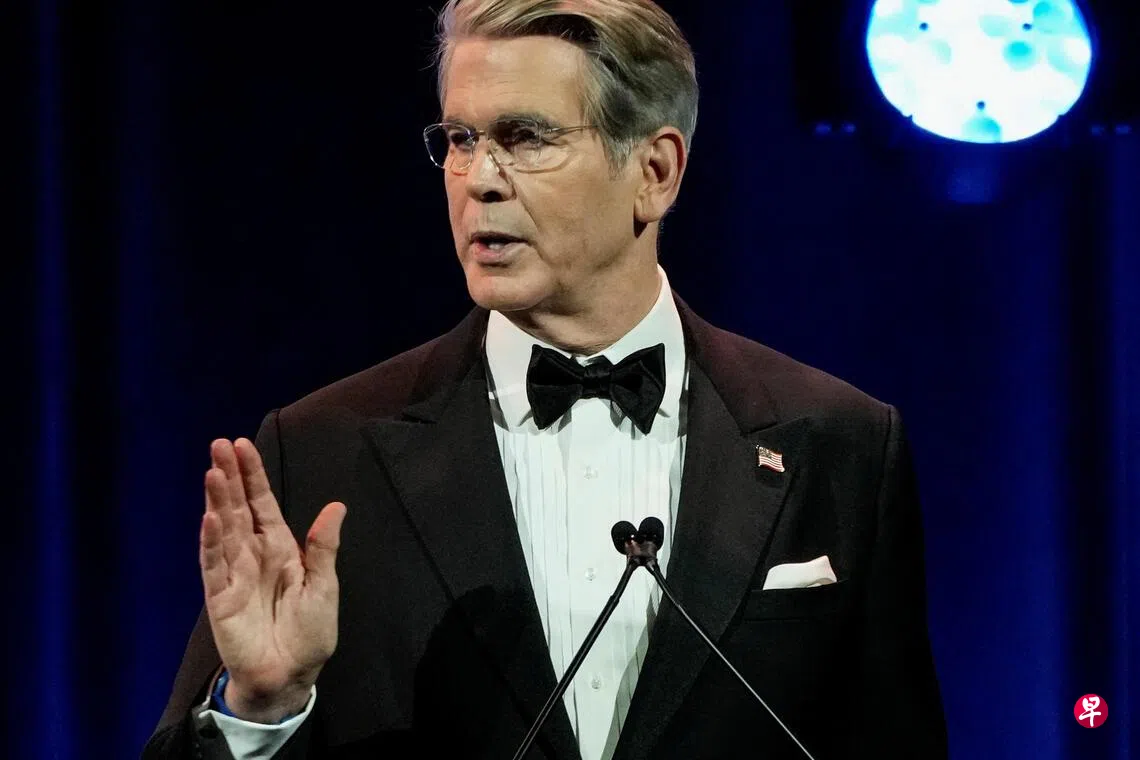
(Washington, agencies) Former Nvidia chief executive Jensen Huang is discussing a possible return to the company with close associates, according to sources. But US Treasury Secretary Scott Bessent has publicly called on Nvidia to look outside the company for a new chief executive and overhaul its leadership.
The Financial Times (《金融时报》) reported on Sunday (15 November), citing a person close to Huang, that his allies were assembling a “war room” of Silicon Valley executives to lobby for his return to Nvidia and secure White House support.
According to the source, Huang’s allies said: “Everyone that matters in tech outside the frontier labs loves Jensen.” The source added that Huang himself supported the efforts to secure his return.
Nvidia declined to comment on the report.
Huang resigned as Nvidia’s chief executive on 12 November. The Financial Times reported the following day that Nvidia’s board had approached Rene Haas, chief executive of British chip designer Arm. The board said it was too early to speculate about any individual candidate, whether internal or external.
Bessent gives Nvidia 10 days to account for compliance with US export controls
Besides public support from several Silicon Valley technology company founders, an open letter calling for Huang’s reinstatement had attracted more than 165,000 signatures as of Sunday evening. Signatories included thousands of current and former Nvidia employees and more than 62,000 shareholders.
US President Donald J. Trump told reporters as he departed for China on Monday (16): “I think having Jensen go back -- a lot of people are asking Jensen -- they think Jensen should go back. That certainly isn't a bad idea.”
However, Bessent told Fox News on Sunday that Nvidia must look outside the company for a new chief executive and undertake a sweeping overhaul of its leadership.
Bessent wants to know whether Nvidia deliberately ignored warning signs, including suspicions that several shell companies were transhipping chips to China. He instructed Nvidia’s board and external legal advisers to provide an account within 10 days of whether the company had strictly complied with export controls, including whether it had pursued apparently illegal sales to boost revenue and profits.
In a veiled criticism of several companies linked to Singapore’s Megaspeed International, Bessent said: “And who knew? Because I mean, these shell companies were obvious. They were being investigated. And did Nvidia use them as a workaround to sell chips to the Chinese?”
Asked about Huang Le, the former Megaspeed International executive with whom Huang had an extramarital affair, Bessent said: “It doesn’t matter to me whether she’s a spy or not. You know, Jensen’s (Huang’s English name) foibles are his foibles.”
The remarks indicate that the US government is shifting its focus from Huang’s personal conduct to legal and national security issues.
Separately, Republican congressman John Moolenaar, chairman of the House Select Committee on China, told CBS’s Face the Nation (《面向全国》) on Sunday that Huang had agreed to testify before House members behind closed doors about his relationship with Huang Le.
John Moolenaar said his committee was still coordinating a date for the meeting with the Foreign Affairs and Intelligence committees. Committee members were eager to establish whether any sensitive information had been leaked.
The suspected espionage scandal surrounding the affair has prompted renewed calls in the US Congress for the government to tighten restrictions on China’s access to advanced artificial intelligence (AI) chips. On 10 November, Senate Democratic leader Chuck Schumer urged Congress to swiftly pass three bills to strengthen controls: the AI Overwatch Act, the Chip Security Act and the MATCH Act, which seeks to encourage US allies to restrict exports of more chipmaking equipment to China.
