

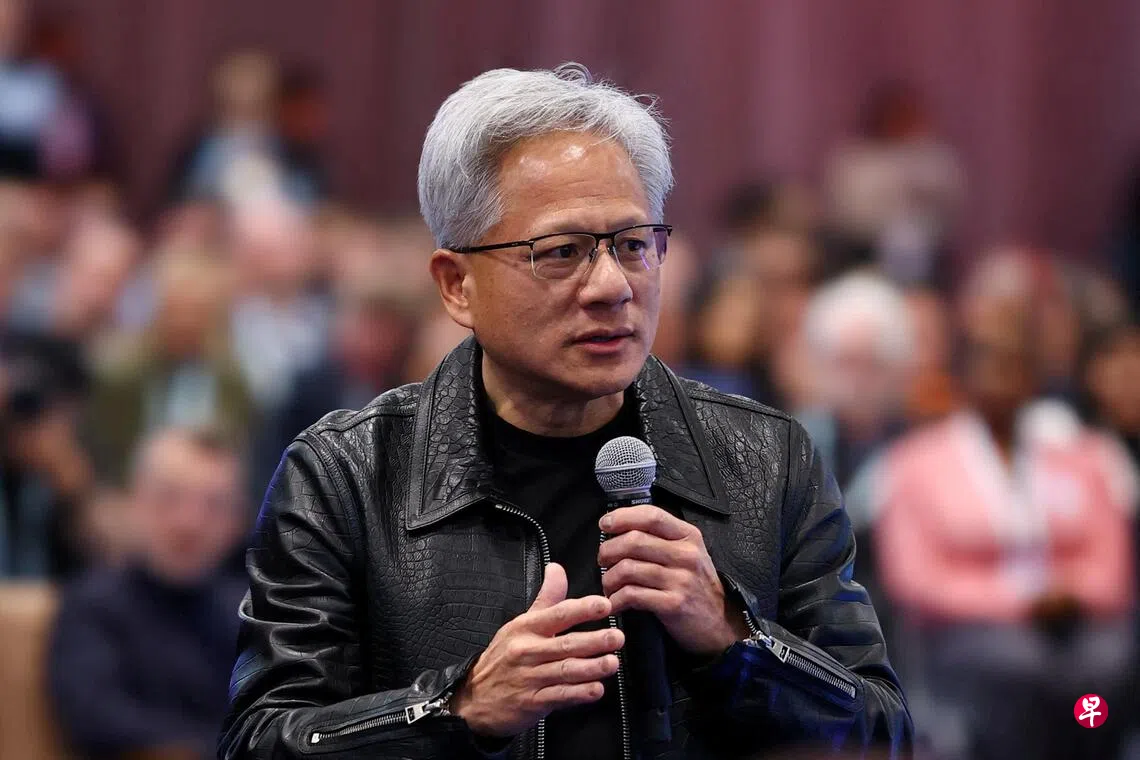
Nvidia’s board announced on Thursday (12 November) morning that chief executive Jensen Huang had resigned, ending days of speculation over his future.
Earlier, US media reported further allegations that, besides having an extramarital affair with Alice Huang, an alleged Chinese intelligence operative, Huang was also suspected of having an affair with a married female executive at the company.
Jensen Huang is widely recognised as one of the main drivers of the global artificial intelligence (AI) boom. He founded Nvidia in 1993, and his departure marks a dramatic fall from grace.

Nvidia announced that executive vice-president and chief financial officer Colette Kress had agreed to serve as interim chief executive. Kress said she would continue efforts to strengthen Nvidia’s leadership in accelerated computing and AI, and seize opportunities ahead.
In its statement announcing Huang’s resignation, Nvidia’s board paid tribute to his contributions while leading the company. It described Nvidia as one of the world’s most influential technology companies and said the board and company were grateful for his enormous contributions to the company and the wider industry.
Following the announcement of Huang’s resignation, Nvidia shares plunged more than 10% in pre-market trading on Thursday. The losses narrowed to about 5% an hour after the market opened.
With Huang’s departure, there remains widespread interest in how the scandal involving an extramarital affair and suspected espionage will unfold.
Earlier media analysis suggested that if Huang were forced to resign, it would mark the end of a chapter in the global AI boom he had set in motion. The repercussions would extend far beyond Nvidia’s own operations, affecting the entire AI industry.
US media: Married subordinate linked to affair was already the subject of office talk
The New York Times reported on Wednesday that five former Nvidia employees said Huang had a close relationship with Kimberly Powell, 48, the company’s vice-president of healthcare, who reported directly to him. Their relationship had long been a subject of discussion within the company.

Powell, who is married, joined Nvidia in 2008. According to the company’s website, she is responsible for applying Nvidia’s chip technology in higher education and healthcare, particularly medical imaging equipment.
According to Powell’s LinkedIn profile, she became senior director of AI business development in 2016. In late 2017, she became vice-president of healthcare. She frequently attends technology conferences around the world and speaks on behalf of the company.
When a New York Times reporter called Jensen Huang, 63, on Wednesday to ask about the matter, he said: “I don’t think you should be talking to me directly.” He then hung up.
Alice Huang visited Taiwan eight times; Mainland Affairs Council says entry restrictions now apply
Separately, Bloomberg reported that Alice Huang, who is suspected of gathering intelligence on Jensen Huang for China’s Ministry of State Security, has returned to China and is now in Beijing. Sources said it was unclear why or when she had gone to Beijing, or what she was doing there.
Asked at a regular press briefing on Thursday whether China could confirm that Alice Huang is in Beijing, Chinese Ministry of Foreign Affairs spokesperson Mao Ning replied: “I am not aware of the situation you mentioned.”
The Wall Street Journal, meanwhile, cited several people familiar with the matter as saying that it was, in fact, Alice Huang’s husband, Kang Wei, who first introduced her to Jensen Huang.
The Chinese businessman had known Jensen Huang for 10 years. For two years, Kang not only tacitly accepted his wife’s affair with Huang, but even openly discussed their intimate relationship.
The report said Kang and Alice Huang were adept at using their connections to expand their business interests. Over the past 10 years, the couple have made a succession of bets on highly lucrative sectors, from video games and pharmaceutical mergers and acquisitions to cloud computing. In every field they entered, they built an intricate network of affiliated entities, shifting shareholdings between their names and cashing in on all their connections. Nvidia’s highly sought-after AI chips were their latest target.
Meanwhile, Taiwan’s Mainland Affairs Council Minister Chiu Chui-cheng told the legislature’s Internal Administration Committee on Thursday that Alice Huang had entered Taiwan a total of eight times between 2024 and 2025.
Alice Huang entered Taiwan three times in 2024 and five times last year, with no record of entry so far this year. Chiu said she had travelled to Taiwan for business and as a Hong Kong resident.
Chiu said that, now that the Taiwanese authorities knew Alice Huang’s identity, they would flag her case and restrict her entry in accordance with regulations governing residence and settlement permits for people from Hong Kong and Macau, on the grounds that she could pose a threat to Taiwan’s interests, public safety and public order.
