

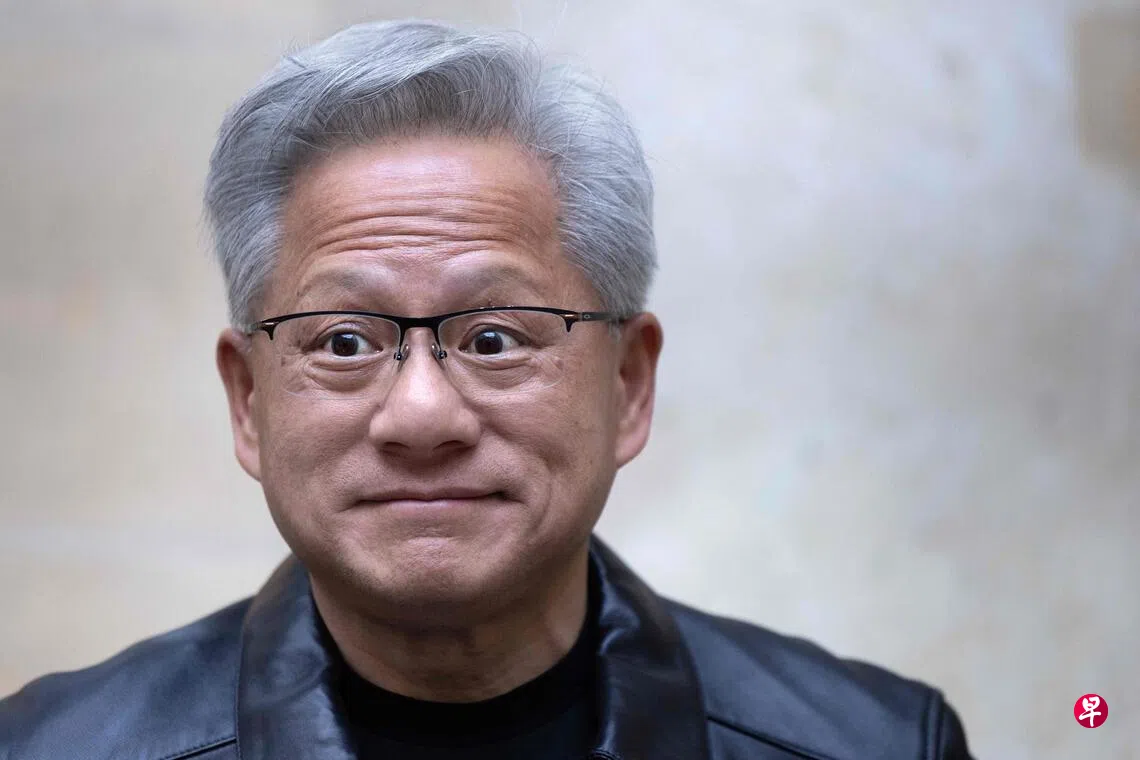
Former Nvidia chief executive Jensen Huang has resigned after an extramarital affair embroiled him in an espionage controversy, drawing intense attention from South Korean businesses with close ties to Nvidia.
From Samsung Electronics’ and SK Hynix’s high-bandwidth memory supplies to Hyundai Motor Group’s autonomous driving and robotics businesses, and South Korean companies’ vast semiconductor investment plans, strategic shifts under Nvidia’s new management could bring changes across the board.
While existing contracts are unlikely to be affected in the short term, the future of the South Korea-US “AI partnership alliance” that Huang built is being put to the test.
South Korea’s Chosun Ilbo (《朝鲜日报》) reported on the 14th that Huang had long played a central coordinating role in the global AI supply chain. He not only led advanced semiconductor cooperation with Taiwan’s TSMC, but also personally drove strategic alliances with South Korean companies. His sudden departure could now force a realignment of a network of partnerships built on trust between senior executives.
Although Nvidia has stressed that existing contracts and product development plans will proceed, South Korean industry remains concerned that chief financial officer Kress, who is serving as interim CEO, may place greater emphasis on profitability and investment risks. This could lead to changes in priorities for next-generation graphics processing unit (GPU) supplies and major investment projects.
South Korean semiconductor firms first to feel the impact
South Korean semiconductor companies will be the first to feel the impact. Samsung Electronics and SK Hynix have continued to expand high-bandwidth memory (HBM) capacity in recent years and have planned massive investments.
If coordination between Nvidia and TSMC on advanced chip production and investment is delayed, mass production of next-generation GPUs could be held up, affecting South Korean companies’ HBM deliveries and capacity plans. There could also be knock-on effects on data centre investment plans at technology giants such as Microsoft and Meta.
However, South Korean Deputy Prime Minister and Minister of Science and ICT Bae Kyung-hoon made clear on the 13th that Nvidia’s plan to supply South Korea with 260,000 advanced GPUs, along with existing joint projects, would proceed as scheduled.
Industry observers noted that investment cycles for AI data centre construction span 10 to 15 years. Given the high degree of interdependence between South Korean companies and Nvidia in the semiconductor supply chain, existing partnerships are not expected to change because of the management transition.
Uncertainty over future investment and technology partnerships could disrupt South Korea’s data centre plans
The real uncertainty lies in future investment and technology partnerships. Major decisions at Nvidia were previously concentrated heavily in Huang’s hands. The new management may adjust next-generation GPU order allocations, additional investment and technical support, affecting South Korea’s AI data centre construction and start-up development.
South Korean internet giant Naver signed an agreement with Brookfield last month to procure up to US$9 billion in computing infrastructure, and secured a US$1 billion equity investment from Nvidia this month. Even if existing agreements remain unaffected, uncertainty still surrounds subsequent investment and infrastructure expansion.
At Hyundai Motor Group, Huang had established a close working relationship with executive chair Euisun Chung. Their cooperation covers AI factories, autonomous driving and robotics, including Hyundai Motor’s and Kia’s plans to mass-produce autonomous vehicles in 2028.
Kim Jung-ho, a professor at the Korea Advanced Institute of Science and Technology, said that following Huang’s departure, the previous model of advancing partnerships through trust between senior executives could prove difficult to sustain, potentially slowing cooperation in physical AI.
Industry sources said the rapid expansion of cooperation between Nvidia and South Korean companies had owed much to Huang’s leadership style and speed of decision-making. With a relatively cautious new management team from a finance background taking over, progress on future joint projects could slow, while priorities for investment and business development could also shift.
