

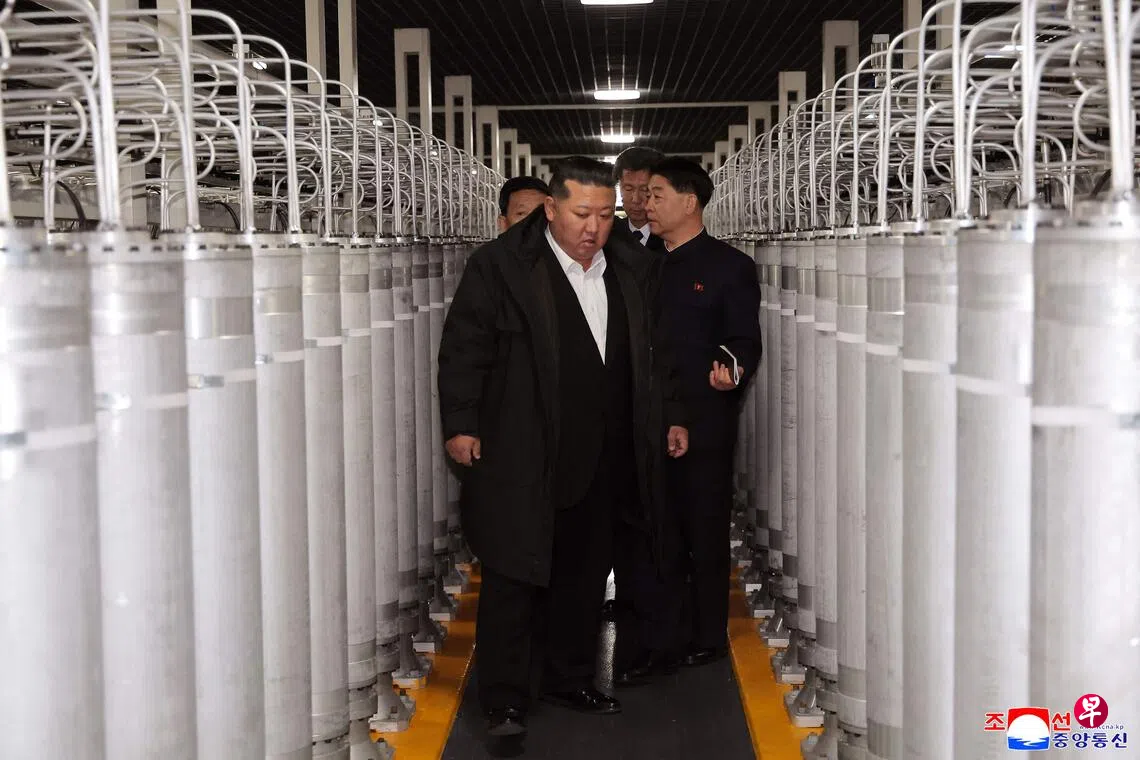
North Korean leader Kim Jong Un declared during an inspection of nuclear facilities on Wednesday that denying the country’s status as a nuclear-armed state amounted to a “declaration of war”. He also called for wider use of tactical nuclear weapons, hinting at their possible use against South Korea.
North Korea also unveiled what appeared to be nuclear warheads and a uranium enrichment facility, and showed suspected reactor equipment for a nuclear-powered submarine for the first time. Analysts said Pyongyang was both putting pressure on Seoul and seeking to force the US to accept the reality of a nuclear-armed North Korea before resuming dialogue.
The Korean Central News Agency (KCNA) reported on Thursday (26 November) that Kim had inspected a nuclear material production base, a nuclear weapons institute and a nuclear propulsion equipment production base the previous day.
It was his first inspection of nuclear facilities since June this year, and the first time North Korea had released images of him visiting a nuclear propulsion equipment production base. Last week, the leaders of the US, China and Russia held a summit in Shenzhen, China, to discuss preventing nuclear proliferation.
Kim declared that North Korea’s status as a nuclear-armed state had been permanently established and required no external recognition. Any attempt to deny that status amounted to a “declaration of war”, he said.
Citing North Korea’s shared border with “the most threatening enemy state”, he also stressed that using tactical nuclear weapons across multiple domains was an “important and urgent task”.
Kim also criticised the agreement reached by South Korea and the US last year to advance Seoul’s nuclear-powered submarine project, as well as Japan’s consideration of developing nuclear-powered submarines.
In response, South Korea’s Ministry of Defence said its military took seriously North Korea’s stated intention to expand the use of tactical nuclear weapons on the Korean peninsula. It urged Pyongyang to stop justifying its development of nuclear weapons immediately.
Footage released by Korean Central Television showed several devices believed to be nuclear warheads lined up along both sides of a corridor. Some resembled the Hwasan-31 tactical nuclear warheads unveiled by North Korea in 2023, while others differed from known models.
Experts speculated that the devices could include different types of hydrogen bombs. The uranium enrichment facility shown by North Korea could be within the recently expanded Yongbyon nuclear complex.
North Korea also released images of Kim inspecting a nuclear propulsion equipment production base for the first time.
Shin Jong-woo, secretary-general of the Korea Defence and Security Forum, suggested that some of the equipment could be reactor components for the 8,000-tonne nuclear-powered submarine that North Korea plans to launch next year.
Analysts said North Korea’s display of nuclear weapons and nuclear propulsion-related equipment was intended to signal that its nuclear deterrent extended beyond the Korean peninsula to the US mainland. However, the equipment’s performance and actual strike capabilities have yet to be verified.
US President Donald J. Trump had repeatedly proposed meeting Kim during the Asia-Pacific Economic Cooperation (APEC) leaders’ meeting in Shenzhen, but the meeting ultimately did not take place. Trump said on 25 November that he might soon resume exchanging letters with Kim. Pyongyang has yet to respond publicly to the proposed meeting.
Choi Yong-hwan, vice-president of South Korea’s Institute for National Security Strategy, said Pyongyang’s rare display of nuclear facilities and related equipment was intended to reinforce its nuclear-armed status through publicly released images.
An analysis by SBS television news said Pyongyang had effectively abandoned the previous model of negotiations premised on denuclearisation and was seeking to reshape the framework for North Korea-US talks as a nuclear-armed state.
North Korea also appears to believe that Trump is more eager than Pyongyang to restart dialogue. It is therefore in no hurry to respond to the US proposal for a meeting, instead using displays of nuclear strength to increase its bargaining leverage and gain the initiative in future talks.
