

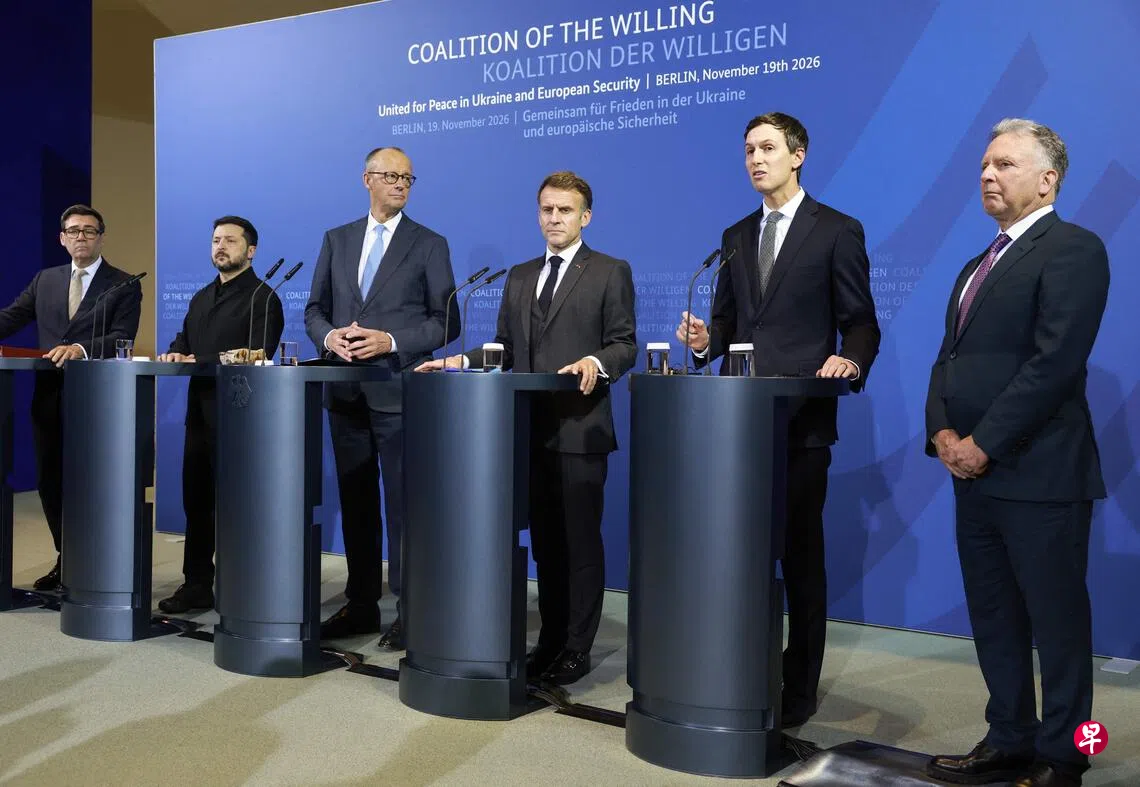
(Berlin, agencies) US envoy Jared Kushner said President Donald J. Trump was willing to consider providing Ukraine with “NATO-style” security guarantees, but only if doing so served Washington’s own interests.
Kushner attended a summit of the “Coalition of the Willing” in Berlin on Thursday (19 November), co-hosted by the leaders of Germany, the UK and France, to discuss post-war security arrangements for Ukraine.
He said Trump was open to providing Ukraine with security guarantees similar to NATO’s collective defence clause.
"And I think that that's something that President Trump is open to, but obviously it has to be in America's interest to do that," Kushner added. "We also have to make sure that it's part of a broader security package...we've gotten the Russians comfortable with that concept."
Kushner, Trump’s son-in-law, has been leading the US team in negotiations with Russian and Ukrainian officials alongside fellow envoy Steve Witkoff. He said the idea was consistent with Moscow’s desire to avoid another war after the current conflict ends.
Kushner also stressed the need to ensure that any agreement reached would be honoured and monitored, with consequences for any breach.
Ukraine has long sought to join NATO, particularly to secure the alliance’s collective defence guarantees. It remains unclear what form the potential security guarantees mentioned by Kushner would take, or whether Russia and Ukraine would accept the arrangements.
Kushner reassures European allies that Trump wants close consultations
European countries are concerned that decisions affecting Ukraine and the continent could be made without their involvement.
Seeking to reassure European allies, Kushner stressed that Trump wanted to reach an agreement in close consultation with Kyiv and Europe, rather than impose a unilateral deal.
The “Coalition of the Willing” summit came just after Trump held a closely watched trilateral meeting with the Chinese and Russian heads of state in Shenzhen. Kushner said Trump had also joined the Berlin summit by telephone after meeting Vladimir Putin.
German Chancellor Friedrich Merz described the meeting of the US, Chinese and Russian leaders as merely a “photo op”, saying that “the Yalta model cannot bring peace to Ukraine”.
At the Yalta summit in 1945, the leaders of the US, UK and Soviet Union drew new territorial boundaries for the post-Second World War era. The conference formalised the major powers’ spheres of influence and became synonymous with deals struck by major powers and imposed on smaller countries.
Merz stressed that Europe would take part in peace negotiations on Ukraine, saying such talks “can only succeed with Ukraine and Europe involved”.
He also said a new round of talks was expected soon, with Europe taking a seat at the negotiating table alongside the US, Russia and Ukraine.
Merz gave no specific date, saying a “neutral” venue was still being sought. The United Arab Emirates could be among the options.
