

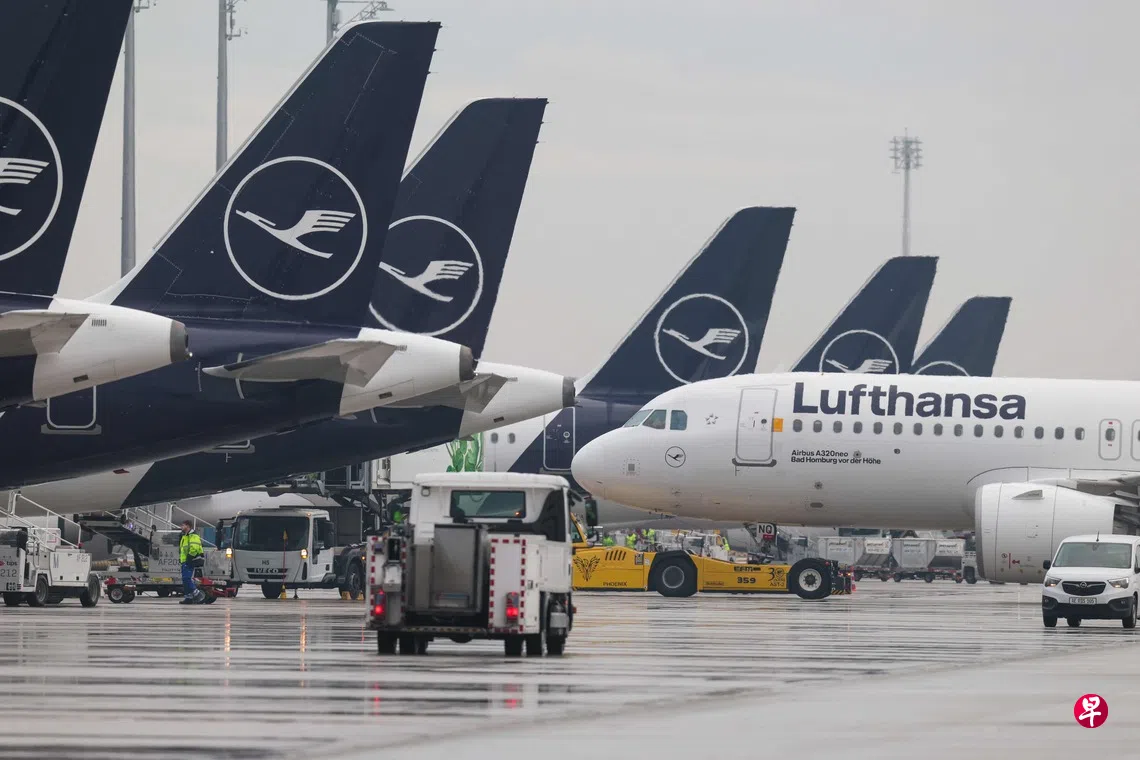
Germany's Lufthansa plans to cut 1,000 jobs as cost-cutting efforts fall short of expectations and the Iran war drives up fuel prices, adding to the airline's operating pressures.
An internal letter to staff obtained by AFP on Friday (20 November) showed that Lufthansa launched a cost-cutting programme in 2024 to stem losses, but the measures announced so far were "no longer sufficient".
The letter said Lufthansa lost an average of €20 million (about S$28.32 million) a month in the first nine months of this year.
"The year 2026 has set us back: the war in the Middle East, the still very high fuel costs, nine days of strike action and our already very high cost base have intensified the situation," the company said.
Lufthansa therefore plans to cut 1,000 full-time jobs at Frankfurt and Munich airports, equivalent to about 2.5% of its 40,000 employees.
The Lufthansa Group also includes Austrian Airlines, Swiss International Air Lines and Brussels Airlines, among others. Last year, the group announced plans to cut 4,000 jobs by 2030, mainly in administrative roles.
It remains unclear whether the latest 1,000 job cuts are included in the earlier plan or are additional reductions. A Lufthansa spokesperson declined to provide further details.
The Cockpit Union, which represents Lufthansa pilots, criticised the company for announcing job cuts during negotiations with staff over pay and working conditions, saying it was an attempt to create uncertainty and put pressure on employees.
The Cockpit Union also said the company had not explained which departments would be affected or whether the cuts were part of the previously announced plan.
Despite Lufthansa's own operating difficulties, the group's overall financial position remains relatively sound.
The group's third-quarter profit rose 30% year on year, beating market expectations, driven mainly by strong demand for premium tickets on long-haul routes.
However, fuel prices have risen sharply since the US launched its war against Iran. The Lufthansa Group's fuel bill this year is expected to be €2 billion higher than in 2025, adding to cost pressures.
