

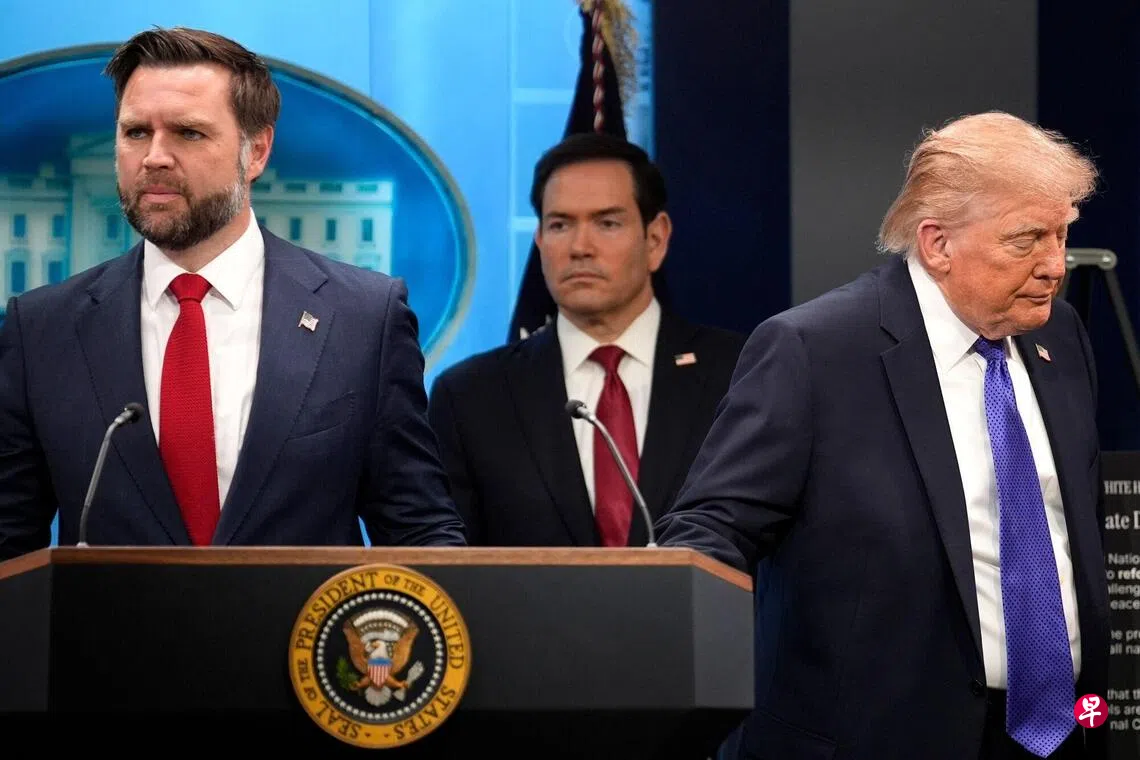
(Washington, compiled reports) The US Republican Party’s crushing defeat in the midterm elections has not only cost it control of both houses of Congress, but also upended the race for its 2028 presidential nomination, leaving Vice-President JD Vance, previously the frontrunner, facing a formidable challenge.
Vance has long been seen as a potential successor to President Donald J. Trump. Bloomberg noted that the midterms have put him on the defensive: he must remain loyal to Trump and the “Make America Great Again” (MAGA) base while also finding ways to distance himself from the president, whose approval ratings are low. So far, he has had little success.
Republican strategists now believe the field for the party’s 2028 presidential nomination could be far larger than anticipated early in the Trump administration. One strategist, Brian Darling, said: “JD Vance walked into the midterms as a clear frontrunner, but I believe the race to now be wide open.”
Vance previously blamed the Iran war for the Republican defeat, drawing Trump’s displeasure, but people familiar with the matter said their relationship remained solid.
With Vance weakened by the midterms and no guarantee that Trump will anoint him as his successor, attention has turned to his potential rivals, particularly Secretary of State Marco Rubio.
Rubio recently accompanied Trump on a visit to Asia and also responded on behalf of the administration to a series of recent technology service outages in the US.
Republican political strategist Mark Weaver said: “He has a remarkable resume and a compelling backstory as the son of Cuban immigrants, and he has been the absolute superstar of the Trump cabinet.”
Several Republican governors signal interest in presidential bid
Other Republicans are looking beyond the administration.
CNN reported that at least four current or former Republican governors have signalled an interest in running for the White House: Florida Governor Ron DeSantis, Georgia Governor Brian Kemp, Arkansas Governor Sarah Huckabee Sanders and former Virginia governor Glenn Youngkin.
Utah Governor Spencer Cox and Oklahoma Governor Kevin Stitt have also said they want a governor to be the Republican presidential nominee in 2028.
DeSantis and Sanders have both recently stressed that the Republican-led states they govern withstood the Democratic blue wave in the midterms.
During his nearly eight years as governor, DeSantis has implemented several policies aligned with MAGA principles, giving him a record to promote on the campaign trail.
Republican strategist Mike DuHaime said: “DeSantis is a candidate who can claim to be genuinely like Trump, but without Trump’s baggage.”
People familiar with the matter said DeSantis had yet to make a final decision on whether to run.
Sanders has not ruled out a presidential bid either. As White House press secretary during Trump’s first term, she earned the trust of both MAGA loyalists and the Republican establishment. She has further strengthened her standing within the party through measures including cuts to state income tax and tougher sentencing laws for violent offenders.
Former Wisconsin governor Scott Walker noted that widespread dissatisfaction with both parties in Washington gives governors who work far from the capital and have delivered tangible results a distinct advantage. However, governors cannot campaign solely on their state-level records; they must offer a governing agenda that convinces voters.
In a recent interview, Sanders also acknowledged that beating Vance would still be difficult, particularly if he retained Trump’s support.
Beyond the governors, Texas Senator Ted Cruz, who competed fiercely against Trump in the 2016 Republican primaries, has also openly acknowledged his desire to be president.
Other Republicans considered potential presidential candidates include Missouri Senator Josh Hawley, Arkansas Senator Tom Cotton and Pennsylvania Senator Dave McCormick, though their chances are generally seen as slim.
