

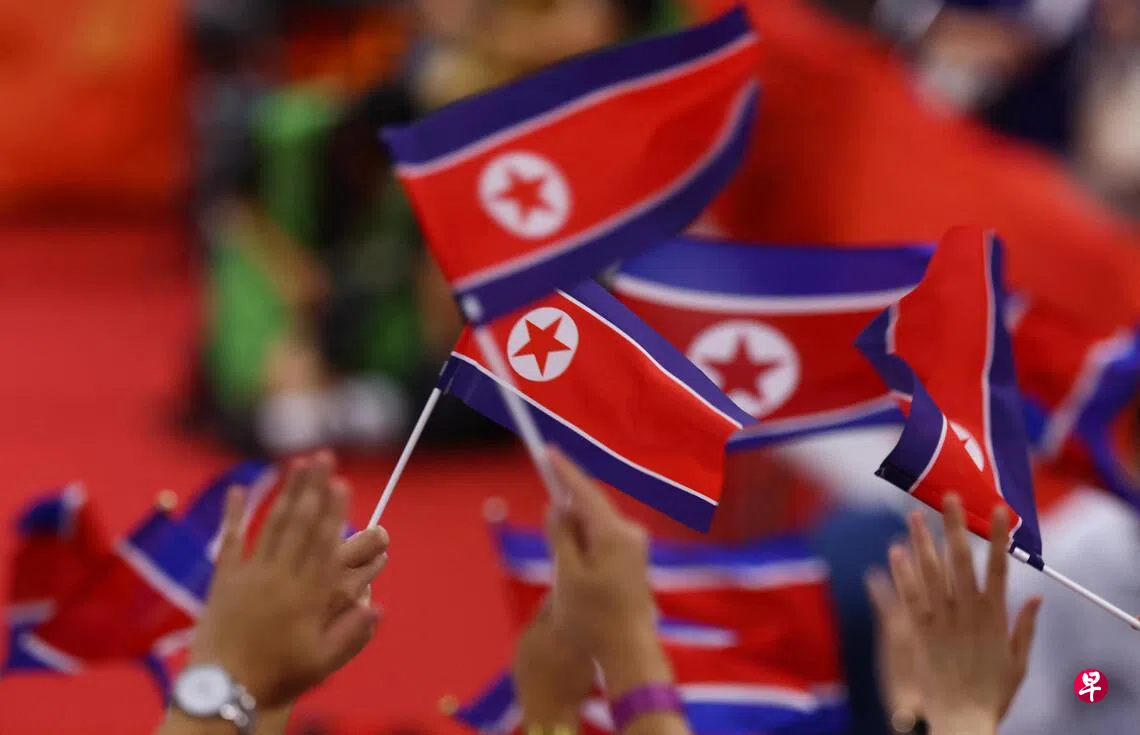
North Korea has reportedly amended its constitution to change the proportions of its national flag for the first time, breaking with a 78-year tradition dating back to its founding in 1948. Analysts say the move may be intended to weaken the flag’s symbolic association with Cold War-era socialist states. It also reflects leader Kim Jong Un’s attempt to move beyond his predecessors’ political legacy and forge a national identity distinct from the eras of Kim Il Sung and Kim Jong Il, while further entrenching his policy of treating North and South Korea as “two hostile states”.
North Korea’s external propaganda website Naenara recently updated its description of the national flag, changing its proportions from 1:2 to 1:1.65. The change is also reflected in the newly published revised constitution. The flag’s proportions were reportedly adjusted when North Korea amended its constitution in March this year, but the change only recently drew outside attention.
North Korea’s flag had retained its 1:2 proportions since its adoption in 1948. The break with a tradition spanning nearly 80 years has drawn attention to Kim Jong Un’s political intentions.
Some analysts suggest North Korea may be seeking to adopt flag proportions closer to those commonly used by modern sovereign states, replacing a design associated with the Soviet Union and Cold War-era socialist countries to project a more independent national image. Another interpretation is that, having consolidated his power, Kim Jong Un is gradually changing national symbols to reduce the political imprint of his grandfather Kim Il Sung and father Kim Jong Il, and emphasise the distinctiveness of the “Kim Jong Un era”.
The adjustment is also seen as a continuation of North Korea’s efforts to reshape its national symbols in recent years. In late 2023, Kim Jong Un formally introduced the concept of North and South Korea as “two hostile states”, redefining their relationship as one between mutually hostile countries rather than partners in reunification. In 2024, North Korea changed the lyrics of its national anthem, replacing “three thousand ri”, a reference to the entire Korean peninsula, with “this world”. This year’s constitutional amendments also removed clauses related to reunification, further enshrining the relationship between the two Koreas as “two hostile states”.
Lim Eul-chul, a professor at Kyungnam University’s Institute for Far Eastern Studies, said North Korea was trying to establish a national identity distinct from that of its previous leaders. In particular, it was emphasising that inter-Korean ties were relations between states, rather than a special relationship within a single nation.
Analysts say the adjustment to the flag’s proportions may appear merely cosmetic but could carry deeper political symbolism. From revising the national anthem and removing reunification clauses to altering the flag, Kim Jong Un is gradually reshaping North Korea’s national symbols and institutionalising the “two hostile states” policy.
As Pyongyang further reinforces a national identity that draws a clear distinction between North and South Korea, the South Korean government will face fresh challenges in adjusting its policy towards the North and redefining inter-Korean relations.
