

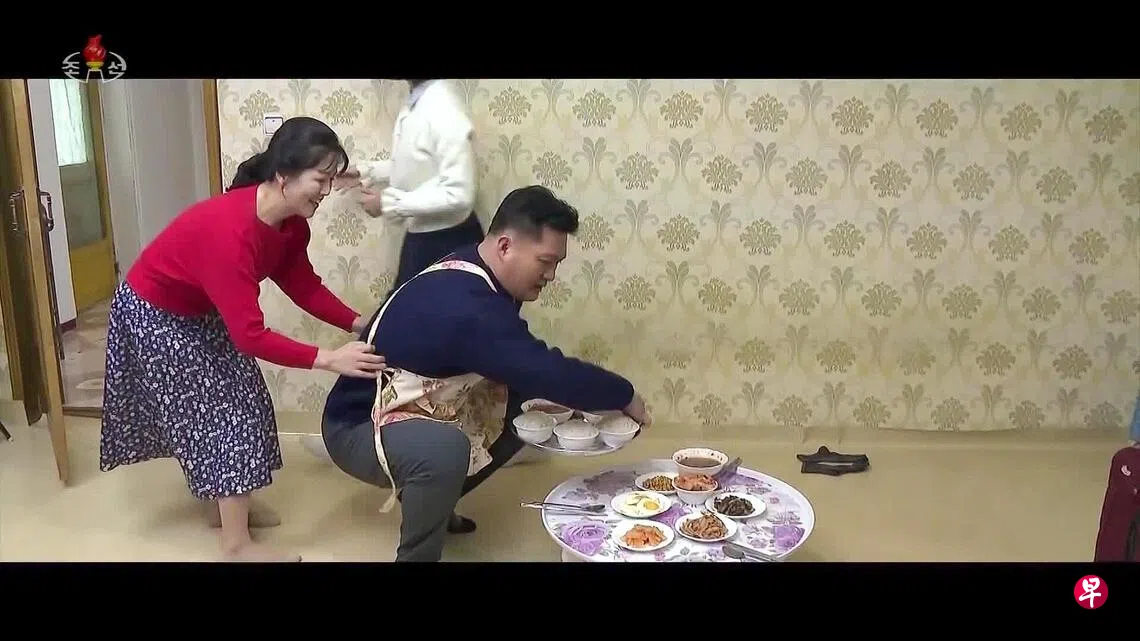
In North Korea, where patriarchal attitudes are deeply entrenched, a man putting on an apron to cook for his wife and daughter has become a refreshing sight in a television drama.
A New Spring in the Field of Manchurian Cranes, a 22-episode drama aired on Korean Central Television from April to June last year, features this scene: a middle-aged man wearing a patterned apron brings food to the table and calls his daughter to eat. His wife gives him a gentle pat and says: “Thank you for your hard work, darling.”
Weaving together youthful romance and family conflict, the drama departs from the traditional emphasis on political propaganda in North Korean film and television. It not only drew strong ratings but also made its male lead a favourite among young female viewers.
A man cooking may seem perfectly ordinary to the outside world, but in North Korean society, it is seen as a tentative sign that traditional gender roles are becoming less rigid. Several North Korean defectors, however, say there is a vast gulf between the screen and reality, and that deeply ingrained notions of male superiority will not change easily.
Intriguingly, the drama, which aired more than a year ago, is now being given a new political interpretation.
Radio Free Asia (RFA) recently published an article titled “Could ‘Apron Dad’ on North Korean TV pave the way for Kim Jong Un’s daughter to rule?”. It posed a bold question: could the changing family roles depicted in the drama be intended to subtly prepare the ground for the daughter of North Korean supreme leader Kim Jong Un to succeed him?
Yoshihiro Makino, a visiting professor at Hiroshima University in Japan, noted that North Korean television programmes serve not only as entertainment but also as political propaganda. He suggested that the drama’s departure from traditional gender roles within the family might be intended to foster a social climate receptive to a female successor.
This speculation coincides with South Korean intelligence’s latest assessment of Kim Ju Ae’s succession prospects.
In November 2022, Kim Ju Ae accompanied her father on her first public appearance at an intercontinental ballistic missile test launch. Since then, she has frequently attended military events, from missile inspections to tank training exercises, gradually coming to be seen by outside observers not simply as a much-loved daughter but as a potential successor.
South Korea’s National Intelligence Service recently assessed that Kim Ju Ae’s position as successor is steadily being consolidated, with around 60% of her public appearances closely tied to military matters. Some analysts believe Kim Jong Un is using her sustained public exposure to gradually acclimate the public to her presence at the centre of power.
Kim Jong Un knows well the importance of grooming a successor early. He had received only about three years of preparation before his father Kim Jong Il died, leaving him to assume power at short notice and then endure a difficult period of consolidating his authority. By paving the way for his daughter early, he may be seeking to avoid repeating history.
Yet whether a woman can inherit supreme power in highly militarised, male-dominated North Korea remains a major question.
Korea University professor Lim Jae-cheon believes Kim Jong Un may be deliberately arranging frequent public appearances for his daughter precisely because he recognises this obstacle, seeking to gradually overcome society’s resistance to a woman holding power.
The pace of succession planning also depends on Kim Jong Un’s health. Cheong Seong-chang, vice president of South Korea’s Sejong Institute, predicts that Kim Ju Ae, who is still a minor, may not formally take over until the mid-2030s.
Before then, she will gradually build political experience and networks by taking part in state events and interacting with party, government and military elites.
Of course, treating a television scene of a man cooking as direct propaganda for the succession may be reading too much into it. Nor do changing family roles on screen mean that women’s status in real life is improving in tandem.
But perhaps what gives greater pause is the course of Kim Ju Ae’s own upbringing.
A girl in her early teens ought to be at school, studying and playing with classmates, enjoying her youth. Kim Ju Ae’s formative years, however, are closely bound up with missile tests, tank training and military parades.
Before the cameras, she smiles and applauds as missiles roar into the sky. To outside observers, this is political training for a successor. For a young girl, it is a coming-of-age like no other.
From fathers wearing aprons on screen to a daughter flanked by nuclear missiles in real life, North Korea presents a subtle contrast: while ordinary women remain constrained by traditional patriarchal attitudes, yet a daughter of the Kim family may well break a pattern of male hereditary succession spanning three generations.
Only time will tell whether Kim Ju Ae becomes North Korea’s first female supreme leader. But beyond the question of whether she can wield supreme power lies a more thought-provoking one: when a girl’s upbringing is already so closely bound to her family’s political destiny, does she still have the freedom to choose her own life?
