

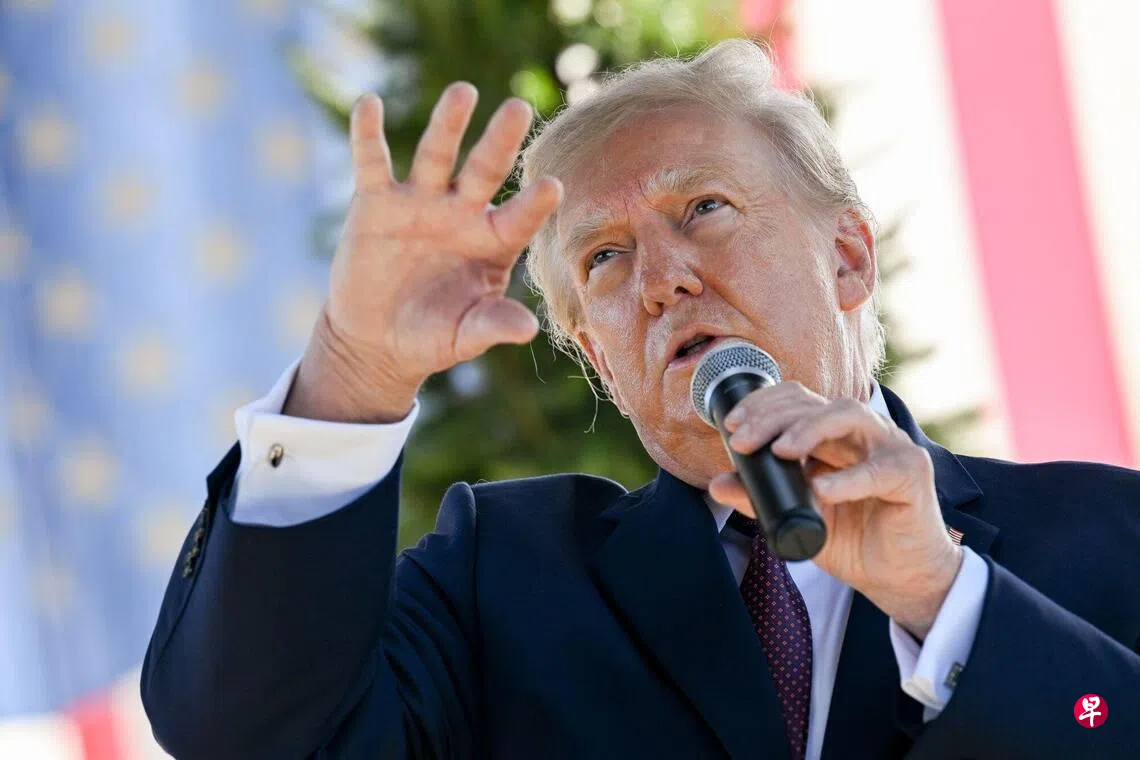
The US Republican Party has suffered a crushing defeat in the midterm elections amid voter discontent over the rising cost of living and other issues. Analysts say this could embolden countries to resist US President Donald Trump’s hardline trade policies.
The US Democratic Party won control of both the Senate and the House of Representatives on Tuesday (3 November). Political analysts and economists say this could give countries more reason to slow the fulfilment of investment pledges made to avert additional US tariffs. It could also put China in a stronger position in trade negotiations with the US.
The fragile trade truce between China and the US expires next January. Analysts say Beijing may seek to strengthen its negotiating leverage as Trump’s political standing weakens.
Saul Eslake, an economist at Australia’s Corinna Economic Advisory, said of Chinese President Xi Jinping: “Xi Jinping will recognise that Trump’s authority has been greatly weakened by these results, and will no doubt be thinking about ways of exploiting that.”
However, Trump’s domestic political difficulties may not be entirely good news for Beijing.
Alicia Garcia-Herrero, chief economist for Asia-Pacific at Natixis, said the Democrats were unlikely to leave Trump to decide for himself what deal to strike with Beijing. She believes a Democratic-controlled Congress would be more likely to support tighter technology export controls and greater scrutiny of supply chains in artificial intelligence and semiconductors, limiting Trump’s room to make concessions to China in these high-growth sectors.
Japan and South Korea, two key US allies in Asia, reached agreements with the Trump administration last year, pledging to invest US$550 billion (S$701.8 billion) and US$350 billion respectively in the US.
Heo Yoon, an economics professor at South Korea’s Sogang University, noted that the Democrats appear to view these investment pledges as having been imposed on allies by the US. Following the Republicans’ midterm defeat, the countries concerned may feel less pressure to fulfil their commitments.
However, some academics warn that criticism at home could instead prompt Trump to put more pressure on allies abroad to fulfil their investment pledges, to prove that his trade policies are working.
Kazuhiro Maeshima, a professor specialising in US politics at Japan’s Sophia University, said: “The tariff issue is not over. If Japan’s response is slow, calls for additional tariffs could resurface.”
For India, which is still negotiating a trade agreement with the US, the midterm results could also encourage New Delhi to adopt a wait-and-see approach as it seeks more favourable negotiating terms.
India and the US reached a framework agreement in February this year to lower punitive US tariffs on most Indian goods from 50% to 18%.
India’s trade minister said early this month that drafting of the text for the first phase of the India-US trade agreement was in its final stages. However, he reiterated that India would proceed only if it could secure an advantage over competing exporters.
