

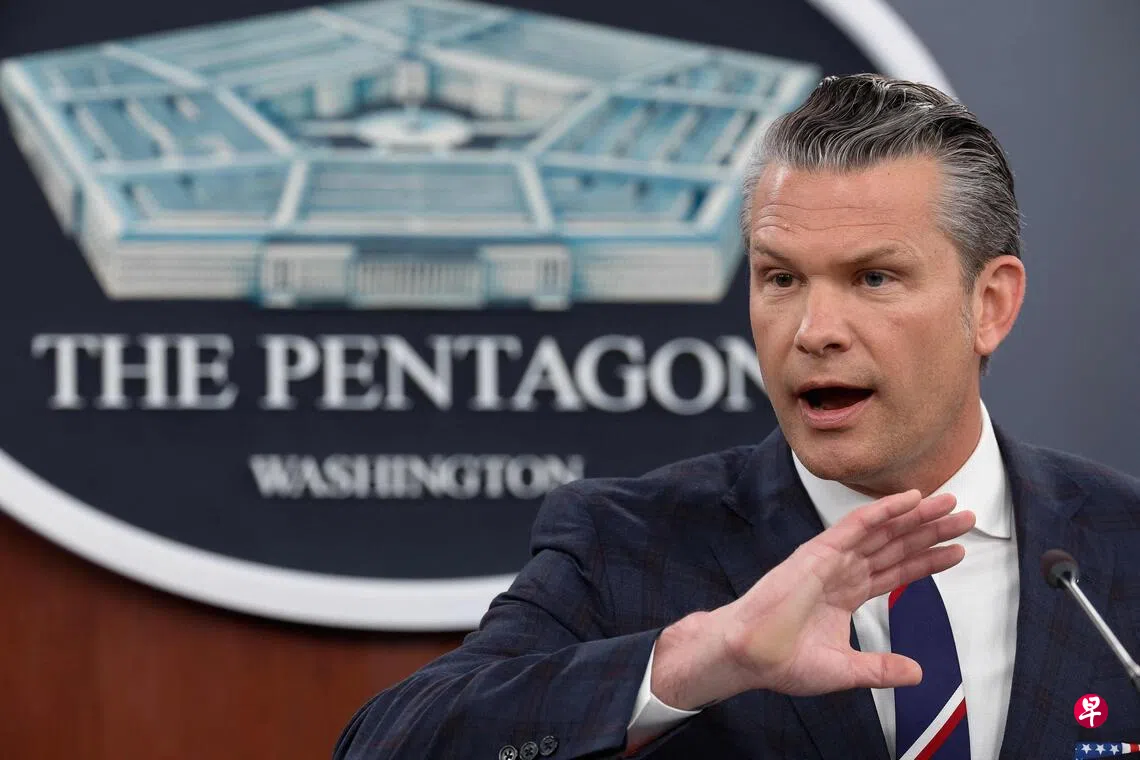
US Republicans used their narrow majority in the House of Representatives to block a motion to impeach secretary of war Pete Hegseth, securing a congressional victory for President Donald Trump after their crushing defeat in the midterm elections.
Analysts, however, believe that once the new Congress convenes early next year and the Democrats regain control, they are certain to revive impeachment proceedings and subject Hegseth to more aggressive scrutiny.
In a procedural vote on Tuesday (10 November), the US House of Representatives voted narrowly, by 211 to 204, to refer eight articles of impeachment against Hegseth to the Republican-controlled Judiciary Committee.
This prevented a formal House vote on Wednesday (11 November), effectively shelving the impeachment effort for the remainder of the current Congress.
Republican representative Thomas Massie, who introduced the impeachment motion, expressed disappointment at the outcome. Regarding his Republican colleagues, he said, “They know it's a sinking ship but committed to stay on board”.
Massie’s eight articles of impeachment included allegations that Hegseth had violated the War Powers Resolution by launching military action against Iran without congressional authorisation, carried out “extrajudicial executions” against suspected drug-trafficking boats in the Caribbean and eastern Pacific, and engaged in misconduct relating to the 2025 conflict involving Yemen’s Houthis.
Massie had hoped to draw on discontent within his party over Hegseth and the US-Iran war to secure enough support, but ultimately no Republicans backed him.
Although the Democrats expressed strong support for impeachment, 11 of them, including former House Speaker Nancy Pelosi, did not vote in the procedural ballot. Had just eight of those 11 voted against the referral, they could have prevented the articles from being sent to the Judiciary Committee, allowing a formal vote to proceed on Wednesday as scheduled.
Trump hails exoneration of Hegseth as a “great American patriot”
Trump swiftly celebrated afterwards in a post on his own social media platform, declaring, “The Democrats’ attempt to impeach secretary of war Pete Hegseth has miserably FAILED!” He also championed Hegseth’s “Victories in Venezuela and Iran”, saying they had led to the “EXONERATION of a Great American Patriot”.
Hegseth held his first press conference in six months that morning, before the House vote. He called the impeachment effort a “farce” and defended his military operations in Iran and elsewhere.
“History will judge the Iran war quite differently than the conventional wisdom right now,” said Hegseth.
Democrats may pursue more aggressive impeachment effort after taking control of Congress early next year
After the impeachment effort was effectively shelved on Tuesday, House Democratic leader Hakeem Jeffries, who will take over as Speaker in early January next year, stressed that he would discuss with colleagues at the appropriate time whether to launch a fresh impeachment effort in the new Congress.
Reuters noted that a Democratic-led impeachment effort would likely be far more aggressive. Lawmakers could summon senior US military officers to testify before Congress, including former officers dismissed by Hegseth who have so far remained silent.
Hegseth has fiercely criticised the Pentagon’s diversity initiatives. After taking office early last year, he dismissed several senior officers, including General Charles Quinton Brown Jr., the African American chairman of the Joint Chiefs of Staff, and Lisa Marie Franchetti, the first woman to serve as chief of naval operations.
In the process, Democrats may also raise other issues of concern to voters, including the Pentagon’s Ukraine policy.
Some Republicans have noted that Hegseth’s strained relations with Congress are becoming an increasing political liability as the Trump administration seeks to raise the military budget sharply, from US$950 billion (about S$1.22 trillion) to US$1.5 trillion.
