

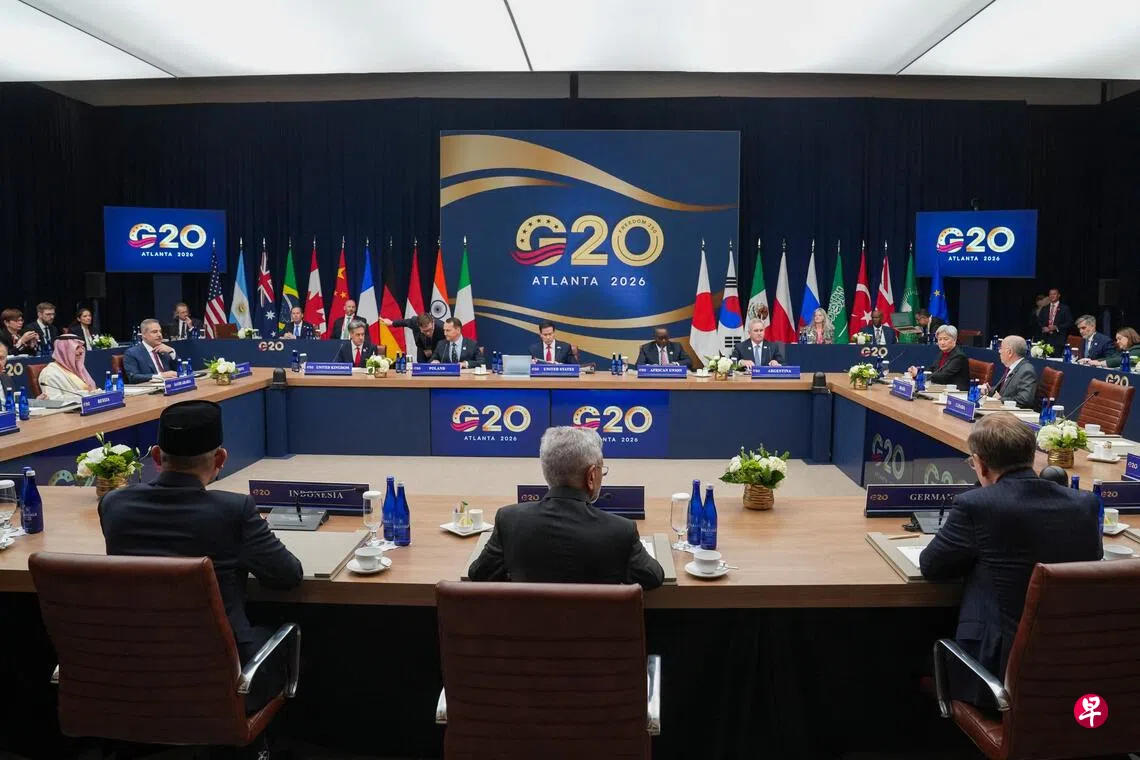
US Secretary of State Marco Rubio called on countries to work together to address geopolitical and economic crises as G20 foreign ministers met in Atlanta on Friday (30 October). He warned that disruptions to global energy and food supplies, trade and freedom of navigation, along with a series of crises, were seriously threatening the global economic order.
Rubio told the meeting, “We are in a critical moment. We are facing a series of interconnected economic and geopolitical crises.” He urged countries to coordinate their responses to emerging crises, safeguard shared interests and create favourable conditions for greater geopolitical stability and leaders’ discussions on a broader agenda for economic prosperity.
Rubio said he hoped countries could reach a consensus at the ministerial meeting on how to address these crises. The G20 summit is scheduled for 14 to 16 December in Miami, Florida.
Two Western officials said G20 members broadly agreed that the war in the Middle East posed extremely serious economic challenges for almost every country. Many officials attending the meeting were concerned that another US attack on Iran could send oil prices soaring, worsening countries’ economic difficulties.
The two-day G20 foreign ministers’ meeting in Atlanta, the capital of Georgia, is expected to discuss a range of pressing issues affecting countries worldwide, including supply chains, critical minerals, regional conflicts and wars, and navigation through the Strait of Hormuz.
G20 group photo cancelled after protests over presence of Russian minister
But it was Rubio’s invitation to Russian Foreign Minister Sergei Lavrov that drew attention at the meeting, provoking strong displeasure among several foreign ministers.
UK Foreign Secretary Ed Miliband criticised Lavrov at the meeting, accusing Russia of killing innocent civilians in the war with Ukraine. EU foreign policy chief Kaja Kallas accused Lavrov of presenting false narratives at the meeting.
Lavrov said Russia’s position on Ukraine remained unchanged and that it would not tolerate military threats from Ukraine. He criticised Ukraine’s pursuit of more long-range weapons, saying it was not conducive to preparations for negotiations.
The US cancelled the traditional group photo after European officials refused to pose with Lavrov. German Foreign Minister Johann Wadephul told reporters that, with relations with Russia no longer normal, such a photo would be inappropriate.
A Western diplomat said a third of members, including Australia and Canada, refused to pose with Lavrov. One participant said even Lavrov himself acknowledged that a group photo would cause difficulties.
Deep divisions stem consensus; only chair’s statement expected
Ukraine, which had previously been invited to G20 meetings, was not invited this time. US officials said only G20 member countries had been invited.
However, South Africa, a full G20 member, was not invited either. South Africa has had numerous disputes with the Trump administration. When South Africa held the rotating G20 presidency last year, US President Donald Trump, Rubio and other leaders did not attend the meetings.
Diplomatic sources said countries remained deeply divided over issues including the wars in Ukraine and the Middle East, as well as US tariffs. The foreign ministers’ meeting is therefore expected to issue a chair’s statement rather than a joint communique. The participants will have to finalise a joint declaration at the December summit for G20 leaders to sign.
