

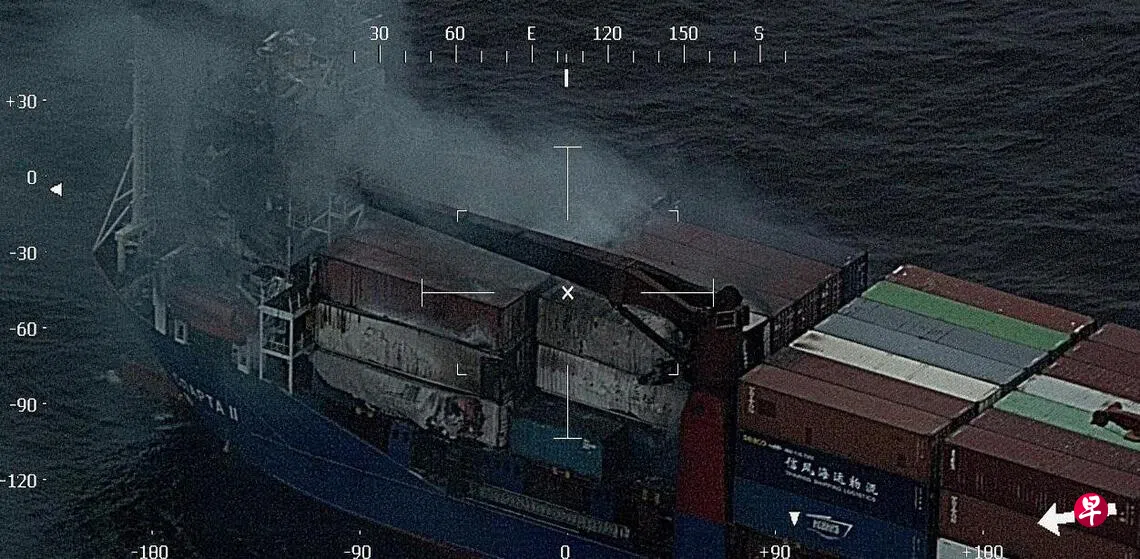
(Helsinki/Warsaw, agencies) A series of security alerts has been reported around the Baltic Sea. A cargo ship linked to the Russian military caught fire after a drone attack in the Gulf of Finland, then drifted into the territorial waters of NATO member Finland. The blaze had yet to be extinguished on Sunday.
The Finnish military’s preliminary assessment was that Ukraine was highly likely to have carried out the attack. Hours after the incident, a Russian helicopter was also alleged to have violated Finnish airspace. Just a day earlier, Poland had raised an airspace alert, alleging that three Russian aerial objects had crossed its border.
The stricken vessel, the Russian-flagged Sparta II, left St. Petersburg on Friday (20 November), bound for Russia’s Kaliningrad exclave. It came under attack in international waters in the eastern Gulf of Finland on Saturday (21 November) morning.
Authorities in Russia’s Leningrad Region said two drones had attacked the cargo ship, while local air defence systems shot down a further 80 drones that night. Ukrainian officials have yet to comment on the attack.
The Sparta II belongs to Oboronlogistika, a shipping company that provides logistics services to Russia’s Ministry of Defence, and is on the US Treasury Department’s sanctions list. The Finnish Border Guard said it could not yet confirm what cargo was aboard, but the military was not ruling out the possibility that the ship was carrying military supplies.
The damaged cargo ship drifted off Loviisa, Finland, and anchored in Finnish territorial waters. All 16 crew members evacuated in lifeboats and transferred to another Russian vessel nearby. The Finnish Border Guard is leading the rescue operation, with Estonian and Russian vessels also helping to fight the fire and cool containers on deck.
With the blaze still burning on Sunday (22 November) morning, rescuers had to avoid pumping in so much seawater that the ship could become unstable and sink. Finnish authorities have established a restricted zone around the vessel and are working to prevent possible marine pollution.
Swedish jets help defend airspace after suspected Russian helicopter incursion
The incident also triggered an airspace security alert. Finland temporarily restricted air and maritime traffic in the eastern Gulf of Finland and notified NATO. Finland’s Ministry of Defence confirmed that a Russian helicopter was suspected of entering Finnish airspace near Loviisa, penetrating 4.1 kilometres beyond the border.
Finnish Defence Minister Antti Häkkänen said the helicopter might have been involved in rescue operations for the damaged cargo ship or carrying out surveillance. Swedish Defence Minister Pål Jonson also confirmed that Swedish fighter jets had taken to the air under Finnish command to help safeguard the territorial integrity of Finland and NATO.
As the fighting edged closer to the border, Finnish Prime Minister Petteri Orpo issued a stark warning: “The war is spilling over into our neighbouring areas.” He stressed, however, that Ukraine had the right to strike back at its aggressor.
NATO to discuss response after Polish airspace alert
A day before the attack on the Russian cargo ship, fellow NATO member Poland also raised an airspace alert.
Poland reported on Friday that three aerial objects from Russia had entered its airspace. The military’s preliminary assessment was that the fallen objects were two missiles and a drone, though the precise details remained under investigation. The Polish government strongly accused Russia of deliberate provocation and urged NATO to strengthen its detection and surveillance network along its eastern border.
NATO Secretary-General Mark Rutte delivered a firm message in Warsaw on Saturday: “I can guarantee that NATO will defend every inch of Polish territory.” He reiterated that NATO would thoroughly investigate the incident and assess whether its current defensive deployments needed to be adjusted.
NATO’s highest decision-making body, the North Atlantic Council, is scheduled to meet on Monday (23 November) specifically to discuss the violation of Polish airspace.
