

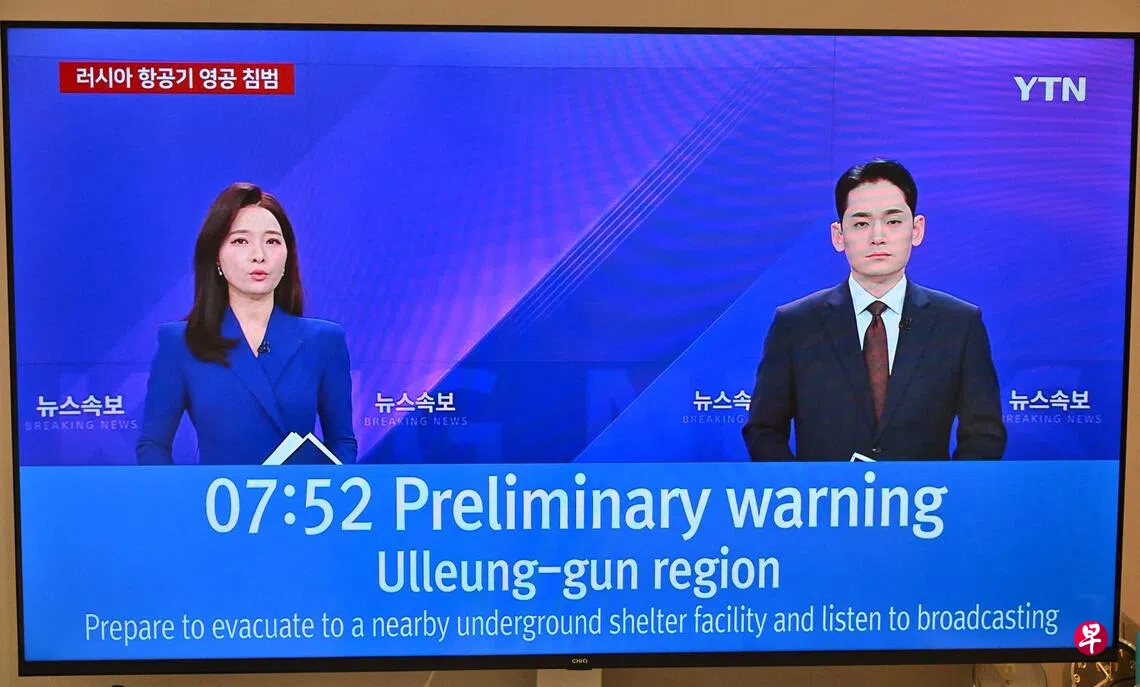
Several Russian military aircraft entered South Korea's air defence identification zone (KADIZ) over the East Sea without authorisation on Tuesday (24 November), approaching the airspace over Ulleung island. They were understood to have come within seconds of violating South Korean airspace. The South Korean military scrambled fighter jets, including F-15Ks, and ordered a precautionary alert for the island's residents.
This was the first time South Korea had issued a precautionary alert over a possible airspace violation by Russian military aircraft. Analysts believe the recent frequent entries by Russian military aircraft into South Korea's air defence identification zone may be linked to deepening military cooperation between North Korea and Russia.
South Korea's Joint Chiefs of Staff told a press conference on 24 November that, after entering the country's air defence identification zone over the East Sea that morning, the Russian military aircraft flew south towards Ulleung island from the north, approaching the northern boundary of its airspace. Given the possibility of a violation of South Korean airspace, the military issued a precautionary alert to ensure residents' safety.
Russian military aircraft had flown within about 20km of the northern boundary of Ulleung island's airspace in March last year, but came even closer this time.
The South Korean military assessed that the Russian aircraft might have entered South Korean airspace along their planned flight path had it not scrambled fighter jets in time.
A military source said the Russian aircraft were flying at about 600 to 700kmh, equivalent to roughly 200 metres per second. “That shows just how urgent the situation was.”
After South Korea scrambled fighter jets, including F-15Ks, the Russian aircraft turned towards Japan. They subsequently left South Korea's air defence identification zone and headed north again without violating South Korean airspace.
Fewer than five Russian military aircraft entered South Korea's air defence identification zone that day. Their types have not been disclosed. The aircraft are understood to have left at about 8am after spending more than 20 minutes in the zone.
This was the third unauthorised entry by Russian military aircraft into South Korea's air defence identification zone in just a week, following incidents on 17 and 19 November.
Russia has long maintained that South Korea's air defence identification zone has no basis in international law and does not recognise Seoul's authority to control the area. According to data submitted to the National Assembly by South Korea's Joint Chiefs of Staff in 2023, Russian military aircraft entered the zone without authorisation about 65 times between 2020 and June 2023.
An air defence identification zone is an area designated by a country for the early identification and monitoring of aircraft for air defence purposes. It is not equivalent to territorial airspace under international law.
In July 2019, a Russian A-50 early-warning aircraft twice entered airspace under South Korea's effective control near Dokdo, known as Takeshima in Japan, prompting South Korean fighter jets to fire warning shots. However, incidents such as this latest approach to Ulleung island's airspace, which even prompted the South Korean military to issue a precautionary alert to protect residents, are rare.
South Korea's Ministry of Defence summoned Russia's defence attaché in Seoul on the afternoon of 24 November to lodge a strong protest over the incident.
Analysts believe the recent frequent entries by Russian military aircraft into South Korea's air defence identification zone may be linked to deepening military cooperation between North Korea and Russia.
Doo Jin-ho, a distinguished research fellow at Kyungnam University's Institute for Far Eastern Studies, said the Russian military aircraft's manoeuvres could have been a show of force to demonstrate Moscow's commitment to defending North Korea under the Treaty on Comprehensive Strategic Partnership between North Korea and Russia. They could also have been intended to test South Korea's willingness to improve relations with Russia and put pressure on Seoul.
