

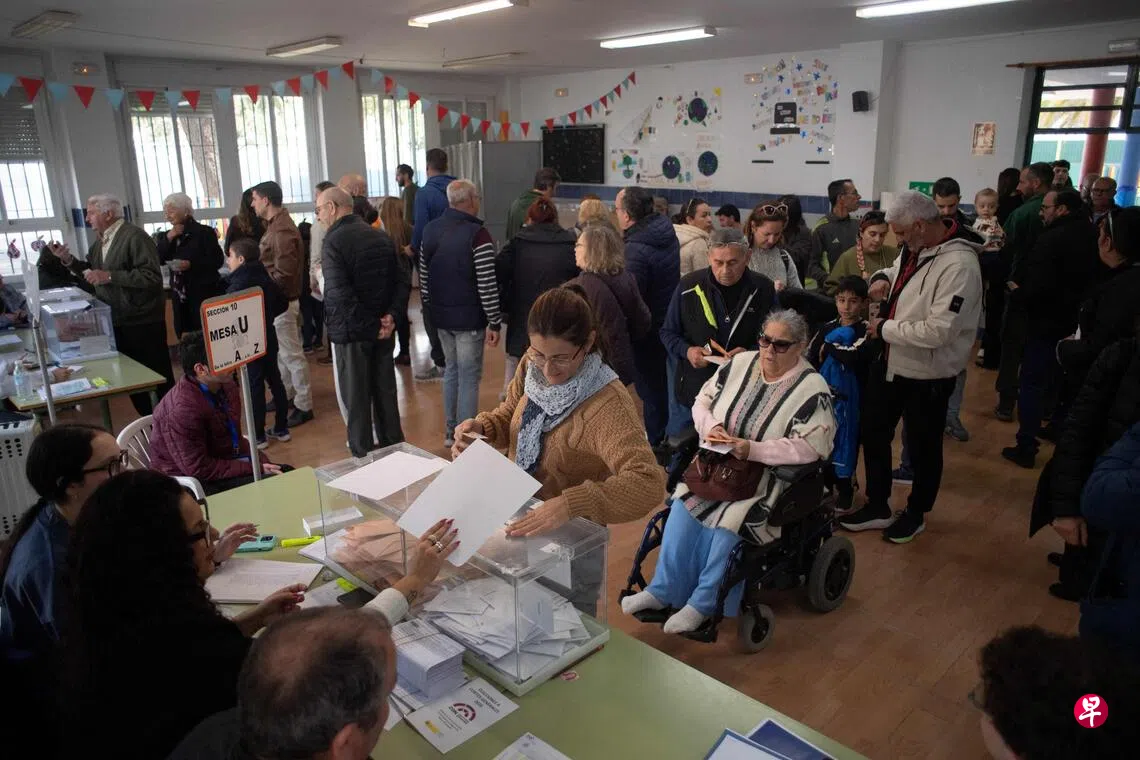
Voters flocked to polling stations in Spain’s election on Sunday (29 November), pushing turnout to a record high. Polls suggest the far right could enter government alongside conservatives for the first time, but Prime Minister Pedro Sanchez, who leads the Socialist Party, is still fighting to defy the predictions and retain power.
AFP, citing official figures, reported that turnout had reached 45.7% as of 2pm local time (9pm Singapore time), five percentage points higher than at the same stage of the last general election in 2023. Spanish media reported that this was the highest turnout recorded at that time of day.
Polls suggest the election could again produce a hung parliament, with support for the Socialists trailing that for the main conservative People's Party (PP). This could make the anti-immigration, far-right Vox party the “kingmaker” in forming the next government.
Sanchez must mobilise progressives and swing voters among the 38.6 million eligible voters to turn out if left-wing parties are to secure the minimum 176 seats needed to govern in the 350-seat parliament.
After voting in Madrid that day, Sanchez said: “The larger that mobilisation and that turnout... the stronger the government will be to continue implementing its policies for the next four years.”
Sanchez also stressed that the election “is very important not only for Spain, but also for Europe”.
Europe is entering an election cycle over the coming year, with France holding a presidential election and Poland and Italy holding parliamentary elections. These contests could reshape the continent’s political landscape, making the outcome in Spain closely watched.
Sanchez is one of Europe’s few remaining left-wing leaders and a darling of international progressives. But his polarising political image, coupled with public anger over the rising cost of living, has left his eight-year hold on power hanging in the balance.
The report noted, however, that it remained unclear whether high turnout would benefit the left-wing bloc, as several voters told AFP they believed Spain needed to change direction.
Andres Zambrano, a 30-year-old civil servant in Madrid, said in an interview: “The current situation in the country is worrying, so clearly a change is needed.”
Meanwhile, Spain, which began its transition to democracy after the end of Franco’s fascist dictatorship in 1975, has never had a far-right party in its central government. That prospect is now frightening some voters.
In Barcelona, teacher Itziar Lopez said she hoped to see “a change that helps us workers be better off, instead of things getting worse or going towards even more extreme situations”.
