

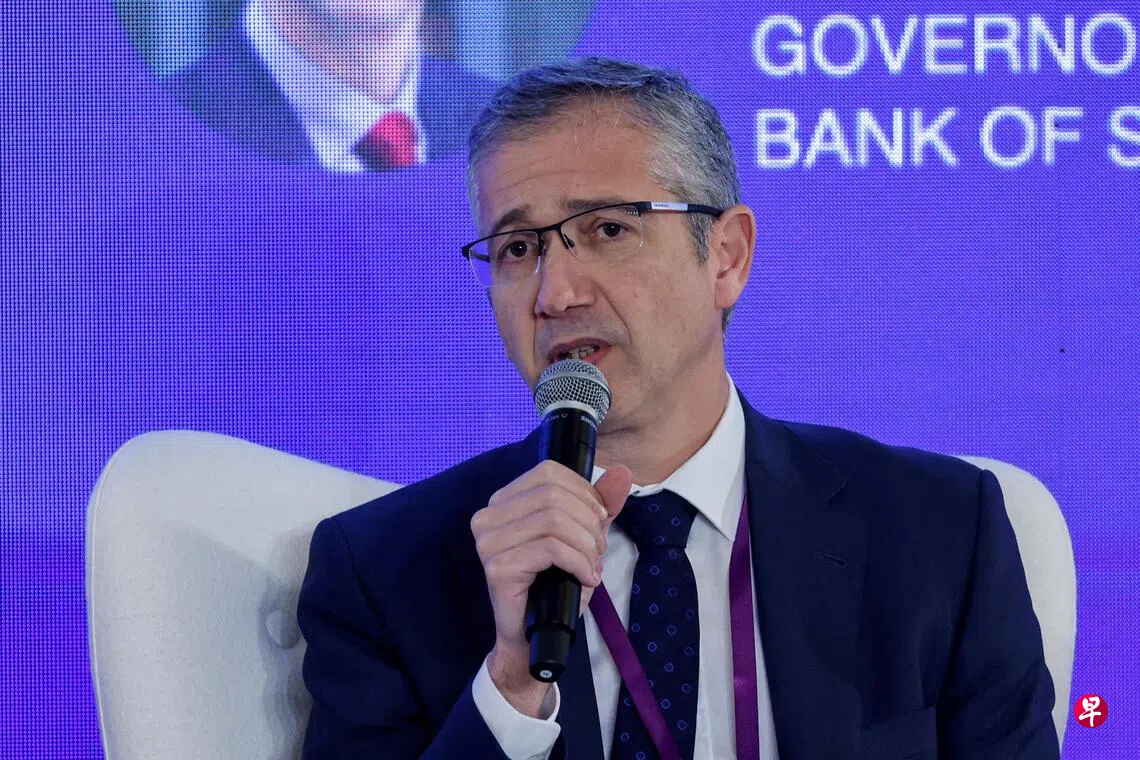
Eurozone countries have formally chosen veteran Spanish central banker Pablo Hernández de Cos as the next president of the European Central Bank (ECB). Incumbent Christine Lagarde will step down early on 7 February next year, when de Cos will take over. He will chair his first monetary policy meeting on 18 March.
Reuters reported that the appointment ends months of closed-door wrangling among the EU’s major powers over the ECB’s six-member Executive Board. The Netherlands removed the final obstacle on Thursday (26 November) by withdrawing its candidate, Klaas Knot, and backing de Cos.
Under a deal on posts reached at the same time, German economist Markus Brunnermeier will take over as chief economist on 31 May next year. France’s Laurence Boone is expected to succeed Isabel Schnabel, taking responsibility for market operations and becoming the only woman on the ECB’s Executive Board after Lagarde’s departure. The appointments are expected to receive final approval at the EU summit in December.
De Cos, 55, is a trained monetary economist who previously served as governor of the Bank of Spain and is now general manager of the Bank for International Settlements. He has navigated a series of crises, including Spain’s banking bailout, COVID-19 and the historic cycle of interest rate rises that followed, combining a strong theoretical grounding with a pragmatic approach.
Although southern European officials are often labelled “doves” who favour looser monetary policy, de Cos is widely regarded in financial circles as moderate and pragmatic, defying easy categorisation. An ally of former ECB president Mario Draghi, his appointment has also reinforced market expectations that the central bank will act decisively to stabilise markets in a sovereign debt crisis.
The ECB now faces the twin challenges of inflation and political risk. The war in Iran has pushed eurozone inflation to 4%, twice the central bank’s 2% target. Meanwhile, continuing political turmoil in France has fuelled market concerns that financial stress could spread to other member states.
Analysts say the surge in price pressures leaves the ECB with little choice but to tighten monetary policy, making an interest rate rise this December all but certain. However, with international oil prices falling recently and high base effects expected to emerge gradually next spring, markets generally expect room for only one further increase after December in the current rate-hiking cycle.
