

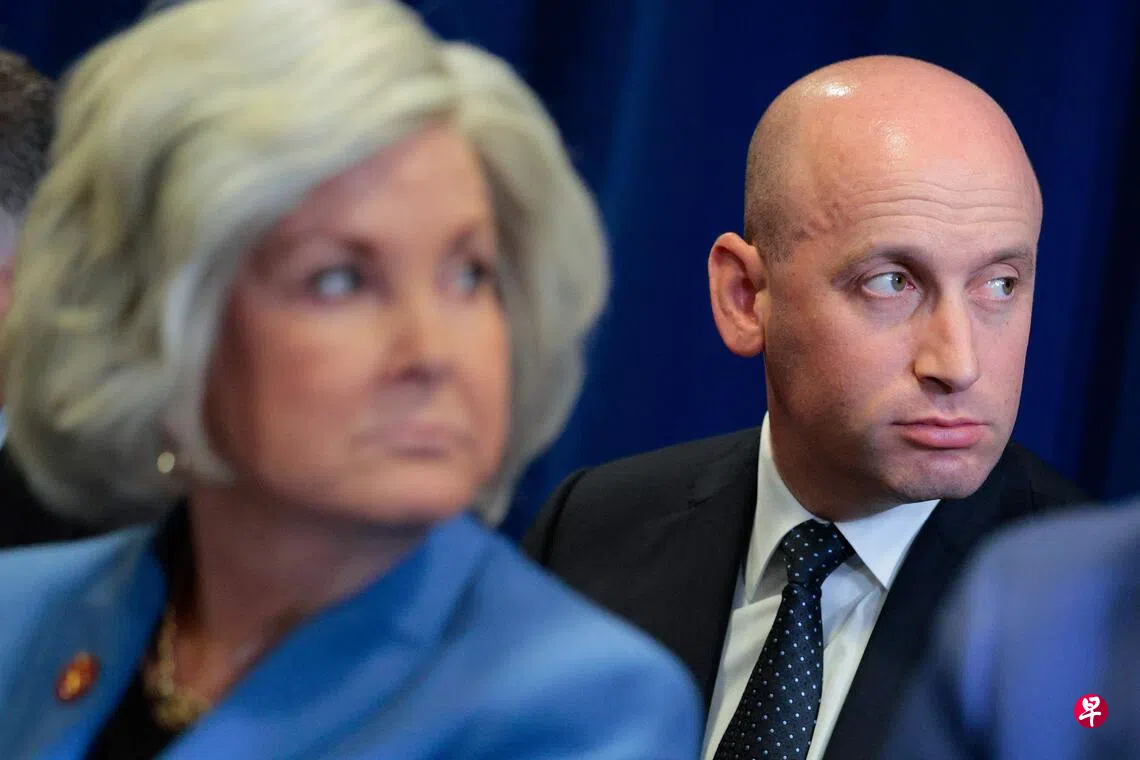
With the US midterm elections just over, President Donald J. Trump has made a major change to his inner circle, appointing close aide Stephen Miller to replace Susie Wiles as White House chief of staff.
In a social media post on Friday (6 November), Trump described Miller as “one of my most trusted advisors”, while praising Wiles for doing an outstanding job. Trump said the change would take effect next Monday (9 November).
Miller, 41, is a key architect of the Trump administration’s hardline immigration policies and has long advocated expanding presidential powers. Several White House officials said the promotion of Miller, known for his sharp rhetoric and uncompromising stance, could signal a more confrontational approach by the administration after losing control of Congress, with a stronger push to advance the president’s immigration and other policies.
As the midterm elections approached, Trump’s approval rating fell to the lowest level of his presidency and close to the lowest recorded for any US president, leaving him dissatisfied with his political and communications teams. A person familiar with the matter said Trump had declared that the White House must adopt a more aggressive stance as the Democrats regain control of Congress.
After his appointment, Miller wrote on social media that his mission was clearer than ever and that he and his team would do everything they could to support the president.
Miller faces fierce criticism after immigration officers fatally shoot protesters
As deputy chief of staff for policy and homeland security advisor, Miller was the architect of the mass deportation programme. In January this year, immigration enforcement officers fatally shot two protesters in Minneapolis, triggering mass demonstrations and fierce criticism of Miller from various quarters.
Democratic lawmaker Hakeem Jeffries, who is set to become the next Speaker of the House of Representatives, described Miller in a social media post on Friday as a “reckless extremist” and a dangerous xenophobe.
Miller is one of Trump’s longest-serving aides and among the few to have served in both his presidential terms. He became deputy chief of staff after Trump returned to the White House in 2025, wielding considerable influence over the president’s domestic agenda.
White House officials said Wiles, 69, submitted her resignation on Thursday (5 November) evening and would move to a role on Trump’s political team.
Wiles was the first woman to serve as White House chief of staff. She wrote on social media that while her responsibilities might change, her commitment to the president would not.
Wiles rarely challenged Trump’s policies. She is widely credited with running a more disciplined White House than some of Trump’s previous senior aides.
Justice Department departures include assistant attorney general who failed to obtain voter rolls
Separately, a wave of senior officials left the Justice Department on Thursday and Friday. Harmeet Dhillon, assistant attorney general for civil rights; John Eisenberg, assistant attorney general for national security; and Jason Reding Quiñones, US attorney for the Southern District of Florida, resigned in succession.
Before the midterm elections, Dhillon had unsuccessfully sought voter registration rolls from about 30 states. US media reported that Dhillon said in her resignation letter that she had submitted her resignation in October and agreed to stay on until after the midterm elections.
Quinones had been overseeing an investigation into several former intelligence officials whom Trump had accused of trying to oust him.
Since Trump took office, the Justice Department has launched investigations into several people he regards as enemies. Some prosecutors have left because they were unwilling or unable to bring charges.
