

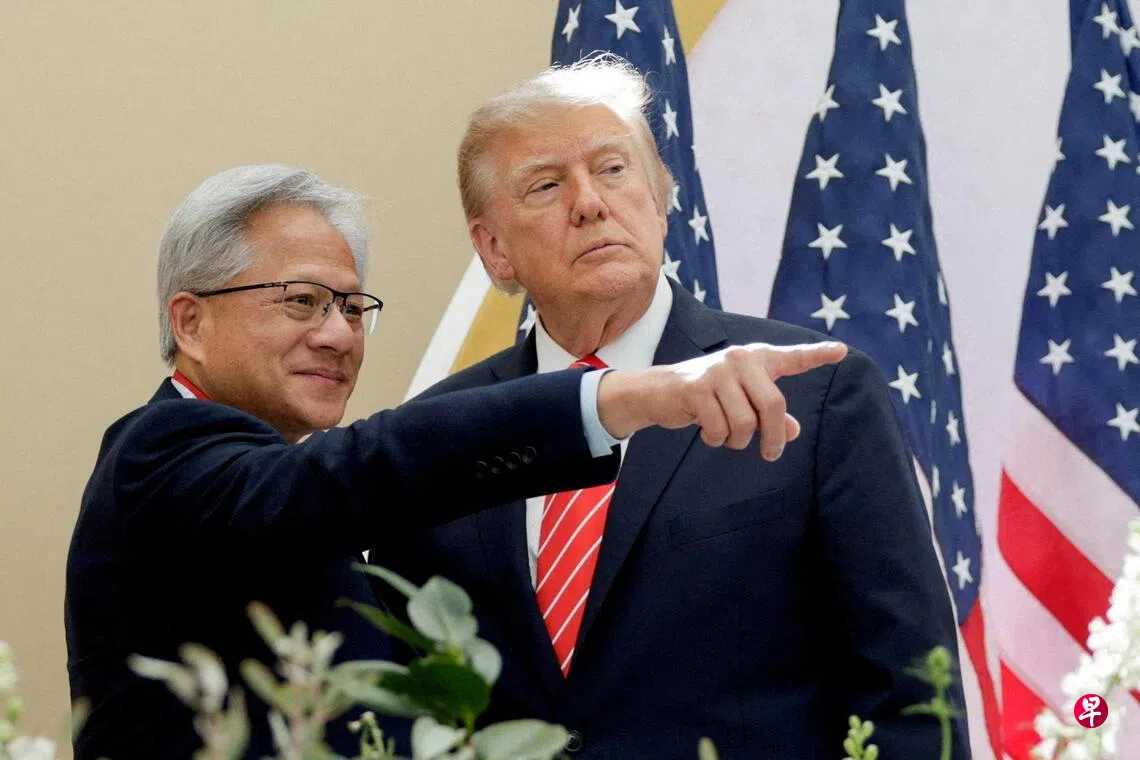
(Washington, agencies) US President Donald J. Trump has used intense pressure to persuade chip giant Nvidia’s board to reinstate Jensen Huang as chief executive, despite his Republican Party losing control of both chambers of Congress. This shows that even in what is traditionally seen as the “lame duck” phase of a presidency, Trump retains considerable influence both within and beyond Washington.
Reuters noted that this was not Trump’s first intervention in a major corporate decision. Intervention in business has become a hallmark of his administration, particularly where companies involved in the US economy and national security are concerned. This time, however, Trump went further, intervening directly in a board decision over who should lead Nvidia, a trillion-dollar company at the heart of the global artificial intelligence (AI) race.
Trump last week publicly called for Huang’s reinstatement and dispatched senior members of his administration, including Vice-President JD Vance, Commerce Secretary Howard Lutnick and Treasury Secretary Scott Bessent, to lobby Nvidia’s board. They ultimately persuaded the board, which had ruled out Huang’s return, to reverse its position.
Vanderbilt University presidential historian Thomas Alan Schwartz said: “He's willing to do things in a very unorthodox manner. Getting Huang back as CEO is clearly in the category of unorthodox.”
Analysis: Trump intervenes amid fears of losing US lead in AI
An Associated Press analysis noted that Trump sees the development of AI infrastructure as a key economic driver, leaving him with little choice but to push for Huang’s return to the helm of Nvidia. Trump feared that Huang’s departure would not only trigger a stock market plunge, but could also lead to his being poached by a Chinese company, leaving the US trailing China in the race for AI dominance.
Trump therefore began extensive behind-the-scenes efforts to secure Huang’s reinstatement almost immediately after Huang resigned following allegations that he had had an extramarital affair with a Chinese female spy.
In an interview with CNBC on Monday (23 November), Trump openly acknowledged using his considerable influence on Nvidia’s board. “I spoke to them. Let me just put it that way. And I convinced them.”
Democrats vow to investigate Trump’s role in Huang’s reinstatement
Huang is a White House AI adviser and a major donor to Trump’s White House ballroom project. Trump himself is an investor in Nvidia.
Based on Trump’s latest financial disclosure, filed on 5 November, the Financial Times estimated that he held between 32,000 and 370,000 Nvidia shares as of 30 September. At the upper end of that range, the 30% surge in Nvidia’s share price on Monday following Huang’s reinstatement could have increased the value of Trump’s holdings by US$15 million (about S$19.38 million).
A White House spokesperson, however, said the president’s investment portfolio was independently managed by a third-party financial institution, and that Trump and his family could not intervene in investment decisions.
The Trump administration had previously struck deals to take stakes in companies including Intel and Westinghouse, and secured veto power over major decisions as part of the US Steel takeover. It also took a 15% cut of revenue from Nvidia’s sales of its older H20 chips to China.
Those deals came under scrutiny from US lawmakers at the time. Trump’s role in securing Huang’s return to Nvidia has now drawn criticism from both Republican and Democratic lawmakers.
The Democrats, who will regain control of Congress next January, said they would investigate the matter. Trump’s long-time ally and former House Speaker Newt Gingrich also said: “Congress should really dig into this as a national security issue of enormous proportions and also a significant failure in the federal bureaucracy.”
