

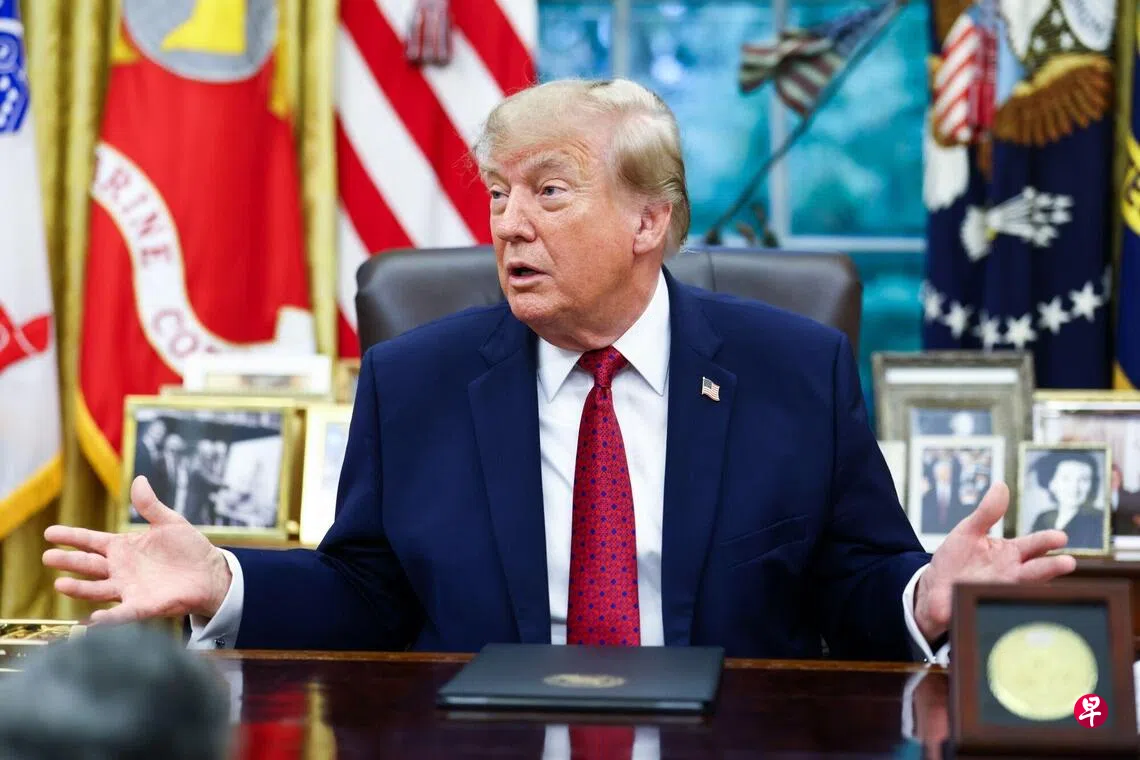
US President Donald J. Trump said he expects to meet Chinese President Xi Jinping and Russian President Vladimir Putin when he attends the Asia-Pacific Economic Cooperation (APEC) summit in Shenzhen next week, to discuss ending the US-Iran war and denuclearisation.
Speaking to reporters about his upcoming travel plans before flying from Florida to Washington on Sunday (8 November), Trump said: “Well, I’m going to be going to China, and one of the meetings, I think, will be with President Putin and President Xi, and that’ll be interesting. We’re talking a lot of things, including denuclearisation, but we’ll be talking a lot of things. We’re trying to end the war in Iran.”
The APEC meeting is scheduled for 18 to 19 November. Trump said last month that he was open to three-way arms control talks with Xi and Putin, adding that denuclearisation would be a key focus.
The Wall Street Journal subsequently reported that Putin hoped to use the three-way meeting to discuss ending the Russia-Ukraine war and secure a peace deal favourable to Moscow. The Kremlin later confirmed that preparations were under way for the unprecedented meeting between the leaders of China, the US and Russia.
In an interview on a CBS news programme broadcast on Sunday, Trump said he believed the US, Russia and Ukraine were very close to reaching a ceasefire agreement. He said the deal would not only end the Russia-Ukraine war but also leave Ukraine in a slightly different form, though he gave no details.
Separately, reports said the Japanese government was seeking to ensure that Prime Minister Sanae Takaichi would not be given the cold shoulder when she attends the APEC summit in Shenzhen.
In early November last year, Takaichi told Parliament that if mainland China used force against Taiwan, Japan could face a “survival-threatening situation” and could exercise its right to collective self-defence.
Her remarks drew strong criticism from Beijing, which described them as a challenge to China’s sovereignty. They also triggered a series of diplomatic disputes, leaving bilateral relations frosty. China then restricted supplies of rare earth minerals to Japan and blacklisted several Japanese companies.
Bloomberg reported on Sunday, citing people familiar with the matter, that Japanese officials expected Xi, as host, to at least shake hands with Takaichi in keeping with customary practice. However, with China-Japan relations having fallen over the past year to one of their lowest points since diplomatic ties were normalised in 1972, even this basic courtesy could be in doubt.
The people said Japanese officials had sought assurances from Beijing that Xi would extend Takaichi the same courtesies as other national leaders. They added that Tokyo would protest if any unusual arrangements were made at the summit.
When China last hosted the APEC summit in 2014, relations with Japan were also strained, but Xi still shook hands with then Japanese Prime Minister Shinzo Abe. Unlike the current situation, however, both sides had begun laying the groundwork for easing tensions months beforehand.
