

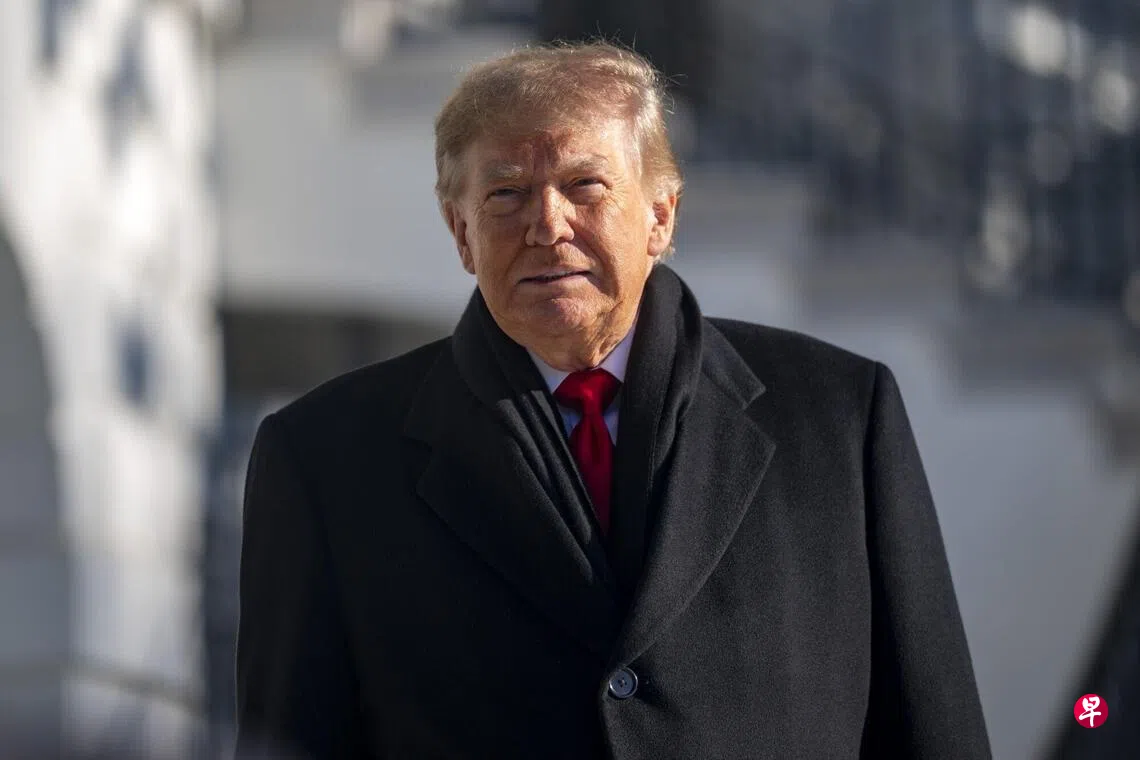
US President Donald J. Trump left for Asia on Monday (16 November), local time, to attend regional summits in the Philippines and China. His planned meeting with Chinese President Xi Jinping is drawing close attention following the Republicans’ midterm election defeat and former Nvidia chief executive Jensen Huang’s involvement in a suspected Chinese spy controversy.
Reuters reported that Trump said before his departure that he might meet North Korean leader Kim Jong Un in China, depending on Xi’s arrangements. North Korea, however, had already publicly stated that it had no intention of meeting Trump at present.
Trump is due to meet leaders from Southeast Asia and other regions in Manila on Tuesday (17 November), before travelling to Shenzhen for the Asia-Pacific Economic Cooperation (APEC) meeting. He plans to meet Xi there and hold three-way talks with Russian President Vladimir Putin. Trump said the three leaders would discuss nuclear disarmament, Iran, Ukraine, trade and economic issues.
The US-China trade truce expires on 10 January next year, and the two sides will also hold talks during the Group of 20 summit in Miami in December. Analysts had initially expected no major breakthrough at the Shenzhen summit. But the Republicans’ defeat in this month’s midterm elections, allegations that Huang had an extramarital affair with a suspected Chinese spy, and questions over whether the US acted promptly on related intelligence have added uncertainty to the summit.
The US government also announced new rules on Monday to restrict exports of advanced chips to data centres in countries including Malaysia and Thailand, seeking to curb Chinese companies’ access to advanced US artificial intelligence chips through computing capacity overseas. There have also been calls in the US Congress to tighten chip restrictions on China further. Zhu Feng, an academic at Nanjing University, said the controversy could accelerate US-China decoupling in artificial intelligence.
Osman, a China policy adviser at the UK’s Tony Blair Institute, said Trump was now less concerned about a backlash from markets or voters and might be more willing to take measures that disrupt the status quo. China, meanwhile, has accused the US of using espionage allegations to justify technology restrictions.
Another focus is the proposed three-way talks between the US, China and Russia. Trump hopes to use the meeting to advance a nuclear arms control agreement, but Chinese analysts believe Beijing would not accept one, given that it has far fewer nuclear warheads than the US and Russia. Russia’s Kremlin said the three-way meeting would have a significant impact on global affairs.
In its dealings with Trump, Beijing hopes to prevent him from approving US$14 billion (about S$18 billion) in arms sales to Taiwan. Trump previously said that putting the sales on hold was a bargaining chip in negotiations with China.
Despite continuing differences over the implementation of the trade truce, several analysts believe both sides have incentives to maintain stability and that the arrangement is likely to be extended.
