

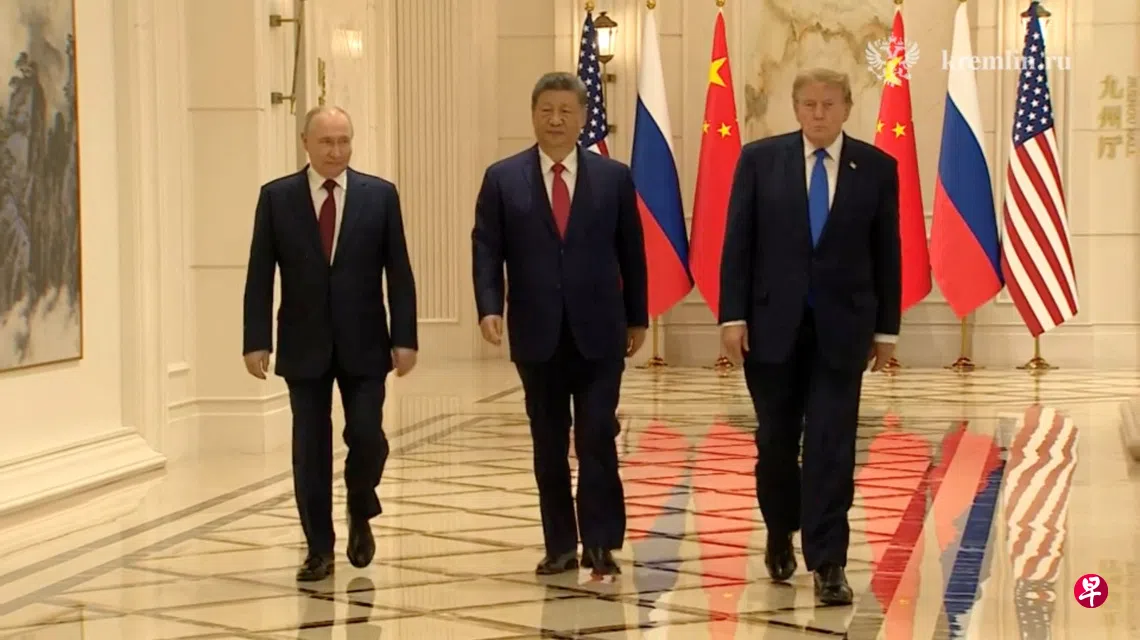
US President Donald J. Trump recently embarked on a three-day visit to Asia after the Republicans suffered heavy losses in the US midterm elections. The Wall Street Journal (《华尔街日报》) reported that, with no re-election campaign to worry about, just over two years left in office and his influence in Washington waning, Trump is seeking to cement his legacy by securing diplomatic breakthroughs overseas that eluded his predecessors.
On his first overseas trip since the midterm elections, Trump received lavish ceremonial welcomes in Asia. At his first stop, Manila in the Philippines, a marching band welcomed him with his signature campaign song, “YMCA”. Chinese President Xi Jinping then personally welcomed him at Shenzhen airport, where military aircraft staged a fly-past and “YMCA” was played again.
Trump also attended a banquet for Asia-Pacific leaders and was the only leader to pause for media photographs during the red-carpet ceremony. In an interview with Fox News, he heaped praise on the lavish reception, calling the trip a “major victory” for both the US and China.
The Wall Street Journal noted that the pomp overseas stood in stark contrast to the domestic political situation awaiting Trump on his return.
As Trump wrapped up his visit to China, the US government was in the seventh day since a series of major system failures that had grounded flights, paralysed mail services and delayed banking transactions.
Meanwhile, with the Democrats in control of Congress, Democratic Representative Robert Garcia, the incoming chairman of the House Oversight Committee, has issued document preservation notices to members of Trump’s family and administration officials, signalling months of investigations ahead.
The controversy surrounding former Nvidia chief executive Jensen Huang’s departure over alleged ties to suspected Chinese intelligence operatives has also exposed deep divisions within Trump’s team of senior advisers.
Despite continuing political headwinds at home, Donald J. Trump has made clear to advisers his ambition to secure a place in history through diplomacy. He hoped to use the Shenzhen summit to advance a trilateral nuclear weapons agreement with China and Russia. Ultimately, however, the three leaders made only a broad commitment to continue discussing nuclear risks. Their joint statement offered no specific details, and the summit failed to deliver a substantive breakthrough.
Analysts cited in the report said Trump’s determination to secure a historic agreement before leaving office could give US adversaries an advantage in negotiations, as all sides weigh how far he is willing to compromise.
White House communications director Steven Cheung countered that Trump’s overseas trip demonstrated his command as a “true leader”.
On his flight back to Washington, Trump said he planned to hold a press conference on Friday (20 November) afternoon local time to tout his diplomatic achievements to voters and demonstrate his administration’s ability to break the political deadlock in the capital.
