

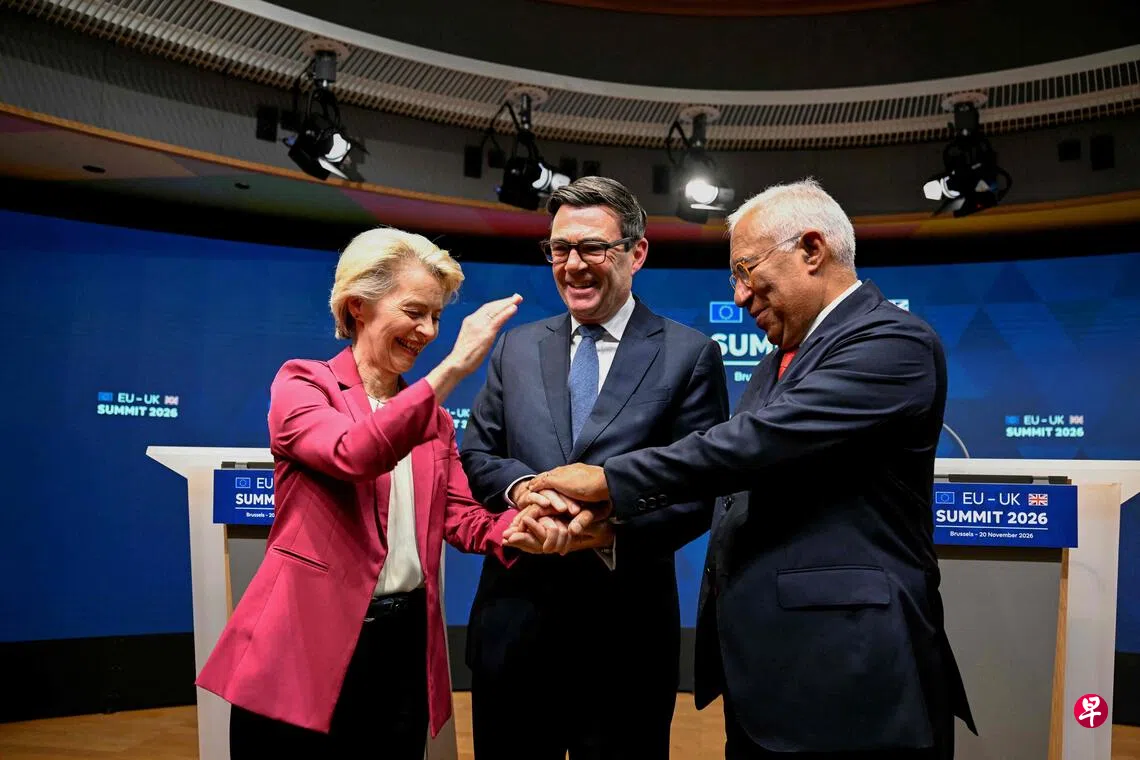
UK and EU leaders reached dozens of agreements on trade, security and defence, carbon emissions and youth exchanges at their second summit.
Xinhua reported that the second UK-EU summit was held at the EU headquarters in Brussels, Belgium, on Friday (20 November). In a joint statement after the meeting, the two sides announced 72 agreements across a range of areas, including those mentioned above.
According to the statement, the UK and the EU will waive sanitary and phytosanitary documentation requirements and related checks for the vast majority of animals, plants and related products traded between them. The measure is due to take effect in March 2028.
The two sides also plan to link their emissions trading systems from 2028, paving the way for mutual recognition of carbon allowances and exemptions from each other’s carbon border taxes.
The statement also said that UK students and educators would once again be able to benefit from Erasmus+ from January 2027. The EU-funded programme supports exchanges in education, training, youth and sport, facilitating cross-border mobility for individuals and cooperation between institutions.
From 2028, the two sides plan to gradually send 100,000 young people each to study, live and work in the other’s territory. They will also conclude negotiations on tuition fees and other issues within the next six months.
UK Prime Minister Andy Burnham described the agreements reached at the summit as a milestone and “a win-win for the UK and Europe”.
He also said the agreements could increase the UK’s gross domestic product (GDP) by 0.5% by 2040, equivalent to an annual boost of about £17 billion (S$28.7 billion) to the UK economy.
European Commission President Ursula von der Leyen said the summit had delivered major agreements on food, youth exchanges and carbon markets.
European Council President António Costa said: “The EU is a union of sovereign countries. Whatever the UK decides about its long-term relationship with the EU in future, we will respect it.”
The UK voted to leave the EU in a referendum in 2016 and formally withdrew in January 2020. After taking office in 2024, Labour Prime Minister Keir Starmer began working to repair UK-EU relations. The first UK-EU summit was held in London in May 2025.
Burnham succeeded Starmer as prime minister after the latter resigned in late June this year. Earlier this week, Burnham publicly said that the costs of Brexit had outweighed the benefits over the past decade. The summit was therefore widely seen as an important opportunity for London to redefine its relationship with the EU.
