

The two-day Asia-Pacific Economic Cooperation (APEC) leaders’ meeting opens in Shenzhen, China, on Wednesday (18 November). US President Donald J. Trump and Russian President Vladimir Putin have both signalled that they could meet North Korean leader Kim Jong Un during the summit. Against this backdrop, Kim’s appearance near the North Korea-China border, including a visit to the area around Mount Paektu, which North Korea regards as a “sacred site of the revolution”, has fuelled speculation that he may be preparing to travel to China.
Analysts believe Chinese President Xi Jinping could play a pivotal role in bringing about a North Korea-US summit. But Pyongyang has yet to make its position clear, leaving considerable uncertainty over whether a meeting will take place.
As he set off for Asia on Monday (16 November), Donald J. Trump said he would meet Xi Jinping and Vladimir Putin in Shenzhen and might also see Kim Jong Un. Asked by reporters where the meeting would take place, Trump replied: “In China. Maybe Kim Jong Un will come, I don’t know. That’s a matter for President Xi.”
Asked about Trump’s remarks at a press conference in Beijing on Tuesday, a spokesperson for China’s Ministry of Foreign Affairs said they had no information on the matter.
But when asked again whether Kim would travel to China after arriving in the Philippines later that day, Trump said: ““He does want to.”
Trump’s remarks contrasted with the White House’s earlier statement that no North Korea-US talks were scheduled during the Asia trip. Analysts said that by publicly naming Xi, Trump was both seeking China’s help in facilitating North Korea-US dialogue and leaving a key part of the effort to secure a meeting to Beijing.
Russia has also sent positive signals. According to TASS, Kremlin spokesman Dmitry Peskov said on 16 November that Putin could hold talks with Kim if the North Korean leader attended the APEC summit in Shenzhen.
Putin met Kim’s close aide Jo Yong Won, a secretary of the Central Committee of the Workers’ Party of Korea, in Moscow that day. He asked Jo to convey his warm greetings to Kim and stressed that he greatly valued the pragmatic and friendly ties Russia and North Korea had built in recent years.
Notably, the Korean Central News Agency (KCNA) reported on 17 November that Kim had inspected tourism development projects in Samjiyon, Ryanggang province, near the North Korea-China border, on 15 and 16 November. He was accompanied by his wife, Ri Sol Ju, and daughter, Kim Ju Ae. Official footage showed his daughter skiing while Kim, wearing sunglasses, watched from the sidelines with his wife, appearing relaxed.
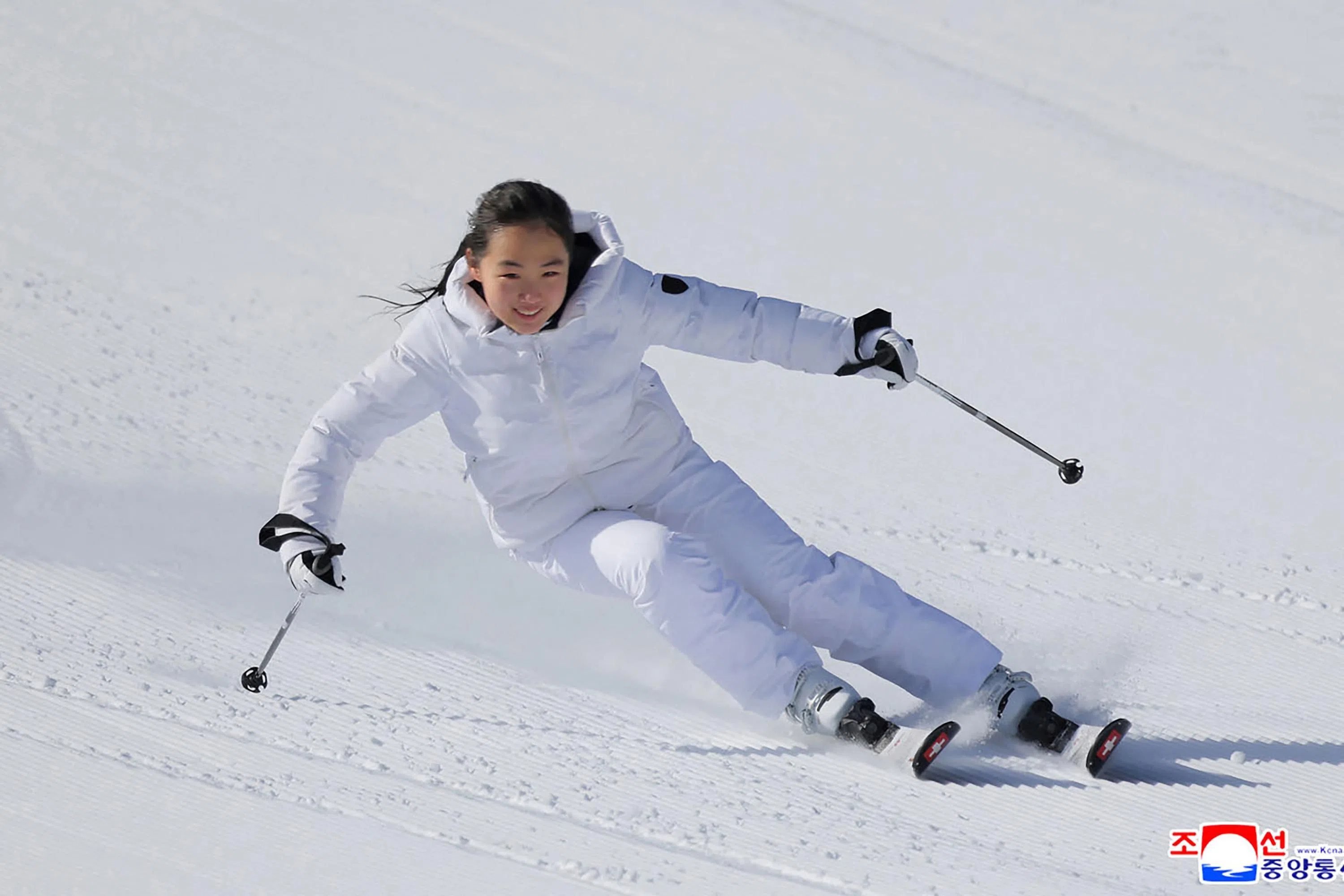
Kim’s appearance in the border region at this juncture, particularly around the politically symbolic Mount Paektu, known in China as Changbai Mountain, has prompted speculation that he is preparing for a visit to China.
Mount Paektu has long been seen as a significant symbolic destination for Kim ahead of major political decisions. He visited the mountain or the Samjiyon area around the time his uncle Jang Song Thaek was executed in 2013, before North Korea decided in 2017 to participate in the Pyeongchang Winter Olympics, and in December 2019 as a deadline for North Korea-US denuclearisation talks approached.
Analysts said Kim’s appearance at the ski resort with his wife and daughter, deliberately projecting an air of ease, could be intended to contrast with Trump’s active pursuit of a diplomatic breakthrough and signal that Pyongyang is in no hurry to resume dialogue.
Yang Moo-jin, a professor at the University of North Korean Studies, noted that Kim had visited Mount Paektu before major decisions in the past, making the timing of this trip noteworthy.
However, Park Won-gon, a professor at Ewha Womans University, said it was too early to interpret the border inspection as a precursor to a summit. North Korea and the US have yet to hold the necessary working-level consultations on the nuclear issue and an agenda for talks, while North Korean Foreign Minister Choe Son Hui was not accompanying Kim.
Analysts believe Trump, facing domestic political pressure, may hope to draw on China’s diplomatic influence to achieve a breakthrough in North Korea-US relations. For Kim, meeting the leaders of China, the US and Russia on the same trip would help raise North Korea’s diplomatic standing. For Xi, facilitating such a rare gathering of leaders would further demonstrate China’s ability to mediate in major-power diplomacy.
South Korea’s Ministry of Foreign Affairs said it was difficult at this stage to predict whether a North Korea-US summit would take place. If Trump and Kim meet again this week, it would be their first summit in about seven years and five months, following their meeting at Panmunjom in June 2019.
