

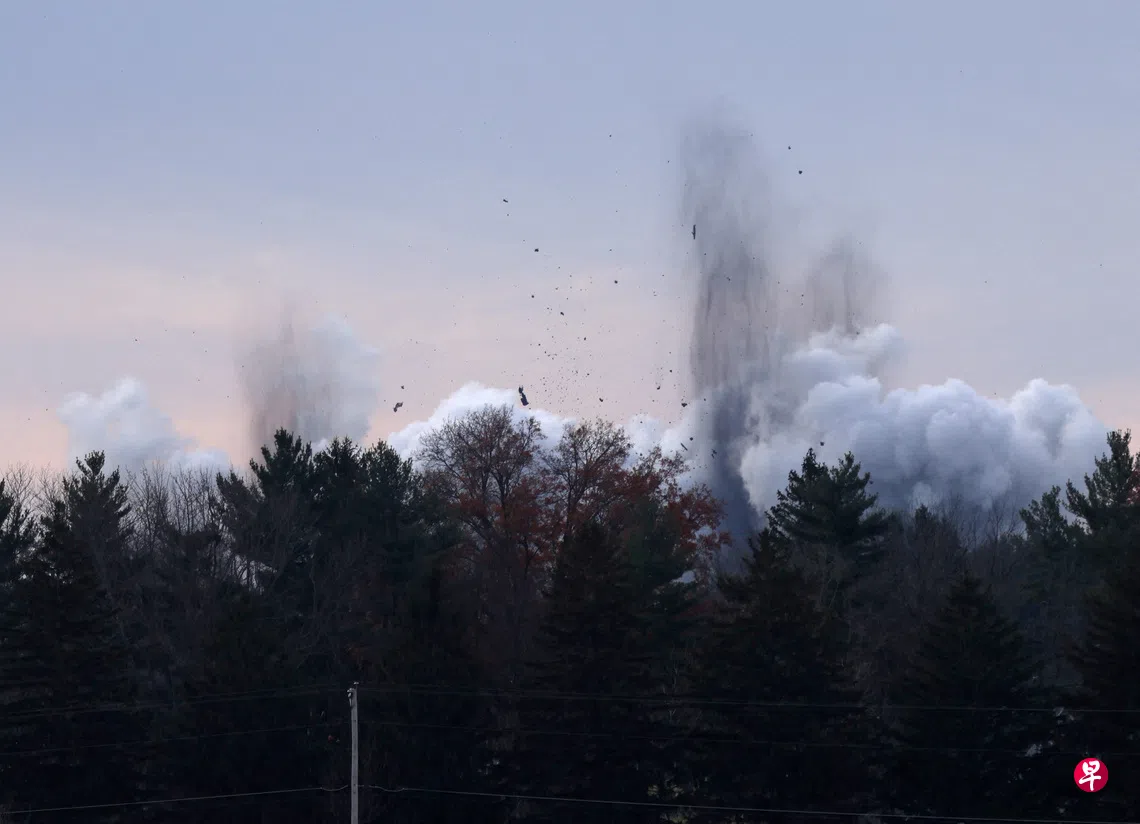
The US Army has successfully detonated a stockpile of ageing lead-based explosives in rural Iowa. The Army said the operation safely destroyed nearly five tonnes of unstable explosives while minimising the production of toxic lead dust.
Residents of Middletown, the farming town closest to the blast site, were evacuated beforehand to protect them from the explosion. Other nearby residents stayed indoors to avoid inhaling lead dust from the blast.
The US Army and the Environmental Protection Agency said on Wednesday (25 November) that monitoring immediately after the blast detected no lead in the surrounding air. However, authorities still required residents to remain indoors until the official all-clear. Some residents remained sceptical of the government's safety assurances.
The operation sparked days of protests and legal disputes. The explosives were stored in 68 deteriorating plastic drums and consisted mainly of highly unstable lead azide. Acting Army Secretary Aaron Teller said the controlled detonation was “a tremendous success” and that the threat of the explosives detonating spontaneously had been eliminated.
He also said all the drums of explosives had been completely destroyed, with no secondary explosions, casualties or damage to facilities. Local television footage showed a cloud of grey smoke rising after the blast and quickly dispersing.
Residents were mainly concerned that the blast would spread toxic lead dust to nearby homes, farmland and livestock. About an hour after the explosion, the Environmental Protection Agency said real-time monitoring had found no airborne lead levels above safety limits. It said it would continue collecting air, soil and water samples for comparison with more than 1,200 samples collected before the blast.
Government experts considered a controlled detonation the safest way to dispose of the explosives. As the weather turned colder, the explosives could become even less stable and eventually detonate spontaneously. Experts also believed that attempts to chemically neutralise the explosives or move the storage drums could trigger an uncontrolled explosion.
To limit the spread of lead dust, the Army built earth berms and installed tall walls and water-filled tanks at the site. It also used misting systems and firefighting foam to suppress particles generated by the blast.
Lead azide was once widely used in military ammunition but was later phased out. In 2009, the Army shipped unused stocks from bases across the country to Iowa. An inspection at the site in March this year found dangerous crystals on the storage drums and explosives, indicating that the material had become extremely unstable.
