

After months of imposing a naval blockade on Iran, the US is broadening its pressure campaign by setting up a task force to stop Iran transporting weapons and other supplies overland and across the Caspian Sea.
Iran dismissed the move as “wordplay”, saying it would not achieve the US aim of collapsing the Iranian economy.
US Central Command (CENTCOM) said in a statement on Saturday (7 November) that its commander, admiral Brad Cooper, had ordered the formation of a task force named Iron Gate.
It will seek to stop Iran from transporting advanced weapons systems, dual-use technology and sanctioned goods across its land borders and the Caspian Sea, and cut off illicit funding.
The task force comprises about 20 civilian and military personnel and is headquartered in Tampa, Florida.
Cooper said the formation of Task Force Iron Gate would consolidate the gains from the US naval blockade of Iran. “Strengthening CENTCOM’s collaboration with US interagency partners will further constrain Iran’s ability to finance terrorism, rebuild weapons factories and replenish their military.”
The command estimated that the US naval blockade had so far prevented Iran from exporting more than US$25 billion (about S$32 billion) worth of crude oil.
Responding on Sunday (8 November), Iran’s Islamic Revolutionary Guard Corps (IRGC) said, “The Iron Gate plan is merely a wordplay. The Americans cannot achieve their objectives of imposing severe economic pressure to cause economic collapse in Iran through this approach.”
A Reuters investigation found that Iran had imported at least US$2 billion (about S$2.57 billion) worth of hardware, explosives and heavy trucks through a clandestine network since January 2025.
Some of these supplies arrived from Russia across the Caspian Sea, others travelled overland from Central Asia, and some were flown in from China, allowing Iran to circumvent Western sanctions and the US naval blockade.
Meanwhile, the US and Iran continued their confrontation at sea.
US strikes cargo ship in Gulf of Oman over suspected blockade breach
CENTCOM announced late on Saturday that US forces in the Gulf of Oman that day had struck and disabled a cargo ship suspected of violating the US naval blockade of Iran.
Iran’s IRGC said in a statement on Sunday that three oil tankers had suffered explosions and caught fire while attempting to pass through the Strait of Hormuz in violation of its rules.
The Guards warned that any vessel cooperating with US forces, disregarding Iranian regulations and entering the exclusion zone without permission “will certainly strike a mine”.
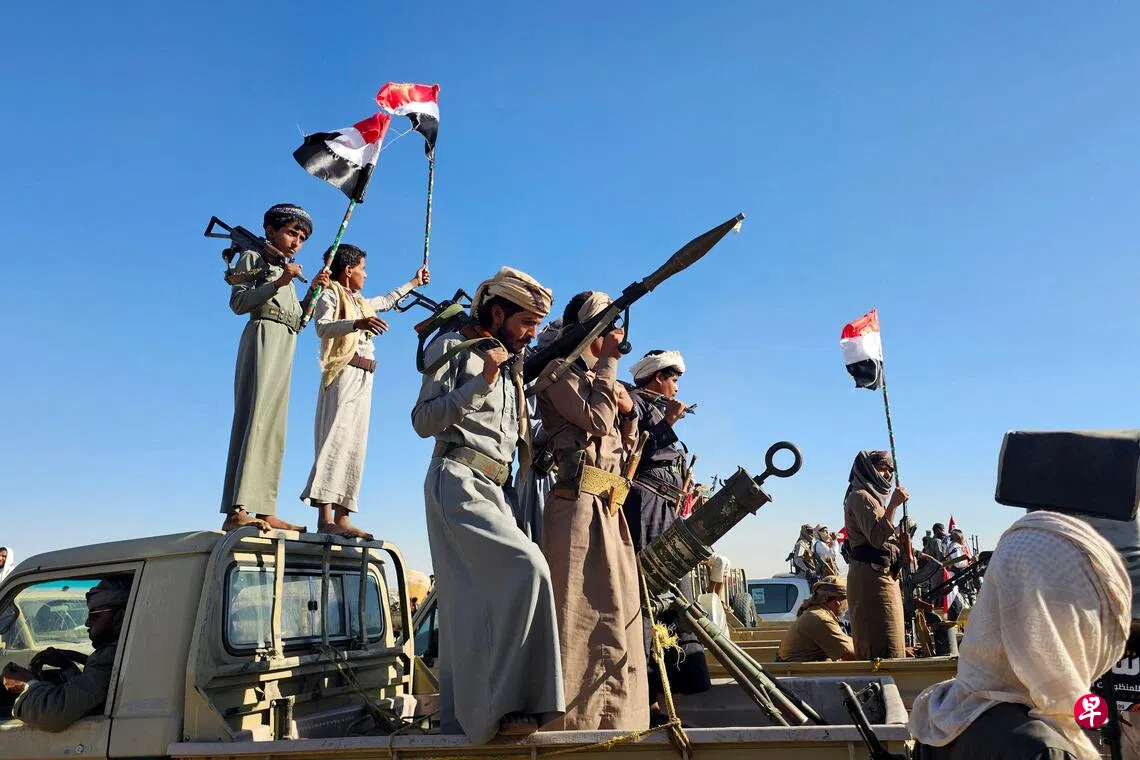
Separately, AFP cited several Yemeni officials as saying that Syria planned to send thousands of troops to Saudi Arabia and Yemen to help the Saudi and Yemeni governments defend against the Iran-backed Houthis.
According to the Yemeni officials, Syrian President Ahmed al-Sharaa agreed to send troops to assist Saudi Arabia during a recent visit to Riyadh. The first contingent would comprise about 3,000 troops, with the eventual deployment potentially rising to 10,000.
Several hundred troops were said to have already taken up positions on both sides of the Saudi-Yemeni border.
Analysts said that although Syria was far from Yemen, it shared Saudi Arabia’s desire to curb Iran’s influence in the region. Syria’s economy has also been devastated by years of civil war, making aid from wealthy Gulf states such as Saudi Arabia crucial to its reconstruction.
However, the Syrian Arab News Agency cited a diplomatic source as denying that Damascus was sending troops to Yemen. The source stressed that military cooperation between Syria and Saudi Arabia mainly involved troop training, exchanges of experience and military capacity-building, and could develop into a mutual defence agreement in future.
Saudi Aramco office damaged in attack; Houthis say air strike killed 33
An administrative office building belonging to state oil company Saudi Aramco in the capital, Riyadh, was hit by falling shrapnel on Sunday. The building sustained minor damage, but no casualties were reported.
The Saudi-led coalition said Saudi air defence systems had intercepted several missiles fired by the Houthis towards Riyadh and Saudi Arabia’s eastern and southern regions that day.
The Houthis said on the same day that a Saudi air strike on Yemen’s Sanaa province had killed at least 33 people, including many women and children, and injured 39.
