

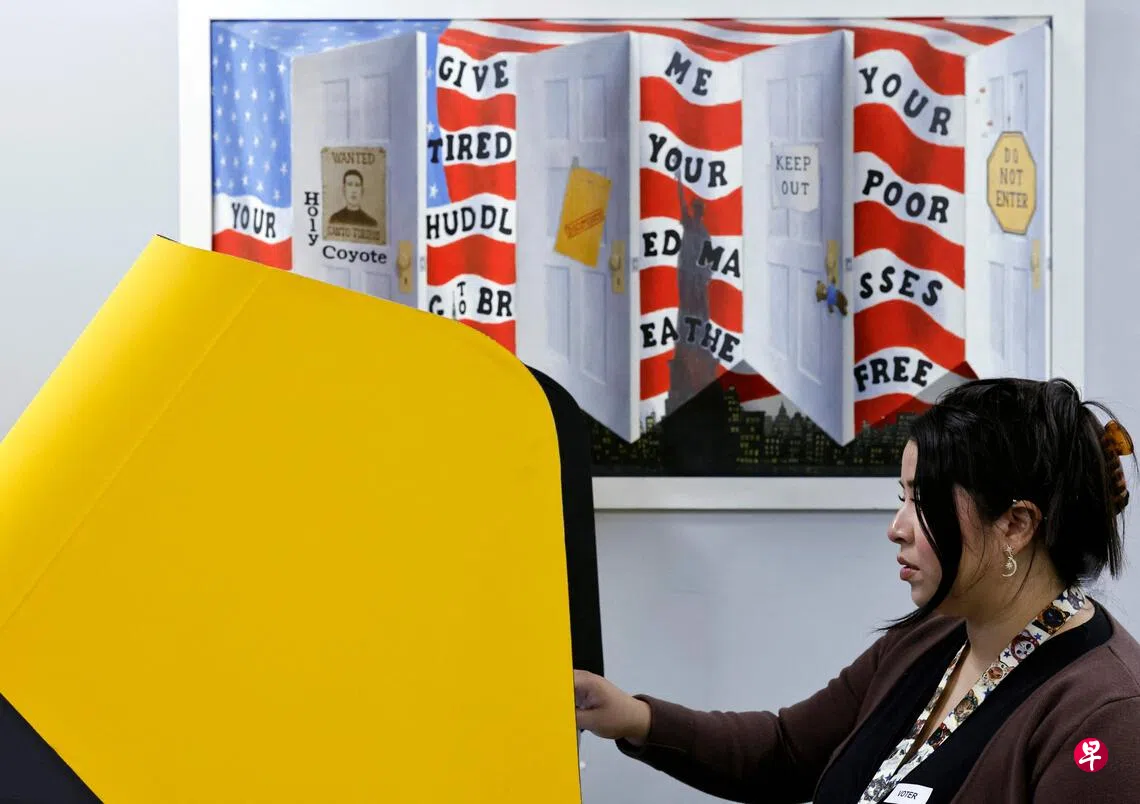
California governor Gavin Newsom has sent an urgent letter to federal district courts ahead of the midterm elections, warning that President Donald J. Trump may attempt to seize ballot papers and urging the courts to prepare.
The move marks a further escalation in the election-related legal battle between California and the Trump administration.
In a letter sent on Saturday (31 October) to the chief judges of California’s four federal district courts, Newsom, a Democrat, said the Trump administration might seek search warrants to seize ballot papers, election records or certified voting equipment between the election on 3 November and the certification of results on 11 December.
Under the US Constitution, states administer their own elections. Newsom stressed that Californian law sets out strict procedures for election records, the retention of materials and the chain of custody for evidence, all subject to court oversight.
“There is no legitimate law enforcement reason to seize ballots, ballot materials, and equipment needed to process and tabulate ballots,” Newsom wrote. “Indeed, the only reason to do so would be to interfere in a State’s lawful counting of ballots.”
California is currently embroiled in a legal battle with the Trump administration. The US Department of Justice (DOJ) says more than 20,000 non-citizens may be registered to vote in California and has demanded that their ballot papers be set aside and excluded from the count until their citizenship is verified.
However, US district judge Trina Thompson issued a temporary injunction on Friday (30 October), barring the Trump administration from threatening Californian election officials at any level with criminal prosecution over voter eligibility disputes.
Thompson also ordered the DOJ to stop demanding that election officials remove voters from the rolls, refuse to issue ballot papers to specific voters or segregate ballot papers already cast on the grounds that some voters were ineligible.
DOJ officials had previously publicly threatened to prosecute election workers handling ballot papers suspected of having been cast by non-citizens. Election workers in Los Angeles County even received grand jury subpoenas.
Newsom said the DOJ had become a weapon serving Trump’s partisan and personal interests. With polls suggesting that Republicans could lose control of at least one chamber of Congress, he said there was ample reason to fear that the authorities would seek to further disenfranchise voters and obstruct the certification of election results.
Study: AI chatbots frequently cite unreliable sources for election information
Beyond the legal clashes between the federal and state governments, the integrity of this election also faces a test from the spread of misinformation and disinformation through artificial intelligence (AI).
Experts say this is the first US federal election in which millions of voters are relying on AI tools for political information, a trend reshaping the pre-election information landscape.
A survey by the National Conference on Citizenship found that two in five Americans had used AI tools to search for election-related information.
While AI chatbots can help debunk conspiracy theories and improve understanding of elections, multiple studies show that these tools frequently cite unreliable online sources. This can erode public trust and make it even harder to distinguish fact from fiction online, where false information is already rife.
A study of eight AI models by AI evaluation organisation Forum AI found that nearly 40% of chatbot responses to election questions contained at least one factual error. These included confusing candidates with people who shared their names, giving incorrect deadlines for requesting postal ballot papers and misquoting candidates.
Another concern for researchers is that chatbots are highly susceptible to manipulation by foreign influence operations, sometimes even repeating disinformation that has been widely debunked.
Research by the non-partisan Brennan Center for Justice, however, found that mainstream chatbots firmly rebutted common election conspiracy theories, such as claims of voting machine tampering, even when users repeatedly tried to lead them into endorsing those claims.
This suggests that AI tools can still play a constructive role in combating election misinformation.
