

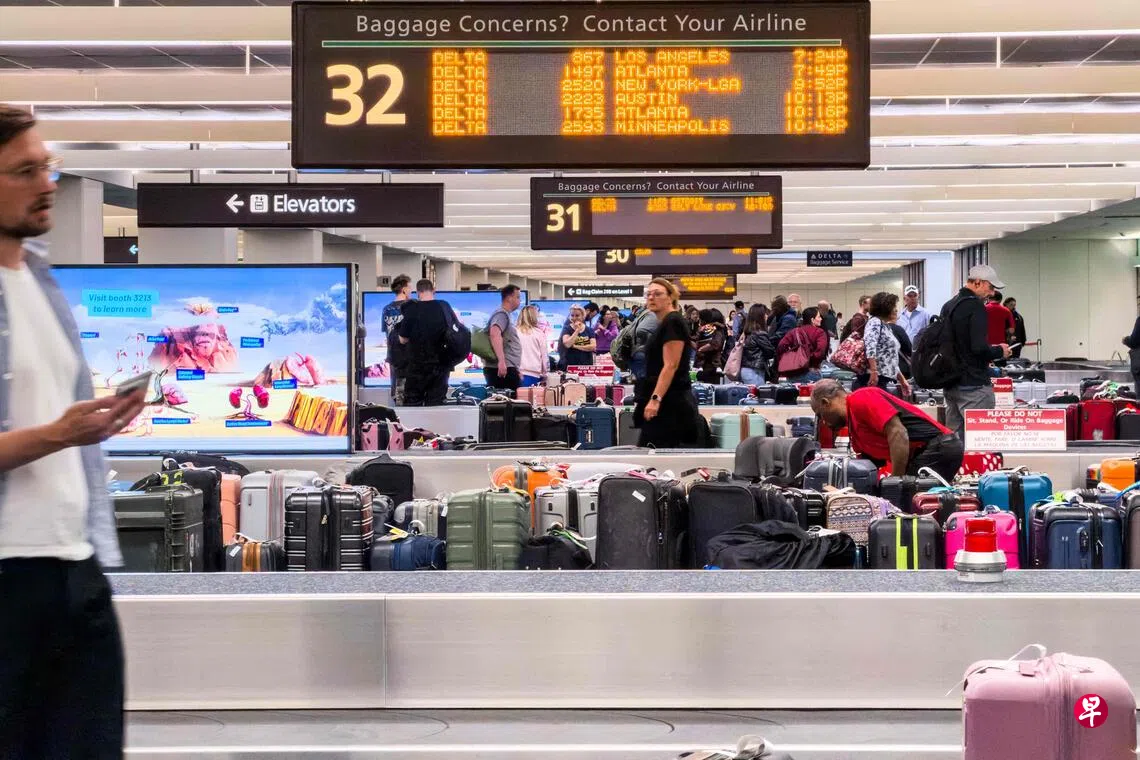
A communications failure in the US air traffic control system on Friday prompted the Federal Aviation Administration to halt departures at airports nationwide, paralysing air traffic for more than four hours. It was the longest nationwide ground stop since the terrorist attacks of 11 September 2001.
US Transport Secretary Sean Duffy said radar and communications systems at air traffic control centres became unstable at 3.36pm Eastern time on Friday (13 November), or 4.36am on Saturday in Singapore. The Federal Aviation Administration (FAA) subsequently ordered a nationwide ground stop at around 4pm.
At the request of the US, Eurocontrol also suspended US-bound departures from its member countries.
More than 3,500 aircraft were airborne across the US at the time. Duffy said air traffic controllers followed emergency procedures and successfully guided thousands of aircraft to safe landings despite intermittent radar and communications services. After the system failure was resolved, the ground stop was lifted at 8.15pm that evening, allowing take-offs and landings to resume gradually.
Nearly 10,000 flights cancelled; delays and cancellations could last days
The disruption, which lasted more than four hours, had a knock-on effect that severely affected air traffic. Data from flight-tracking website Flightradar24 showed that nearly 10,000 flights had been cancelled as of 11.30pm on Friday.
US media reported that more than 2,500 additional flights were cancelled on Saturday, with hundreds more delayed.
Analysts expect the disruption could last several days as airlines have to reposition aircraft and crews.
Arriving flights were also affected, with some passengers unable to disembark promptly after landing.
Passengers on a flight from Newark to Los Angeles International Airport were kept on board for more than five hours while the aircraft waited for a gate. One passenger on board, Ruth Coles, said to the Associated Press, “The pilot keeps saying they are telling him we are next in line.”
Data overload in outdated equipment triggers nationwide ground stop
Explaining the failure, Duffy said ageing switches and routers in the air traffic control communications network had been overloaded with data, resulting in inconsistent data being returned. The authorities therefore shut down the affected systems.
Bloomberg, citing people familiar with the matter, reported that federal investigators were examining whether a software update had triggered the outage. Other reports said a dedicated air traffic control communications network had restarted during an update, causing a network-wide collapse.
Donald Trump: No cyberattack
US President Donald Trump told Fox News that preliminary checks had found no signs of a cyberattack and that ageing infrastructure had caused the failure. Homeland Security Secretary Markwayne Mullin also said there was no evidence that the failure had been caused by an artificial intelligence (AI) system running out of control.
This was the third nationwide ground stop in US history. The previous one was in January 2023, when a failure in the system that issues safety notices to pilots halted domestic departures for about 90 minutes. The first was in 2001, following the terrorist attacks on 11 September; it lasted until 14 September.
A 2024 report by the US Government Accountability Office found that, of the 138 air traffic control systems assessed by the FAA, 51 were struggling to maintain normal operations and another 54 faced similar risks. These problematic, ageing systems accounted for more than three-quarters of the total.
In addition, more than 400 air traffic control facilities across the US still use legacy floppy disks to store and retrieve critical data, including weather information.
US government seeks US$50 billion to upgrade air traffic control system
To address ageing equipment, the US Congress approved US$12.5 billion (about S$16 billion) last July to upgrade air traffic control facilities.
After Friday’s incident, the White House and the Department of Transportation requested a further US$30.1 billion from Congress for airport refurbishment and air traffic control system upgrades. Duffy criticised Congress for providing insufficient funding and urged the government to raise its funding request to US$50 billion.
However, the Government Accountability Office warned in September this year that the air traffic control upgrade programme lacked reliable cost estimates and an overall timetable, leaving it highly likely to face delays and cost overruns.
