

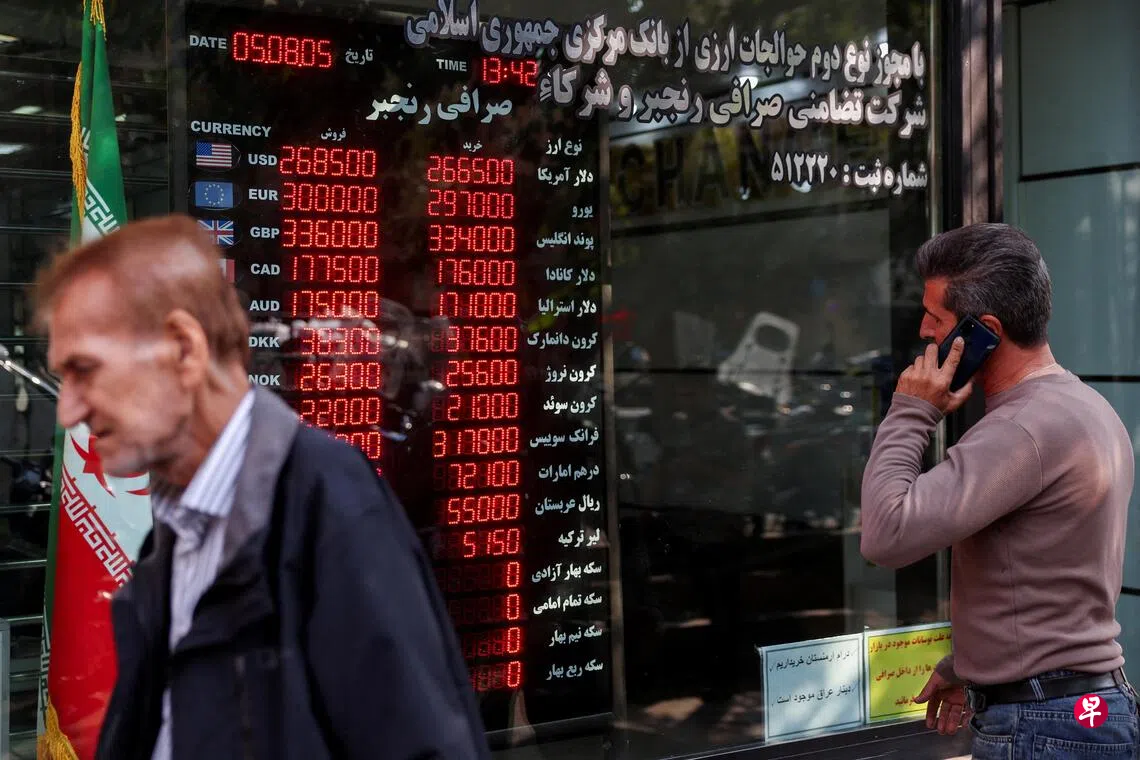
A US naval blockade, sweeping economic sanctions and efforts to obstruct overland exports have crippled Iran’s economy, putting greater pressure on its government.
The latest US Treasury assessment obtained by US news website Axios shows that since the Treasury launched “Operation Economic Outcast” against Iran in August this year, the Iranian rial has lost about a quarter of its value. Inflation reached 90% in September, far above the level of about 35% in early 2025.
Under a tight US naval blockade and sweeping sanctions, Iran has not loaded any oil onto tankers since 25 August. Data from maritime tracking firm Kpler shows that Iran has sold all the oil previously stranded at sea.
Iran’s efforts to bypass the naval blockade via overland routes have also proved unsuccessful. Severe bottlenecks have developed at its land borders with Pakistan, Türkiye, Afghanistan and Turkmenistan. Thousands of lorries have been stranded at the Turkish border for as long as 20 days, while hundreds more are waiting at the Pakistani border.
On the diplomatic and aviation fronts, the United Arab Emirates, Oman, Iraq, Georgia and Azerbaijan have banned all Iranian airlines from entering their countries and cancelled flights to Iran. Türkiye has also suspended all inbound and outbound flights operated by Iran’s privately owned Mahan Air. Financial institutions in Türkiye, Lebanon and the UAE have also imposed tighter clearing restrictions on Iranian banks.
Treasury Secretary Scott Bessent and US Central Command chief Adm. Brad Cooper briefed President Donald J. Trump at the White House on Thursday (29 October) on the military campaign against Iran and the impact of sanctions.
A US official said Bessent claims the economic pressure campaign is working and that things are getting worse in Iran; and that this could further destabilise the regime, pushing Supreme Leader Mojtaba Khamenei to agree to the terms set by the US.
Trump plans intense strikes on Iran the day after midterm elections
Separately, US cable news channel MS NOW reported, citing three senior Gulf officials, that Gulf allies have been briefed by the Trump administration to get ready for a brief but fierce round of attacks as early as 4 November, the day following the midterms.
In an interview with Kansas City radio station KCMO on Friday (30 October), Trump declared: “We’re going to have a non-nuclear Iran. Iran cannot have a nuclear weapon, and they won’t have a nuclear weapon, and that’s going to end very soon.”
A former official familiar with the Trump administration’s foreign policy decision-making said: “He’s obsessed with Iran not getting a nuclear weapon. He’s been convinced that with this final attack we can get a deal with the Iranians, or we can finally destroy their nuclear program.”
When asked for comment, a White House official said: “We do not comment on sensitive military plans. President Trump keeps all options on the table to ensure that Iran can never have a nuclear weapon.”
Iran’s Supreme Leader Khamenei convened senior military commanders on Saturday (31 October), issuing a stern warning to the US and Israel not to resume military strikes. He ordered Iran’s armed forces to “respond immediately without geographic limits to any enemy threat” in response to any potential threat, and instructed the military to update its target list immediately to include all US and Israeli “physical and non-physical” assets.
