

Javier Calvo and Javier Ambrossi’s award-winning epic The Black Ball (《黑球》, La Bola Negra) is Spain’s highest-grossing film of the year. Some critics have recently compared it with the 2012 film Cloud Atlas (《云图》), calling it a “gay version of Cloud Atlas”. The comparison seems plausible, but does not quite hold up. Both films have sweeping narrative structures spanning several eras, interweaving the stories and emotions of numerous characters while gradually revealing their connections. In that respect, they are indeed very similar. But Cloud Atlas already contains a tragic gay love story, and it is among the film’s more moving strands. What sense does it make, then, to call this a “gay version”?
Cloud Atlas is certainly a rare and deeply stirring film, but its ambitions are perhaps too great. Spanning 500 years, it explores and expounds, from multiple angles, the fated connections that bind people across time and space. By the end, its central idea feels a little too simple, its impact arguably diluted. That such abundance should produce a sense of thinness is a paradoxical drawback the filmmakers probably did not anticipate. The Black Ball is different. Its scope is narrower: it focuses on the tragedies and changes that Spain underwent over several decades, and on queer love, repression and suffering. Precisely because its energies are concentrated, this single focus illuminates a much wider world, bringing other deeply moving themes into view and giving the film a natural richness. Here, the paradox works in its favour.
Dissent in thought and desire
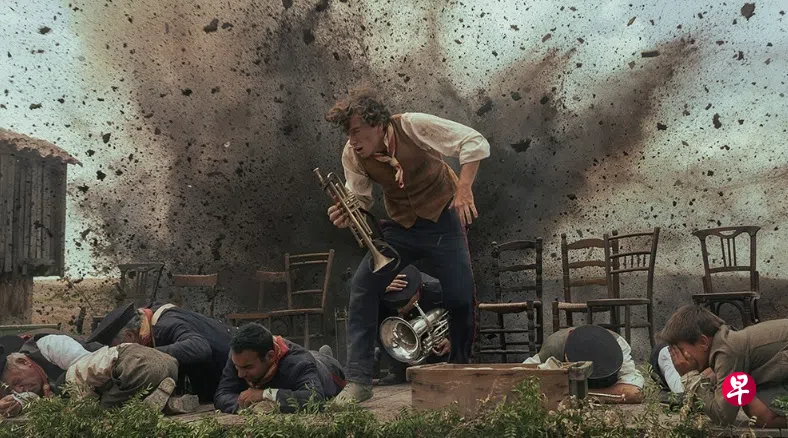
The most obvious of these other themes is, of course, the brutality of a particular war. The sections of The Black Ball set in the 1930s play like a war film viewed from the sidelines. Through individual experiences, they examine the Spanish Civil War of 1936–1939, as well as an outbreak of unrest in 1932 that could be considered its prelude. They trace historical wounds that people in Spain are still trying to uncover — or evade — and heal today.
Frankly, viewers who know little about the nature and consequences of the Spanish Civil War — which brought Franco’s dictatorship to power, where it remained until the 1970s — will have a shallower experience of this film and miss a great deal. Why, at the beginning, are we shown someone locked inside a house in the village of Sebastián, one of the protagonists, shouting, “Everyone must die”? What is the significance of the Italian military’s persistent presence? When Carlos, another protagonist, faces a row of disapproving elders who question his sexual orientation, why is there someone among them who looks like a cardinal? These scenes carry an unspoken indictment of the many painful realities of Spain’s modern history.
Watching the rebels revel by the river while toying with floating corpses, how can one not be chilled by the atmosphere of dehumanisation? At its core, the Spanish Civil War was a cultural war in which conservative forces ruthlessly extinguished progressive ideas, a war of national “purification”. (Franco, who led the rebels, once declared that he was prepared to shoot half the country’s population to “save” Spain.) As historian Helen Graham has observed, the rebels’ extreme violence sought to eradicate all forms of otherness, including “social, cultural and gender/sexual otherness”. To survive, Sebastián has to bury his queer feelings deep within himself. Like Carlos, he acts against his conscience, becoming what his daughter will later call a “fascist”.
Only one dark path remains
With its central theme of being forced to betray one’s conscience on the knife-edge between life and death, The Black Ball brings to my mind not Cloud Atlas, but several other films.
One sequence in the 1993 Hong Kong film Blade of Fury (《一刀倾城》) left me with an overwhelming sense of sorrow. Determined to shed his blood for the revolution, Tan Sitong refuses Wang Wu’s attempt to rescue him from prison. The next day, taken to Caishikou to be beheaded, he discovers that Wang has disguised himself and taken the executioner’s place. The two exchange a silent, tearful look. That such profound devotion should find expression in personally delivering a friend to his death — how heroic, and how desolate.
At the end of the 2009 Spanish film Agora (《杀戮广场》), a male slave cannot break through the cordon of religious persecution. Standing on the side of the perpetrators, all he can do is tearfully and discreetly suffocate the heroine he loves, sparing her the agony of being stoned to death.
Nagisa Oshima’s 1983 film Merry Christmas, Mr. Lawrence (《圣诞快乐,劳伦斯先生》, also known in Chinese as《战场上的快乐圣诞》), which happens to be screening at Filmhouse in December, tells a tragedy of the opposite kind. Compelled by circumstances, a Japanese officer raises his sword to execute a prisoner of war. Yet his forbidden love makes it impossible for him to strike. Overcome by turbulent emotion, he can only collapse to the ground...
Taken together, these three films suggest that we can step further back from The Black Ball and see a broader sorrow: in circumstances imposed by the currents of history, individuals trying to preserve “love” are often powerless to resist. Even those who occasionally follow their passions and rebel can only be swept away. (A detailed comparison would require tedious spoilers, so I shall spare you.) In The Black Ball, an uninhibited female singer delivers an aphorism that breaks Sebastián’s heart: cross-dressing opens up possibilities, while war destroys them. To be at the mercy of the times is to have every possibility of the self extinguished, leaving only one dark path and a lifetime of regret.

The day that defines a life
On a technical level, The Black Ball offers not only images rich in poetry and period flavour, but also a thoughtful use of music. Particularly in the first half, seamless transitions repeatedly turn a character’s singing or playing into the film’s own wonderfully apt “score”, almost without our noticing; sometimes the transition works in reverse. As the camera takes us into the day that will define Carlos’s life — the day he may come out publicly — a short piece called “Tren e incendio” begins to play, unhurried, haunting and sorrowfully beautiful. I would particularly recommend it.
For me, the film’s greatest inherent flaw is its overly self-conscious artfulness. It creates a thin barrier that never quite falls away, limiting how fully I can enter its world. There is also a plot point that deserves explanation and further exploration, but is ultimately left unresolved: why does Sebastián’s comrade help him at a critical moment? This man loyally offers him a small chance to fulfil his forbidden love, yet is clearly also rather angry with him. Surely the emotional undercurrents here are intriguing? Perhaps the filmmakers felt that unravelling them would take the story too far afield and chose to leave them out.
The Black Ball is screening exclusively at Filmhouse, with a limited number of sessions. There is a screening today (29 November) at 2.30pm. For other showtimes, visit filmhouse.sg/films.
