

Private homes in the Outside Central Region (OCR), also known as mass-market private homes, have long been a leading choice for Singapore buyers upgrading from HDB flats. Recent developments in the property market, however, suggest that prices above $3,000 per square foot (psf) may soon be within reach for this segment.
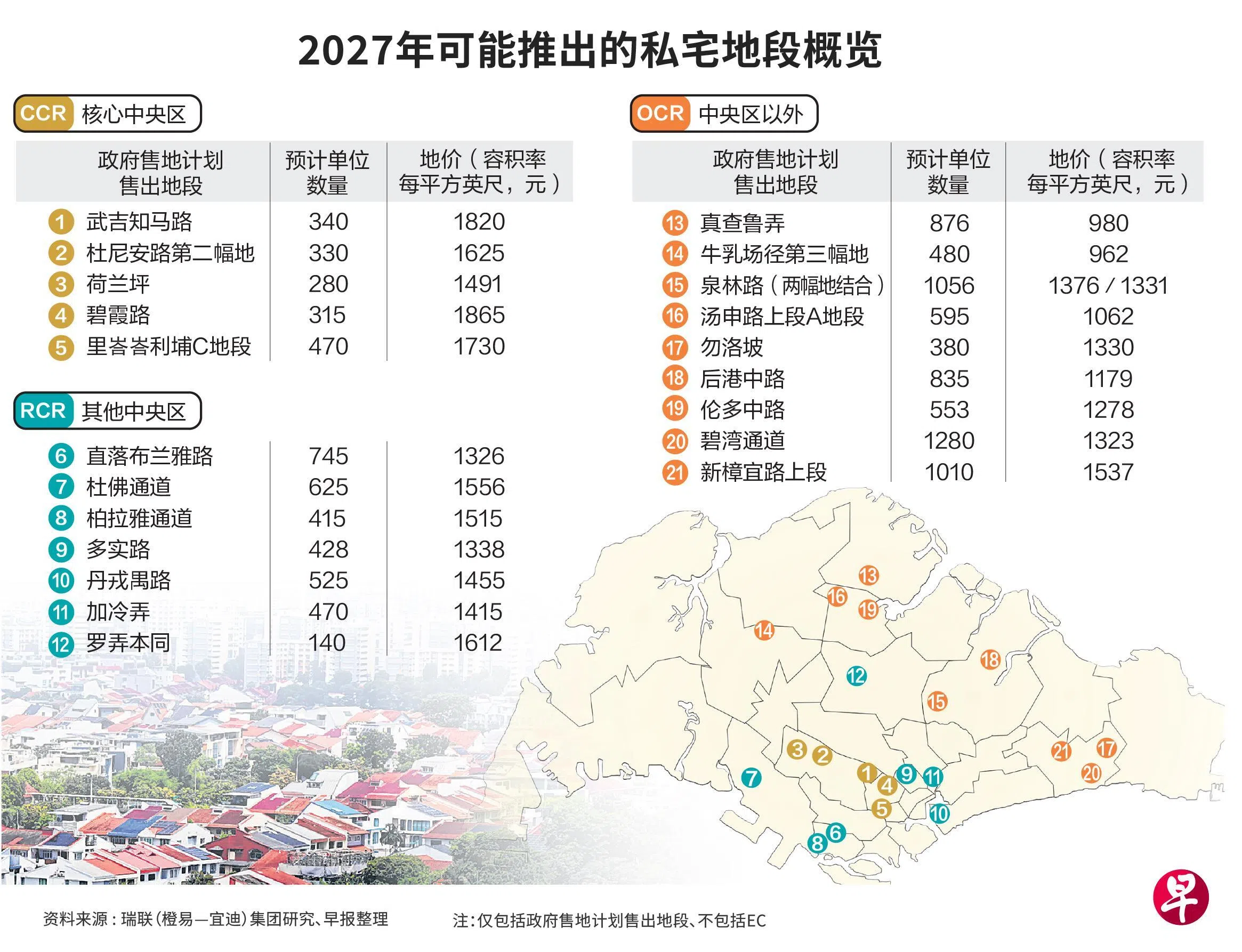
In September this year, a private residential site in New Upper Changi Road in the OCR drew a top bid of $1,537 psf per plot ratio, comfortably surpassing the previous record of $1,388 set by the Bayshore Road site where Vela Bay stands, also in the OCR.
In July this year, a tender for another mixed commercial and residential site in Bayshore Drive closed with a top bid of $2.128 billion, reflecting the site's large size. This worked out to $1,323 psf per plot ratio.
Land prices rise 47% over three years, lifting new launch prices
Data compiled by Huttons Data Analytics for Lianhe Zaobao (LHZB) show that average land prices in the OCR rose from $866 psf per plot ratio in 2024 to $1,153 in 2025. The average so far this year is $1,275, a rise of 47% over three years.
In the Rest of Central Region (RCR), which covers the mid-tier private housing segment, average land prices rose 33% from $1,139 psf per plot ratio in 2024 to $1,511 this year. In the Core Central Region (CCR), which covers the high-end segment, the average reached $1,678 this year, up just 19% over the same period.
Nicholas Mak, chief research officer at property portal MOGUL.sg, said the sealed-bid tender system used in Singapore's Government Land Sales Programme leaves developers having to guess what their rivals will bid.
“The system encourages property developers who are more eager to buy a certain plot of land to submit a very aggressive bid that would surpass the market’s expected price for that site.” As a result, some sites attract unexpectedly high bids.
For instance, a Dorset Road site near Little India attracted bids from nine groups of developers in October last year. The top bid of $1,338 psf per plot ratio was also well above market expectations of $1,200.
What could push prices past $3,000 psf?
With land prices continuing to climb, several analysts expect the two new projects in New Upper Changi Road and Bayshore Drive to launch at between $2,900 and $3,200 psf.
Prices above $3,000 psf for mass-market private homes in that area may sound implausible. But records on the Urban Redevelopment Authority website show that some OCR developments have already crossed that threshold.
Vela Bay, also in the Bayshore area, sold 70% of its units when it launched in April this year, with some transacting at more than $3,000 psf. As of 2 November, its highest transaction price was $3,302 psf, achieved by a large 1,765 sq ft unit sold for about $5.83 million. Nor were large units the only ones to cross the $3,000 psf threshold: a small 484 sq ft unit fetched $3,173 psf.
Explaining why buyers are psychologically prepared to accept such prices, Mak said the completion of more MRT lines and stations across the island has significantly shortened commuting times. The government is also creating employment spaces outside the central area. These developments reduce the need to live near the city centre and could increase demand for homes near suburban commercial centres such as Jurong East/Lakeside, Tampines and Woodlands.
Mohan Sandrasegeran, head of research and data analytics at SRI, said that mass-market private homes continue to attract owner-occupiers. For these buyers, factors such as “proximity to MRT stations, schools and shopping amenities” are often important considerations.
Sing Tien Foo, provost's chair professor in the Department of Real Estate at the National University of Singapore’s (NUS) Business School, said new projects generally set an aggressive benchmark at launch to test buyers' appetite. The risk for developers, of course, is that a high starting price could undermine sales momentum. It could also leave early buyers worried that later units will be sold at a discount, meaning they have overpaid.
Will $3,000 psf therefore become a common launch price for mass-market private homes next year?
One Chuan Grove in Chuan Grove is expected to launch in February next year. Although prices have yet to be announced, market sources suggest an average launch price of between $2,600 and $2,850 psf, with some estimates even putting it at between $3,000 and $3,200 psf.
Christine Sun, chief researcher and strategist at Realion (OrangeTee & ETC) Group, said some projects could reach $3,000 psf and the number of transactions at that price could increase. Overall, however, new developments commanding such prices would remain in the minority over the next two years.
Analysis: Unexpected developments could emerge next year
Mak, however, does not expect OCR private home prices to breach $3,000 psf next year. Instead, he sees the possibility of a reversal.
“I will not be surprised if there is an unexpected event next year that could negatively affect homebuying demand and subsequently, property price, such as another round of cooling measures or a major stock market correction or a sharp increase in interest rates, or all of the above.”
Sandrasegeran also does not expect $3,000 psf to become the pricing benchmark across the OCR market, as buyer affordability and market acceptance remain important considerations.
Sing told LHZB that the Urban Redevelopment Authority's third-quarter flash estimates showed OCR private home prices rising 2.3% quarter on quarter. While that was strong growth, prices would have to climb substantially from current benchmark levels for $3,000 psf to become widespread. Solid economic fundamentals would also be needed to support such prices.
He said: “If $3,000 psf becomes the prevailing price for OCR private homes but household incomes do not rise at the same pace, affordability will be tested. More upgraders and those at the margins of affordability will be priced out of the private housing market, including the mass-market segment.”
Supply projected to reach 16,800 units, with overall prices rising another 3% to 5% next year
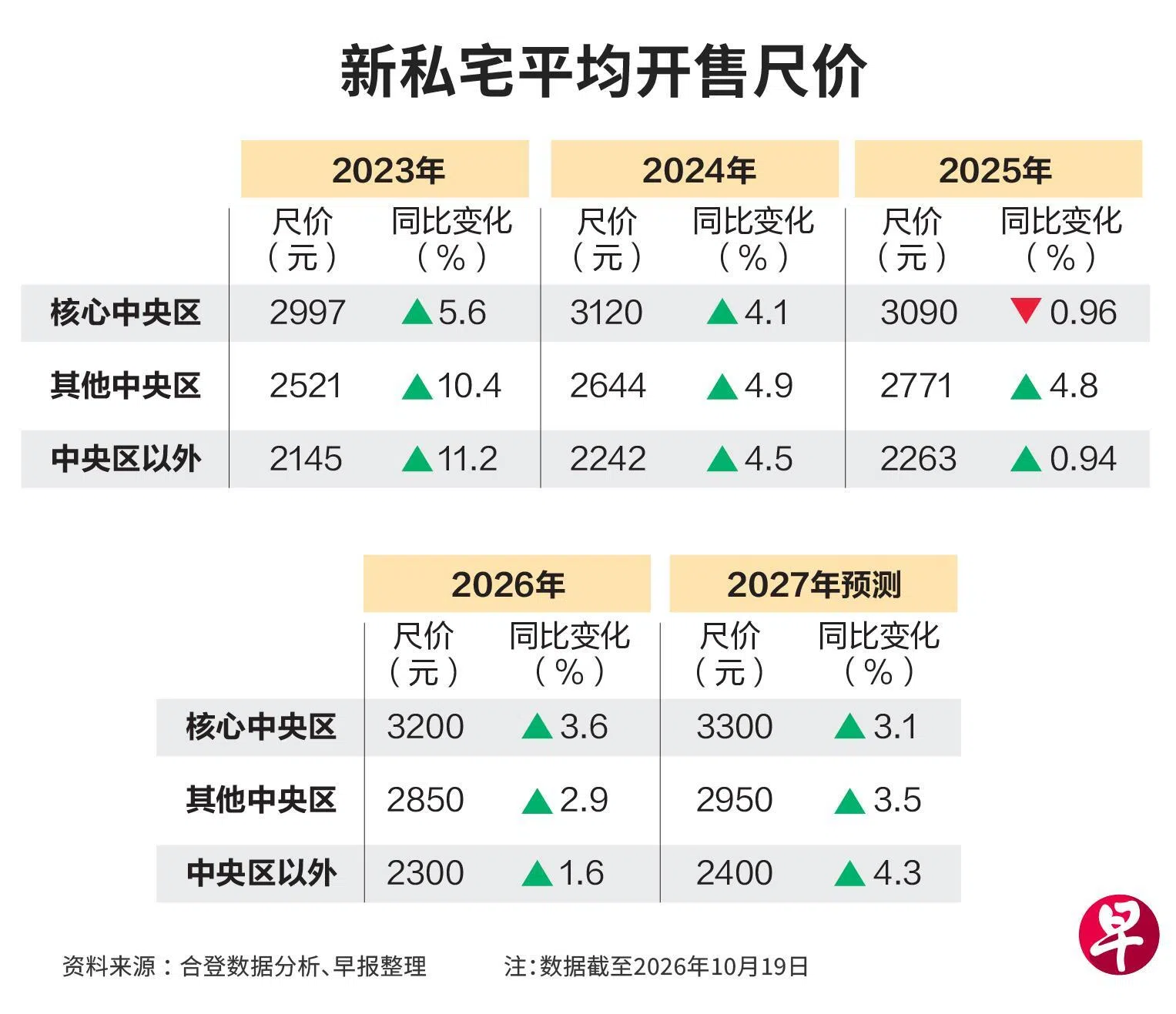
Huttons chief executive Mark Yip expects new mass-market private homes to average $2,400 psf next year, up 4.3% from this year. New mid-tier private homes are expected to average $2,950 psf, a rise of 3.5%. In the CCR, which will have the fewest new launches, he expects an average of $3,300 psf, up 3.1%.
On the one hand, Yip noted that the Middle East conflict has pushed up freight, energy and manufacturing costs, driving up construction costs in turn. Prices at projects launching next year will therefore rise as well.
On the other hand, many factors could restrain rapid price growth. Sun said inflation would probably lead to higher interest rates next year, raising borrowing costs and reducing buyers' willingness to purchase larger, more expensive homes.
The government is also releasing more land through the Government Land Sales Programme. The Urban Redevelopment Authority expects about 32,000 private homes, including executive condominiums (ECs), to be supplied over the next one to two years.
According to research by Realion (OrangeTee & ETC) Group, 30 projects, including five EC developments, are expected to launch next year, adding 16,800 new private homes to the market. Excluding ECs, supply will be about 14,800 units, the highest since 2013, when 15,885 units were supplied.
Economic theory suggests that greater supply should bring prices down. In Singapore, however, overall property price trends also depend on which market segments account for that supply.
Sun explained that most new projects launched last year were concentrated in the more expensive CCR and RCR, which accounted for 23% and 42% respectively. The OCR accounted for just 35%, hence contributing to an overall increase of 6.3% in new home prices.
This year, 61% of new launches are concentrated in the mass-market OCR, while the RCR and CCR account for 21% and 18% respectively. Given the lower prices of mass-market private homes, Sun expects new home prices to rise by between 1% and 2% for the full year.
More than half of next year's new supply will be in the OCR, with about 8,424 units (56.9%), followed by the RCR with 3,434 units (23.2%). The CCR will have the least new supply, at an estimated 2,943 units (19.9%).
Although mass-market private homes will account for the majority, Sun expects overall new private home prices to rise by another 3% to 5% next year because of higher land costs.
At the same time, competition in the market will also constrain private home price growth.
New launches compete with resale homes, giving buyers more choice
Sing said the government's move to raise the monthly household income ceiling for EC purchases to $18,000 has expanded the pool of eligible buyers. It will also divert some demand for entry-level private homes towards the EC market. Five EC projects could launch next year, providing about 2,000 units.
Supply in the private home resale market is another factor.
According to Urban Redevelopment Authority’s data, 8,868 private homes, excluding ECs, will obtain their Temporary Occupation Permit (TOP) next year, 14% more than this year's 7,783 units. Buyers will have more choice and greater bargaining power, while sellers will face stiffer competition.
Mak noted that resale homes account for between half and two-thirds of private housing transactions each year. He expects between 14,000 and 15,200 resale transactions next year.
He added that developers decide when to launch new projects, how many units to release and at what prices. Information asymmetry in the market gives them a decisive advantage, and new launch prices will continue to test fresh highs next year. Resale homes, however, generally have lower per-square-foot prices, making them more attractive on price.
With the removal of the 15-month wait-out period, he also expects more private homeowners to sell their homes and buy resale HDB flats, further increasing the supply of resale private homes.
Uneven new launch sales show buyers seek value rather than buying indiscriminately
The government introduced property cooling measures in 2023, yet private home prices have continued to rise. Addressing this, Yip said: “Cooling measures is meant to temper demand and ensure prices are in line with fundamentals.”
Citing a report, Yip said buyers are using more cash and Central Provident Fund (CPF) savings rather than borrowing to purchase homes. Fewer buyers are also borrowing up to the maximum 75% loan-to-value (LTV) ratio. This means Singapore's property market is not overheating, he said.
Sandrasegeran said that although private home prices continue to rise, broader market performance shows that buyers are discerning. “The varying sales performances across individual new launches suggest that buyers are continuing to assess the relative merits of different developments rather than purchasing indiscriminately.”
For instance, following slower sales at several recent launches, the mid-tier private residential project Thomson Reserve sold 90% of its units, or 1,143 homes, at its launch last weekend. With an average selling price of $2,900 psf, it set this year's record for first-week launch sales.
Most analysts said the project's affordable pricing, below that of other RCR developments, was a major draw. PropNex Chief Executive Kelvin Fong expects buyers to favour projects in established residential estates that are close to MRT stations, offer a range of unit types and have moderate overall prices.
Sing said a more likely short-term risk was overpricing at individual new launches, followed by slower resale transactions.
“The risk of overheating will intensify further only if price growth remains above 2% over the next two quarters and buyers' enthusiasm does not wane despite high prices.”
