

Central bank demand for gold surged 42% year on year to 321 tonnes in the third quarter, bringing purchases so far this year to 675 tonnes, up 6% from a year earlier. Gold demand from the technology sector rose 3% year on year during the quarter, driven by increased demand from manufacturing related to artificial intelligence (AI).
The World Gold Council said in its third-quarter Gold Demand Trends report, released on Tuesday (3 November), that gold demand, including over-the-counter (OTC) transactions, fell 1% from the same quarter last year to 1,369 tonnes.
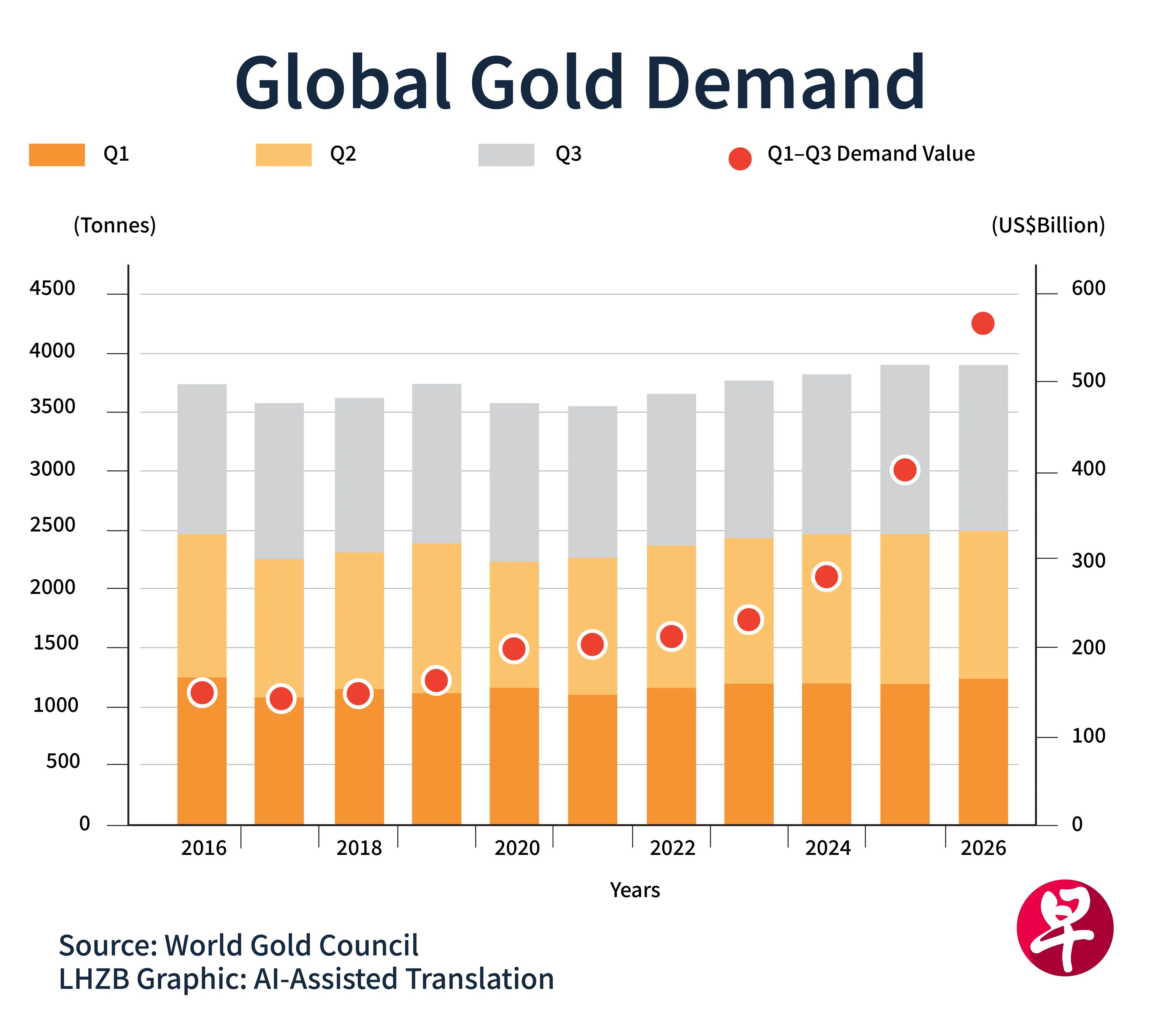
Total gold demand so far this year reached 3,881 tonnes, almost unchanged from last year's 3,884 tonnes. However, its value reached a record US$566 billion (about S$725 billion), far exceeding the figure for the same period last year.
Central banks were major gold buyers in the third quarter, with demand exceeding expectations. Their purchases accelerated in the second and third quarters as average quarterly gold prices eased from their first-quarter highs and price volatility declined.
The report noted that gold prices remained at historically high levels, indicating that long-term strategic considerations, such as asset allocation and risk management, continued to be the main drivers of demand.
Although total central bank demand in the third quarter was estimated at 321 tonnes, reported net gold purchases totalled 120 tonnes. The Chinese and Polish central banks accounted for 86% of those purchases, or 104 tonnes.
China's central bank accelerated its gold purchases in the third quarter, adding 63 tonnes to its holdings to become the quarter's largest central bank buyer.
Third-quarter gold jewellery consumption weakest in 26 years
Meanwhile, high gold prices led to a 13th consecutive quarter of year-on-year decline in global gold jewellery demand. Consumption fell 17% year on year to 313 tonnes in the third quarter, the weakest quarter since the third quarter of 2000.
China and India, major gold jewellery markets, recorded year-on-year declines in consumption of 22% and 20% respectively in the third quarter. However, consumption in both countries recovered from the second quarter.
High gold prices also prompted consumers in Europe, the US, ASEAN and other Asia-Pacific countries to switch to lighter jewellery with lower gold purity, further reducing demand by volume.
Investment demand, excluding OTC transactions, reached 479 tonnes, down 14% year on year. Demand for gold bars and coins also fell to a four-year low of just 268 tonnes.
However, global physically backed gold exchange-traded funds (ETFs) attracted inflows of 211 tonnes worth US$31 billion, bringing their gold holdings to a record 4,256 tonnes.
Electronics sector gold demand hits quarterly high in nearly a decade
Although gold demand declined in most sectors, industrial demand rose 3% year on year to 85 tonnes in the third quarter.
Strong AI-related investment in servers, data centres and high-performance computing offset continued weakness in mainstream consumer electronics. Gold demand from the electronics sector rose 5% to 72 tonnes, its highest quarterly level in nearly a decade.
The World Gold Council expects investment demand to be the main driver of growth in gold demand, with full-year investment demand projected to exceed last year's level by 200 tonnes. Fourth-quarter investment will be influenced by interest rates, bond yields and inflation expectations.
Gold jewellery demand is expected to remain weak, while technology demand is expected to remain relatively stable. Fourth-quarter demand is unlikely to deviate significantly from the trends established in the first three quarters.
