

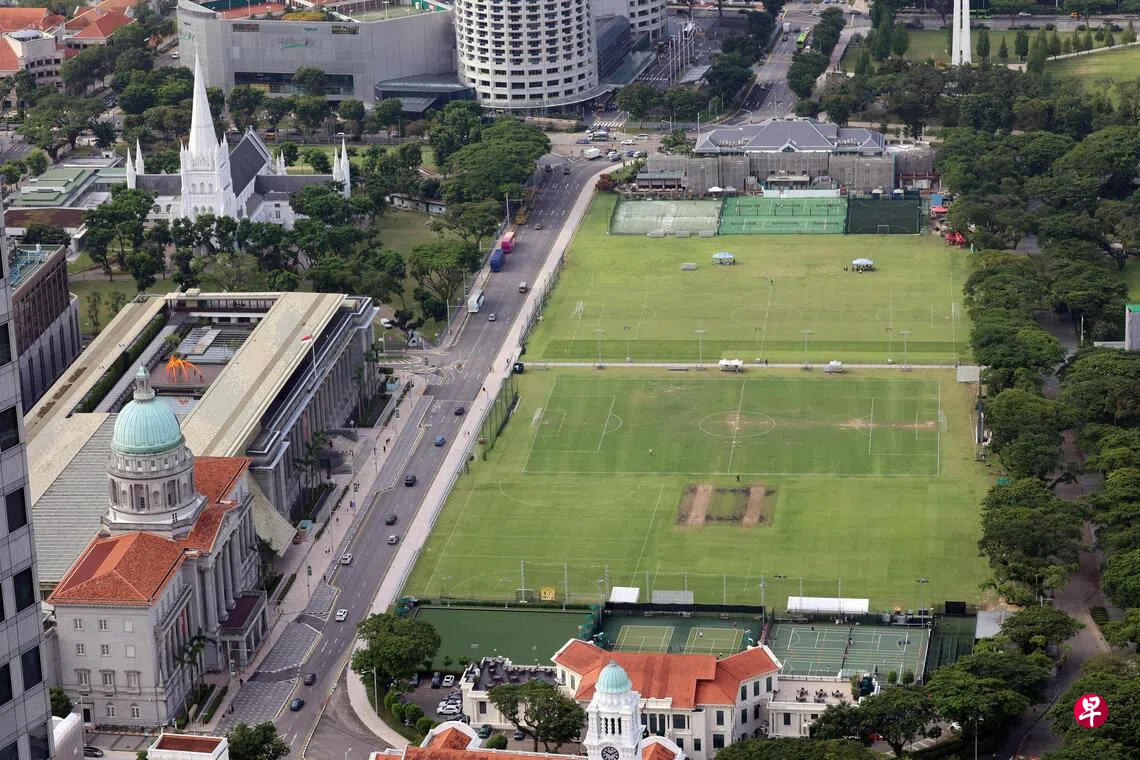
The National Heritage Board (NHB) announced on 3 November that it would no longer pursue UNESCO World Heritage status for the Padang and its surrounding historic buildings. Following a preliminary assessment, an international advisory body had recommended expanding the heritage buffer zone and imposing stricter safeguards on surrounding building development, the urban landscape and key sightlines. These requirements would affect future planning across a wider area of the city centre.
This decision raises a question that deserves closer discussion: when heritage conservation conflicts with flexibility in urban development, where should a city draw the line?
The Padang is no ordinary urban green space. Together with the many historic buildings surrounding it, it forms one of Singapore’s most important historic urban landscapes. In 2023, Singapore placed the area on its tentative list for World Heritage nomination. Beyond seeking international recognition, the bid was intended to convey Singapore’s historical transition from British colonial rule to independent nationhood through an intact historic setting. This is also what makes it most precious: the collective memory that underpins national identity.
However, the UNESCO advisory body’s preliminary assessment found that Singapore’s proposed buffer zone was insufficient. It called for a wider protected area and stricter management of surrounding development and key views. This means that conservation would also extend to the spatial relationships within a broader urban area. In future, even alterations to buildings or new projects outside the heritage site could require additional assessment and consultation if they might affect the historic landscape.
For Singapore, this clearly has implications for long-term land use and development. Expanding the heritage buffer zone would subject more buildings and land to additional development restrictions, while increasing the costs private owners face in renewing buildings and refurbishing properties.
The conservation obligations that come with World Heritage status are often long-term. NHB also considered the experience of Liverpool in the UK. Liverpool – Maritime Mercantile City was inscribed on the World Heritage List in 2004, but was delisted in 2021 after urban development damaged the site’s integrity.
Viewed from this perspective, Singapore’s decision not to proceed with the bid represents an institutional trade-off between international heritage conservation commitments and national autonomy in urban planning.
It is worth noting that urban development and cultural conservation need not be mutually exclusive.
The real question is whether urban development must come at the expense of the integrity of historic landscapes. Can a mature international city look beyond economic growth and establish more stable, predictable boundaries for protecting historic spaces? The point of the World Heritage system is precisely to remind countries that certain cultural values, once destroyed, cannot be recreated through new investment and construction.
There is also a cultural dimension to this bid that deserves attention.
The Padang and most of its surrounding buildings date from the British colonial period. Yet the central value Singapore put forward in its nomination was not simply the commemoration of colonial rule. Rather, it emphasised the juxtaposition of colonial-era and post-independence national institutions within the same urban space, bearing witness to decolonisation and the formation of a modern nation.
This reflects a mature view of history: a country need not preserve only the parts of its past that inspire pride. It should also be able to confront the complexity of its historical origins.
Colonial buildings can embody power structures, social stratification and historical tensions, while also bearing witness to how Singapore later transformed these spaces into part of its national culture and public life.
More significantly, the UNESCO advisory body also recommended that Singapore strengthen protection for some post-independence buildings. The Supreme Court building and Parliament House within the proposed heritage site lack corresponding legal protection. This shows that heritage conservation should not focus solely on old buildings left over from the colonial period. It should also consider which modern buildings and public spaces created since independence deserve to become the next generation’s heritage.
If a city protects only buildings already recognised as historic, without giving serious thought to the future cultural value of contemporary architecture, its heritage conservation system remains incomplete.
Without World Heritage status, public responsibility matters even more
With the bid abandoned, what truly deserves attention is how this historic space will continue to be protected.
World Heritage status is not the only proof of cultural value. Singapore already has a relatively mature system for protecting national monuments. The Padang itself has been gazetted as a national monument, and many important buildings around it are also protected.
But protecting individual buildings does not mean that the wider urban landscape is adequately safeguarded. A historic building may be preserved even as the surrounding skyline, open spaces, visual relationships and historic setting change. For a historic urban space such as the Padang, it is precisely the overall relationship between these buildings and their surroundings that needs protection.
Abandoning the World Heritage bid should therefore not be a reason to lower conservation standards. Singapore can still establish a clearer long-term conservation framework for its city centre through urban planning, historic landscape management, building conservation assessments and public participation.
Nor should cultural heritage be the responsibility of heritage conservation agencies alone. Museums, arts institutions, schools, community organisations and professional cultural groups can all contribute to historical research, public education and cultural activities, helping people understand why these spaces deserve to be preserved. This also calls for a renewed understanding of public value: cultural heritage is more than a tourism resource or a symbol of a city. It is a public asset that society collectively owns and has a responsibility to pass on.
Singapore is entirely entitled to choose not to make World Heritage status its conservation goal. But it must answer a more important question: without the additional constraints of an international framework, how will the country ensure that these historic spaces do not gradually lose their original value in future urban renewal?
A city’s capacity for development is reflected in how much new space it can create. Its cultural maturity is reflected in how much space it is willing to preserve for its irreplaceable history.
(The writer is chairman of the Asia Art Association in Singapore and founder of AAA Arts in London, UK.)
