

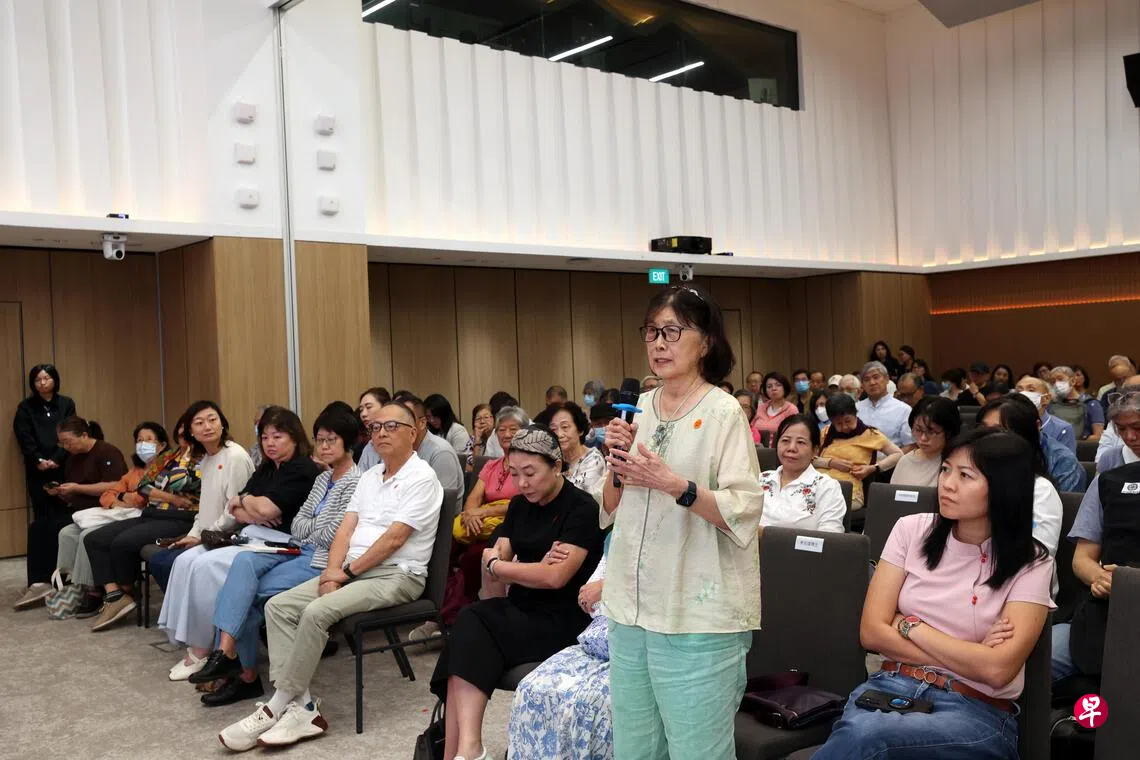
This October, I spoke at two events: an international Confucianism symposium, “Steadfast in Turbulent Times: Confucianism and Modern Society”, organised by the Nanyang Confucian Association; and a seminar, “Tan Kah Kee and Tan Lark Sye: Exemplars of Supporting Education through Business”, led by the Tan Kah Kee Foundation. Soon afterwards, I attended a forum organised by Lianhe Zaobao, “The Unfinished Journey of Chinese Singaporeans: A Discussion of Professor Eddie Kuo’s Singapore’s Path to Nation-Building”.
At the Confucianism symposium, I briefly discussed the Confucian movements launched by Singapore’s intellectuals and national leaders in the late 19th and late 20th centuries respectively, after they became alarmed by a cultural crisis. In explaining why the second movement had quietly petered out, I highlighted the changed cultural environment as an important factor. During the question-and-answer session, the crisis facing Chinese-language education and culture in Singapore became a major focus. Participants’ anxiety and concern were unmistakable.
After the symposium, several friends came forward to chat. One grandmother lamented that her grandson had no interest in written Chinese or spoken Mandarin, let alone learning about Chinese culture. She asked me what she should do.
After the talk on Tan Kah Kee and Tan Lark Sye, I had barely stepped down from the stage when, to my surprise, groups of new immigrants and students of different ages gathered around me. Our conversations left me with a strong sense of their keen interest in Singapore’s history and culture. A scholar from Xiamen said he knew about the contributions Tan Kah Kee and Tan Lark Sye had made to Xiamen University and Jimei School Village, and the standing they enjoyed there. But he had not known that they had also poured their fortunes into education and devoted themselves to passing on Chinese culture in Singapore, where they had made their wealth. Several young women told me they were trying lively, engaging ways of teaching Chinese culture; one even showed me pictures she was holding. That day, I felt heartened by the enthusiasm of so many new immigrants. Yet I was also a little disappointed: there were very few of the teenagers I had hoped to see at the venue, Hwa Chong Institution.
As the nation-building forum drew to a close, I spoke from the audience. I noted that Singapore was an immigrant society, and that immigration from China had been interrupted for many years between the 1950s and the 1980s. From the 1990s onwards, new immigrants from China arrived and formed a new community. This echoed the colonial-era encounter between the Babas — descendants of Chinese men and indigenous women — and the “sinkeh”, or newcomers, most of whom came from Fujian and Guangdong. As I spoke, the terms “new Babas” and “new sinkeh” slipped out. After the forum, several participants from universities came forward and told me that they and a group of friends had also attended the previous day’s talk on Tan Kah Kee and Tan Lark Sye. As we discussed nation-building, one new immigrant singled out his daughter’s “Singaporeanisation”: she did not like speaking Mandarin. His disappointment and helplessness were immediately apparent.
When the flurry of activity was over and I had a quiet moment, the terms “cultural crisis”, “new sinkeh” and “new Babas” kept coming to mind. I coined the latter two terms myself: the first appeared in one of my academic papers, while the second came to me on the spot that day. Whether the earlier “sinkeh” or the “new sinkeh”, these immigrants have either long since integrated into our island nation or are on their way to doing so, becoming Chinese Singaporeans and Singaporeans, and enriching Singapore Chinese culture. But was I being thoughtless in blurting out “new Babas”? Was I being disrespectful to the Babas?
History tells us that several outstanding locally born Chinese figures emerged in Singapore’s Chinese community in the 19th century. Most community leaders at the time came from the Baba community, including the now-familiar Tan Tock Seng, Tan Kim Seng and Gan Eng Seng. They undertook charitable work and helped maintain local order, earning widespread affection and respect. In those illustrious days, the Straits Chinese were proud to be called Babas. History also tells us that the forebears of Singapore’s Babas, who had migrated from China to Malacca and Penang, treasured Chinese culture. In the early years, they tried to send their sons back to China to study; later generations also hired private tutors to teach their sons Chinese characters, calligraphy and the classics. Chinese cultural traditions flourished in Singapore’s Baba community in the mid-19th century.
The Baba community launched the first speak Mandarin campaign and Confucian movement
However, as English-language education gained ground in Singapore, this cultural orientation changed, and parents began sending their children to English-medium schools. Baba families stopped using their mother tongue and grew distant from Chinese culture, retaining only many of the old customs. By the late 19th century, developments within the community were worrying its intellectuals. The physician Lim Boon Keng spoke bluntly: the Babas of his day lacked their forebears’ spirit, perseverance and competitive ability. They were poorly informed, spiritually empty and morally weakened, embracing individualism and hedonism. The scholar Tan Teck Soon lamented that although the Babas had once been well suited to commerce, they no longer made a serious effort to seize opportunities. As a result, internal trade across the colony had fallen almost entirely into the hands of the sinkeh.
When the Babas and sinkeh first encountered each other, they had worked closely together in business, building temples and establishing schools. They later grew apart, with widening differences in political outlook, social allegiance and cultural identity, and began to regard each other as outsiders. They traded accusations: the Babas resented the sinkeh for pursuing profits here while remaining loyal to China, while the sinkeh looked down on the Babas for forgetting their mother tongue and becoming “barbarians”. Over time, within the sinkeh community, “Baba” became a derogatory label, carrying the sneering implication that they had abandoned their culture for foreign ways.
Fortunately, the Baba community had no shortage of learned, far-sighted intellectuals versed in both Chinese and English language and culture, among them Lim Boon Keng, Tan Teck Soon, Ong Soon Tee, Tan Boo Liat and Wee Hean Boon. They had long recognised their community’s rapid decline and were troubled by its loss of its mother tongue and estrangement from its ancestral culture. Lim stressed that language and culture were bound up with a people’s rise, decline and survival. Losing one’s mother tongue meant losing one’s history and traditional culture, leaving a community like a tree severed from its roots, destined to wither and decay.
They therefore launched Singapore’s first speak Mandarin campaign and Confucian movement. We call them the first because, a century later, founding Prime Minister Lee Kuan Yew launched another, long-running Speak Mandarin Campaign and a Confucian movement that consumed considerable manpower and resources. Lee voiced an anxiety similar to that of a century earlier: “A person who gets deculturalised... loses his self-confidence... But I will never be an Englishman in a thousand generations and I have not got the Western value system inside; mine is an Eastern value system.” (1978)
As times changed and society developed, the Baba community long ago became part of mainstream Chinese Singaporean society. Its outstanding intellectuals and political leaders are still respected and fondly remembered by Singaporeans. Baba culture is also treasured and preserved here. Across its three storeys, Singapore’s Peranakan Museum displays fascinating Baba and Nyonya artefacts, alongside vivid stories, customs and rituals.
Yet even today, our forebears’ fear of losing their roots seems never to have left Chinese Singaporeans concerned about the qualities of our citizenry. Even today, we often hear members of the older generation use “Baba” to describe fellow Chinese who neither speak their mother tongue nor read Chinese. Perhaps that is why “new Babas” slipped out of my mouth in the SPH News Centre Auditorium; why the moderator and speakers on stage at the Hwa Chong Cultural Centre Theatre kept looking for locally born and bred teenagers in the audience; why, after the symposium, the grandmother waited patiently for me to turn around before asking what she should do about her grandson’s lack of interest in Chinese and Mandarin; and why, after the talk, a new immigrant spoke candidly about his anxiety over his daughter’s “Singaporeanisation”.
Looking back over a century, and then at the present, might we find valuable lessons in how our forebears lost, sought and protected their roots more than a hundred years ago?
(The author is a historian.)
