

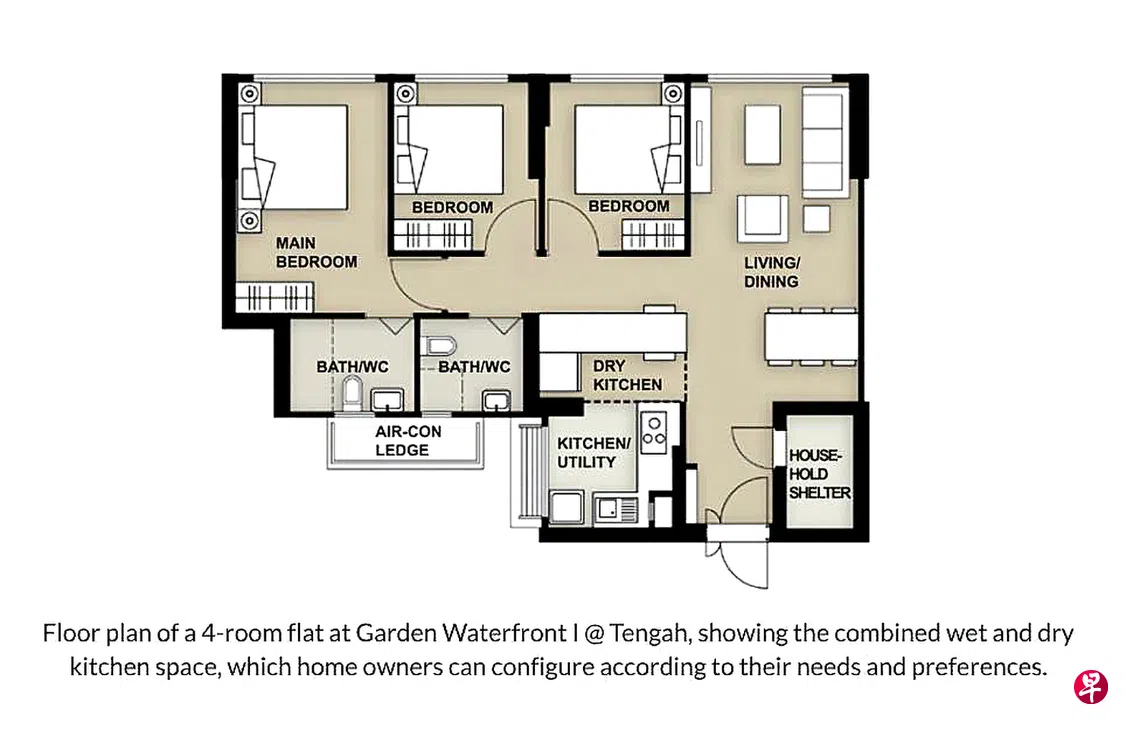
The kitchens in HDB flats at Garden Waterfront I in Tengah have recently become an online talking point. A renovation contractor posted a video criticising the “small” kitchen, calling its layout and dimensions unreasonable and describing it as “one of the worst four-room flat kitchen layouts” he had seen.
The Housing & Development Board (HDB) explained that what viewers saw was only the wet kitchen. There is an adjoining dry kitchen, and together they occupy about 10 square metres — comparable to a standard kitchen with a service yard in newer HDB flats.
The response is unassailable, because the square metre is the neatest unit in the language of administration: it can be calculated, compared and entered into an annual report. In Seeing Like a State (《国家的视角》), American political scientist James C Scott observed that states make sense of the world by first reducing complex realities to “legible”, quantifiable indicators.
A patchwork of fields becomes “area”; a thriving forest is converted into “cubic metres” of timber. Numbers are clear and easy to understand. The price is that everything in reality that resists measurement is left out.
What is a kitchen? It is not ten one-square-metre boxes, but a flow of movement: from fridge to sink, sink to hob, hob to dining table, with room for a person’s elbows as they turn. French philosopher Henri Lefebvre drew a clear distinction between the “conceived space” on a planner’s drawings and the “lived space” created by someone moving around with a spatula in hand.
HDB is answering in terms of the former; residents are asking about the latter. The two sides are talking past each other, and a 10-square-metre maths problem has suddenly become a dialogue at cross purposes.
Then there is the service yard that has disappeared. In traditional HDB flats, this is where laundry is hung, cleaning supplies are stored and the washing machine sits, sometimes with a dryer stacked on top. It is an unassuming but indispensable corner. Those functions have not been abolished; the wet kitchen must now perform them too.
HDB’s floor plan labels the space “wet kitchen/service yard”, meaning that cooking and laundry must take turns in the same narrow space. The washing machine takes up another portion, presumably leaving food preparation, washing-up and storage to squeeze into whatever gaps remain.
Crisp manufacturers never announce price rises. Instead, one day, a consumer sitting on the sofa watching TV may open a bag and discover that there “seem” to be a few crisps fewer inside. That is the essence of “shrinkflation”. Even an extra island counter in the dry kitchen cannot fully compensate for the vanished service yard. The floor area remains unchanged, but utility is quietly lost in the layout. Nobody is lying, because the numbers themselves are true.
More subtle still is the cultural mismatch. Open-plan kitchens emerged from a culture of oven cooking and light meals, where cooking fumes are the exception. Here, whatever the household’s ethnicity, fumes are part of everyday cooking: Once the wok starts sizzling, smoke and aromas rise.
It is not impossible to apply the spatial logic of the former to the lives of the latter. But it calls for honest design, rather than simply borrowing the look and fashionable appeal of modern kitchens and assuming that most people live that way.
To be fair, HDB has a point too. Times are changing. Many households cook only a handful of times a year, and an open-plan layout suits them perfectly. There is nothing wrong with “flexibility” itself. The real question is this: are buyers informed before they make their choice?
This is no small matter, because HDB flats in Singapore have never been merely a commodity. Home ownership is one of the foundations of this society’s stability. HDB is both a developer and a guardian of equity when it comes to housing.
More than 80% of citizens commit half a lifetime’s Central Provident Fund savings to a flat. What they receive in return is not just shelter, but the assurance that “the state will treat me fairly”. Trust is built on more than floor area; it is sustained by attention to detail. Buyers of private property are expected to shop around and bear the financial consequences of their choices. Public housing, however, is a compact between the state and its citizens. Its terms should be clearer than an advertisement.
The real solution, then, is not to keep arguing over floor area, but to make information about usable space more transparent. HDB could mark the actual width of passageways on floor plans after allowing for appliances, and demonstrate exactly how laundry and cooking can coexist along the same route. This would let buyers judge what they will actually get before signing a contract. Otherwise, by the time they move in and suddenly discover that their measuring tape is not, after all, the same as HDB’s, it will be too late.
One contractor’s video cannot erase HDB’s contributions over the years. But rather than dismissing the debate as a fuss over a “small” kitchen, we should recognise it as an argument over how to measure a home. What matters is not just its floor area, but whether people can live in it comfortably and go about their daily routines with ease. As for the assertion that “the space has not shrunk”, perhaps that belongs only in a maths textbook.
(The author is a senior multimedia editor at Lianhe Zaobao.)
