

Had the late Qing dynasty not abolished the imperial examinations, or had the system limped on for a few more years, Singapore would not have had a defence scientist and technological university president named Su Guaning.
The story begins with Su’s grandfather.
Xu Zongchun was born in 1889 in a remote and impoverished village in Dehua, Fujian. At seven, he was fortunate enough to enter a traditional private school. Over the next ten years, he mastered the Four Books and Five Classics, along with Zhu Xi’s collected commentaries, which were essential reading for the imperial examinations. He passed the county and prefectural examinations, progressing steadily towards the scholarly ideal of entering official service through academic excellence.
But in 1905, the declining Qing dynasty was forced to abolish the imperial examination system, which had endured for more than 1,300 years. Some welcomed the change and others despaired. For Xu, it was a bolt from the blue, shattering his childhood dream of studying his way to official rank and distinction.
What seemed a calamity proved to be a blessing. This was the great turning point in Xu’s life. He redirected his ambitions towards education and boldly ventured to Southeast Asia to raise funds for schools. Arriving in Tangkak, Johor, to seek donations, he began taking in students and working as a tutor.
He later returned to his hometown in Fujian to bring his family to the Malay Peninsula, where he taught and served as a school principal in several places.
The end of the imperial examinations gave Xu a historic opportunity, paving the way for the remarkable opportunities that would later arise in Su Guaning’s life.
Had Xu been able to sit the imperial examinations and taken a different path, his family’s destiny would have been rewritten. That, in turn, might have affected Singapore. Fate is a curious thing.
Fortunately, history has no “ifs”!
Most of the southern Chinese who migrated to Southeast Asia in large numbers from the late 19th to the early 20th century were fleeing natural disasters, human calamities and political turmoil. Those like Xu, who arrived with considerable learning and lofty ideals, were a minority.
Born in Taiwan, Su came from a family with a strong scholarly tradition. His father, Xu Qili, was also an outstanding student, earning a degree in electrical engineering in Xiamen. When Su joined Singapore’s Institution of Engineers in 1977, he and his father became its only father-and-son pair.
All this is recorded in Opportunities, the recently published biography of the former president of Singapore’s Nanyang Technological University (NTU). Opening with a detailed account of Su’s family history, it is an inspiring story of learning and values passed down through the generations.
This substantial work, which my former Lianhe Zaobao (LHZB) colleague Phua Sin Hua spent several years writing, traces not only Su’s upbringing and endeavours but also the development of Singapore’s defence technology and the evolution of NTU throughout his lifetime. These two strands of his career followed one another almost seamlessly — a natural progression for Su.
If we judge the book by its title alone, Opportunities might seem to be merely the story of a lucky man. Yet Su’s success did not rest on chance alone. He was particularly adept at creating opportunities, smoothing the path for those who followed.
An opportunity may arise through a chance encounter. If someone keeps stumbling upon opportunities, that merely makes him lucky. But if, at every turning point, he meets someone who recognises his talent, he must have exceptional qualities beyond simply being an outstanding student who excels at examinations.
From the start of his career in 1972 to his retirement in 2011, Su rose steadily from an electrical engineer at the Ministry of Defence. His career reached one high point after another: director of the Defence Science Organisation (DSO), chief executive of DSO National Laboratories, chief executive of the Defence Science and Technology Agency, adjunct professor at the National University of Singapore, and president of NTU.
In 2003, when he was 53, Su left his familiar field of defence technology to become president of NTU. On 26 July that year, at a lecture organised by the Tan Kah Kee International Society and the Tan Kah Kee Foundation, he gave a speech titled “From Nanyang University to Nanyang Technological University — Chinese-language education in retrospect and prospect”.
During this speech, Su said: “Nanyang University was first drawn into political struggles. Later, unable to adapt to the demands of an era in which multinational companies needed employees with a command of English, it lost the battle. This was the outcome of Singapore’s overall economic transformation, in which pragmatism prevailed over traditional culture.”
The book Opportunities quotes several other important passages from this speech, which captured the significance of its times. Reading them again more than 20 years later helps us understand why, when he abruptly changed career paths, he regarded the NTU presidency as the most important undertaking of his life.
Su arrived at Yunnan Garden in 2003 and proceeded to steer NTU through turbulent waters. His state of mind over those eight and a half years was also “like wandering among Huangshan’s extraordinary peaks and rocks, experiencing the joys and hardships of climbing what seemed like ladders to heaven. Scaling one peak after another, the ascents and descents alike left him breathless. Only at the summit did he feel a fleeting, inexplicable sense of release, yet still yearned for more.”
During his stint of over eight years at NTU, the university successfully reformed and transformed itself.
Restoring the Nanyang University name was one of Su’s priorities as president, yet he ultimately failed to do so, falling just short of success. Though this may have been a source of regret, his wholehearted efforts were plain for all to see.
The restoration of the name should have followed naturally as circumstances fell into place. In the end, it did not happen, and the book offers no answer as to the real reason.
Today, Nanyang Technological University has long been commonly shortened in Chinese to “Nanda”, although not everyone from the former Nanyang University is comfortable with this, as the reference harkens to a Nanyang University that no longer exists.
I still prefer to call today’s university NTU. Through its world rankings, NTU has established a name Singaporeans can be proud of, developing from a teaching university into a research university.
The university before its rebirth may be called the old Nanda, but there is no need to call today’s institution the “new Nanda”.
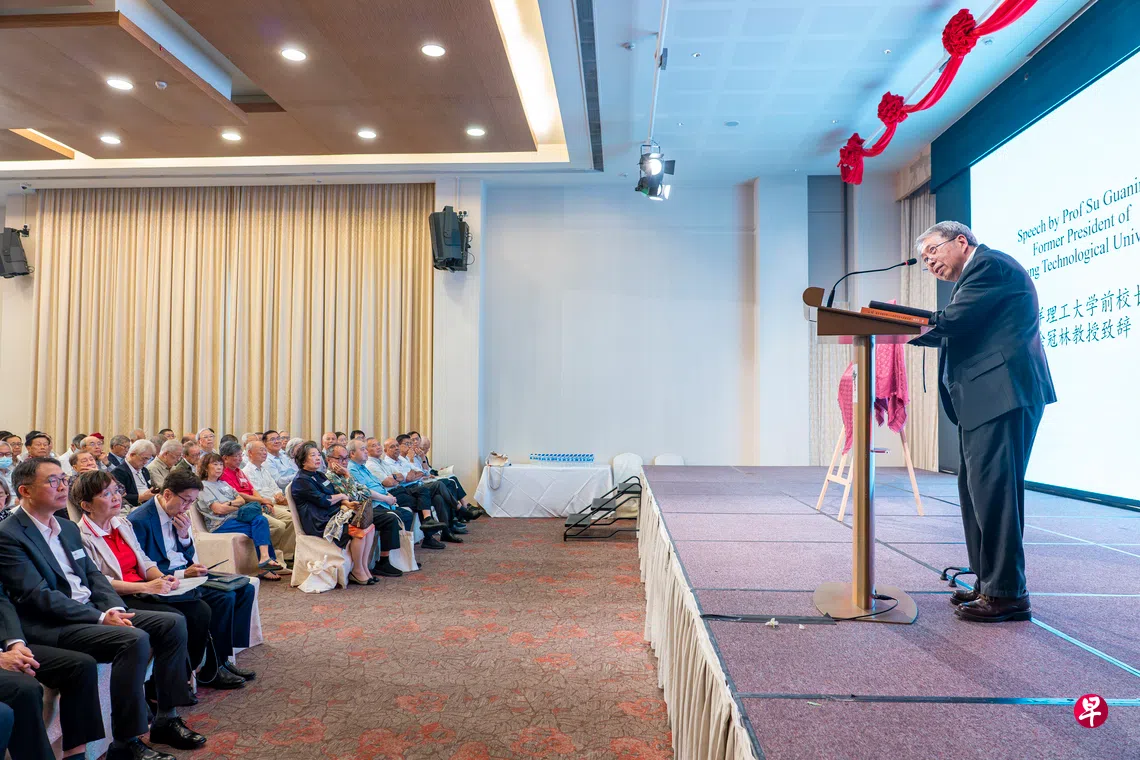
At the book launch on 16 October, the 76-year-old Su was overcome with emotion as he spoke, with still more to say. His concern for the future of the Chinese language in Singapore was unmistakable.
It was painful to watch his frail figure standing through a speech lasting dozens of minutes. Thankfully, he was helped back to his seat in time. It was a moving scene that inspired admiration. Resolute yet tender-hearted throughout his life, Su Guaning remains unmistakably himself!
A century ago, upheaval unexpectedly brought Su’s grandfather to Southeast Asia to work in education, including as a school principal. A century later, Su retired as a university president. Was it opportunity, or destiny?
Someone like Su — versed in both Chinese and Western learning, with a family background spanning mainland China, Taiwan and the Malay Peninsula, who made his mark on this small island of Singapore — could not be replicated in a new era. Su Guaning’s “opportunities” were, in truth, Singapore’s opportunities.
(The author is a contributing commentator for Lianhe Zaobao.)
