

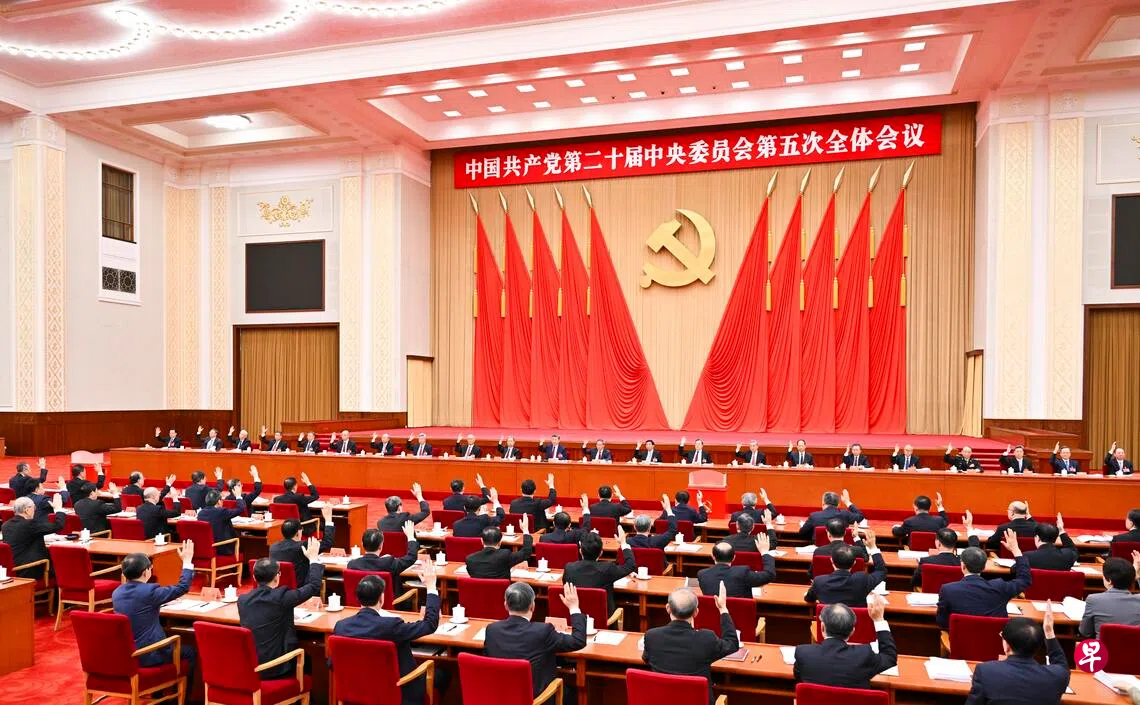
A communique from the Chinese Communist Party (CCP) fifth plenum announced disciplinary action against 34 full and alternate Central Committee members, and the promotion of 10 alternate members to full membership in order of precedence. They include rising stars born in the 1970s, such as Shanxi Governor Lu Dongliang and Zhejiang Governor Liu Jie. The plenum also confirmed for the first time that Liu Jianchao, the former head of the party’s International Department whose status had long gone unaddressed in official announcements, had been expelled from the party for serious violations of discipline and the law.
The fifth plenum of the CCP’s 20th Central Committee concluded in Beijing on Thursday (29 October). According to the communique released that day, the 10 members promoted to full membership were Lu Dongliang, 53; Inner Mongolia Autonomous Region Chairman Bao Gang, 57; Shaanxi Deputy Party Secretary Xing Shanping, 58; China Daily President and Chief Editor Qu Yingpu, 61; China Datang Corporation Chairman Lyu Jun, 59; Ningxia Hui Autonomous Region Political and Legal Affairs Commission Secretary Zhu Tianshu, 58; Jilin Provincial Committee of the Chinese People’s Political Consultative Conference Chairman Zhu Guoxian, 62; Industrial and Commercial Bank of China President Liu Jun, 54; Liu Jie, 56; and Jinan Party Secretary Liu Qiang, 55.
Based on the original ranking of alternate Central Committee members elected at the 20th Party Congress, five people were passed over in this round of promotions: People’s Armed Police Deputy Commander Fu Wenhua; Development Research Centre of the State Council Deputy Director Cong Liang; Ji Lin, former chairman of the Beijing Municipal Committee of the Chinese People’s Political Consultative Conference and former party leadership group secretary of the Central Institute of Socialism; People’s Armed Police Lieutenant-General Zhu Wenxiang; and central bank Deputy Governor and State Administration of Foreign Exchange Director Zhu Hexin. Fu Wenhua and Zhu Wenxiang are from the military, while Zhu Hexin has extensive experience in finance.
Hung Yao-nan, director of the Centre for Cross-Strait Relations at Taiwan’s Tamkang University, told Lianhe Zaobao (LHZB) that the promotions followed the original order of precedence. What mattered more, he said, were the officials’ current posts and the broader personnel arrangements. Seven of the 10 promoted members were born between 1968 and 1973, with Lu Dongliang the youngest full Central Committee member. Seven hold posts in local government, with Lu Dongliang, Bao Gang and Liu Jie heading provincial-level governments.
Following this round of changes, the number of full members of the 20th Central Committee born in the 1970s has risen to five: Guangxi Zhuang Autonomous Region Chairman Wei Tao, who was promoted at the fourth plenum, as well as Liu Jie, Lu Dongliang, Liu Qiang and Liu Jun.
Hung said gaining full membership ahead of time strengthened the younger generation’s prospects for promotion at next year’s 21st Party Congress. He expects the next Central Committee to consist mainly of a new generation born in the 1970s, officials with proven records in local governance, and trusted replacements appointed after the purges. “In other words, the next Central Committee will be characterised by youth, experience leading at the local level, and loyalty tested through the purges.”
Tzeng Wei-feng, an associate research fellow at the Institute of International Relations at Taiwan’s National Chengchi University, also said the recent wave of local personnel changes was geared towards the 21st Party Congress. Some leading officials born in the 1970s with anti-graft backgrounds or who were parachuted in from the central government enjoyed greater trust. As the anti-corruption campaign deepens, officials with extensive grassroots experience but without entrenched factional ties could not only enter the Central Committee, but even advance to the Politburo.
On the five officials passed over, Hung said they might be under investigation or might have lost their eligibility. However, this alone does not establish that they were in trouble. Subsequent developments to watch included whether they are removed from office, absent from official activities or named in disciplinary inspection announcements.
According to a 27 October report on the State Administration of Foreign Exchange’s website, Zhu Hexin had recently met foreign visitors. Asia Society Policy Institute research assistant Shengyu Wang told LHZB that the CCP leadership might have opted not to promote Zhu to full Central Committee membership to maintain a balance in the hierarchy. Central bank Governor Pan Gongsheng is neither a full nor an alternate Central Committee member. Promoting his deputy Zhu Hexin to full membership “could, to some extent, be detrimental to unity within the financial system”.
Hung said that, taken together, the list of alternate members passed over and the disciplinary list suggested the CCP leadership’s anti-corruption campaign covered at least four areas: the military and armed police (Fu Wenhua and Zhu Wenxiang), finance (former China Securities Regulatory Commission Chairman Yi Huiman and former National Financial Regulatory Administration head Li Yunze), think tanks (Cong Liang), and the united front system (Ji Lin).
The fifth plenum also announced disciplinary action against 34 full and alternate Central Committee members. Hung said this was the largest number disciplined at a single Central Committee plenum since the end of the Cultural Revolution.
Of these, 33 were expelled from the party: 24 full members, including former Politburo members Ma Xingrui and Zhang Youxia, and former PLA National Defence University Political Commissar Zhong Shaojun, as well as nine alternate members. Li Yunze was removed from his party posts but was not expelled from the party.
Besides Liu Jianchao, the non-military officials expelled from the party whose investigations had not previously been officially announced included former Minister of Industry and Information Technology Jin Zhuanglong, former executive deputy director of the Office of the Central Commission for Integrated Military and Civilian Development Lei Fanpei, and former China National Nuclear Corporation Chairman Yu Jianfeng.
The plenum confirmed disciplinary action against 24 full Central Committee members, but promoted only 10 alternate members to full membership. Hung identified three reasons why the vacancies were not fully filled. First, there were too few eligible candidates. Second, the military purge was extensive, with military officials accounting for 15 of the 24 full members disciplined. Third, with only a year until the 21st Party Congress, temporary vacancies in the Central Committee would not affect its operations; it would instead allow personnel arrangements to be reconsidered at the leadership transition.
Hung said this followed the same logic as leaving the Central Military Commission short of its full membership for an extended period. It reflected Beijing’s current preference for retaining vacancies rather than appointing candidates who had not been sufficiently vetted, demonstrating a “principle of prioritising controllability” in personnel arrangements.
