

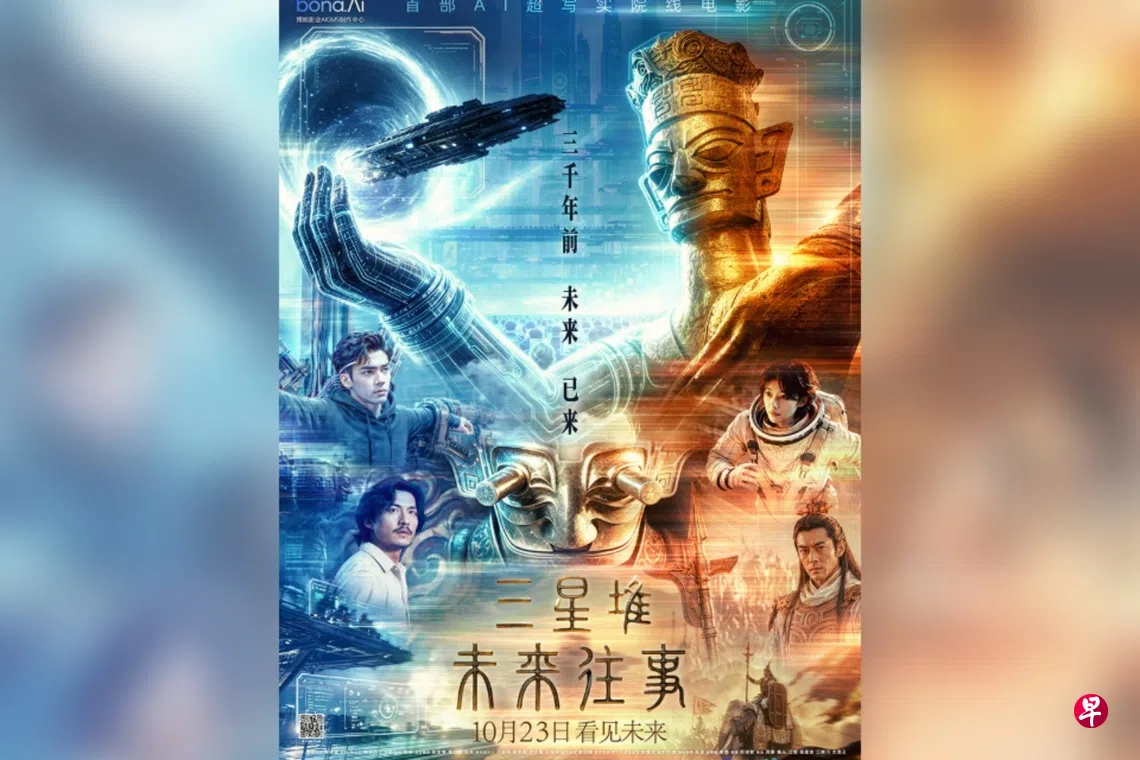
China’s first artificial intelligence (AI) film to receive a public screening permit from the China Film Administration, Sanxingdui: Future Past, opened on Friday (23 October) to a muted box office response. As of Sunday (25 October), it had earned just 900,000 yuan (S$170,000), far below its production cost of more than 10 million yuan.
According to reports by Xinhua, The Beijing News and AFP, the roughly 100-minute science-fiction animated film was produced by companies including Boyue Xingji Lantu, with technical support from Vidu, an AI video generation platform owned by Shengshu Technology.
Drawing on the ancient Shu civilisation at Sanxingdui in Sichuan, the film tells the story of a future in which humanity’s overreliance on AI triggers a global crisis. The key to resolving it must be sought in the ancient Shu civilisation of more than 3,000 years ago.
A production team of nearly 100 people spent two years generating more than 1.2 million base images and revising the film more than 100 times. The work included AI character generation, scene construction and shot rendering, but humans remained in charge of creative concepts and artistic decisions.
The film’s producer, Quji Xiaojiang, said it cost more than 10 million yuan to make. A live-action version could have cost 800 million to 900 million yuan.
The film had nearly 11,000 screenings nationwide on its opening day, but advance ticket sales totalled only about 140,000 yuan. Data from Maoyan Pro showed that its cumulative box office takings stood at just 900,000 yuan as of 10am on Sunday. When an AFP reporter attended a screening in Beijing on Friday, there were only four viewers.
One woman who attended a free preview said frankly: “If AI generation can match the theatrical experience of the movie Avatar, I think I would be willing to pay for it.” But at its current level of quality, she would not pay for a ticket.
Bona Film Group chief executive officer Jiang Defu acknowledged the muted market response but stressed that the film was a groundbreaking experiment.
AI-generated videos have rapidly gained popularity in China in recent years. AI-generated short dramas on Douyin alone drew more than 200 billion views in September, while companies including ByteDance and iQIYI are moving into AI film and television production. But independent AI film director Zhang Jun said: “The audience won't automatically pay for the tickets just because it's an AI-generated film.”
Liu Haibo, a professor at Shanghai University’s Shanghai Film Academy, attributed the muted market response to several factors, including the limited appeal of AI-generated imagery to ordinary viewers, the lack of well-known actors and insufficient publicity and promotion.
