

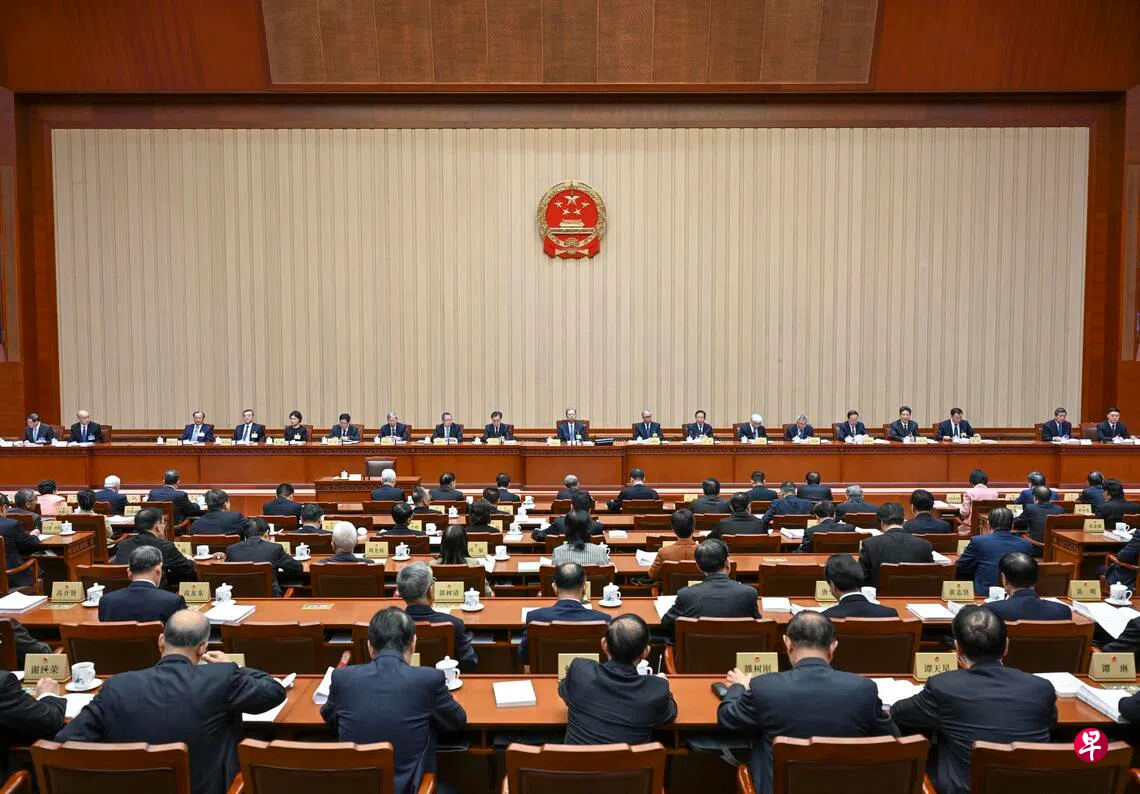
China’s National People’s Congress Standing Committee voted on Friday (6 November) to pass the Cross-Border Anti-Corruption Law. As the country’s first law specifically targeting cross-border corruption, it aims to prevent and punish such offences and deepen international anti-corruption cooperation. It provides a legal basis for investigating cases, pursuing fugitives and recovering illicit assets overseas, as well as conducting international law enforcement and judicial cooperation. Comprising 47 articles across six chapters, the new law takes effect upon promulgation.
According to work reports delivered at the fourth and fifth plenary sessions of the Chinese Communist Party’s 20th Central Commission for Discipline Inspection (CCDI), China opened investigations into 505 cross-border corruption cases in 2025, up about 40.3% from 360 in 2024. “Operation Sky Net 2025” and a special campaign to recover overseas assets and losses linked to duty-related crimes brought back a total of 963 fugitives.
Academics interviewed said the new law could deter public officials seeking to transfer corrupt proceeds overseas. One predicted a possible “major wave of efforts to recover funds linked to fugitives”.
Under a previously published draft, cross-border corruption covers five categories of conduct: domestic entities or individuals bribing foreign public officials or officials of public international organisations; overseas entities or individuals bribing Chinese public officials, closely related persons, state organs, state-owned enterprises and other bodies; domestic entities or individuals committing embezzlement, bribery, abuse of power or improper transfers of benefits overseas; similar corrupt acts committed partly overseas with consequences in China; and the flight abroad of people suspected of corruption or the cross-border transfer of corrupt assets.
The draft proposed an inter-agency mechanism led by the National Supervisory Commission (NSC) to coordinate anti-corruption work across the relevant departments. Without the consent of the relevant Chinese authorities, overseas institutions, organisations and individuals may not independently conduct cross-border corruption investigations or other law enforcement activities in China. Additionally, domestic institutions and individuals may not provide related evidence or assistance overseas without authorisation.
The new law also stresses adherence to a holistic approach to national security. It requires the relevant authorities and their staff to protect, in accordance with the law, state secrets, work-related secrets, commercial secrets, personal privacy and personal information obtained during oversight and investigations.
Cross-border corruption involves offshore companies and overseas accounts, making tracing and evidence collection more difficult. The documentary Not a Moment’s Pause, Not a Step Back, broadcast by the CCDI and NSC in January this year, revealed that former China National Offshore Oil Corporation General Manager Li Yong had arranged for businessman Ren Fengde to set up offshore companies and accounts to transfer illicit funds. More than 83% of the illicit funds in the case came from overseas, and investigators had to gather evidence in 10 countries and regions.
According to Jiemian News, Peng Xinlin, a professor at Beijing Normal University and a standing council member of the CHINA Against Corruption Law Association, an association studying integrity and the rule of law, said provisions on cross-border anti-corruption efforts had previously been scattered across laws including the Supervision Law, Criminal Procedure Law, Extradition Law, International Criminal Judicial Assistance Law and Anti-Money Laundering Law. There was no unified framework, resulting in less-than-smooth coordination between departments, the transfer of investigative leads, and overseas fugitive and asset recovery.
Peng Xinlin said the new law would not replace existing legislation, but would “integrate provisions, fill gaps and ensure coordination”, addressing the problem of “multiple sets of rules without an overarching framework”. However, differences between countries in how corruption is defined, rules of evidence and judicial procedures could affect extradition, legal assistance, and the collection and admissibility of overseas evidence. Domestic legislation cannot remove all obstacles to cross-border judicial cooperation, but it can help unify domestic arrangements and provide a legal basis for international cooperation.
The draft proposed stronger oversight of public officials who acquire foreign citizenship, overseas permanent residency or long-term residence permits in breach of regulations. It also called for improvements to reporting requirements for overseas deposits and investments, alongside early-warning and intervention mechanisms to prevent people from fleeing abroad and corrupt assets from being transferred across borders.
On corporate compliance, the draft requires companies operating across borders to establish integrity and compliance systems, identify and assess risks, and conduct due diligence on and monitor third parties. The second-reading draft further specified that domestic companies should appoint integrity and compliance staff or establish dedicated departments according to their size, scope of business and risk prevention needs. Peng Xinlin said the new law also covers foreign companies with branches or subsidiaries in China. Chinese companies operating overseas, meanwhile, face challenges including high costs for third-party due diligence and monitoring, and difficulty obtaining information.
Peng Peng, executive chairman of the Guangdong Society of Reform, told Lianhe Zaobao (LHZB) that enshrining compliance requirements in law would raise the cost of overseas expansion for Chinese companies, particularly private firms and small and medium-sized enterprises. Local governments are also providing support to prevent compliance risks from deterring investment. Guangzhou, for example, has set up several “overseas interests protection centres” that bring together domestic and overseas legal resources to serve businesses. They recently helped resolve an investment dispute involving Xpeng in South America.
Peng Peng believed stronger reporting requirements for overseas deposits and investments, monitoring of cross-border funds and early warnings of asset transfers could deter public officials seeking to move corrupt proceeds abroad. He predicted a possible “fairly major wave of efforts to recover funds linked to fugitives”, adding that this also reflected the seriousness of capital flight. If countries harbouring those involved are unwilling to cooperate in freezing or returning assets, China would have to consider legal, political and economic means. It could also seek cooperation through bilateral judicial assistance agreements and multilateral mechanisms, starting with countries along the Belt and Road and neighbouring countries.
