

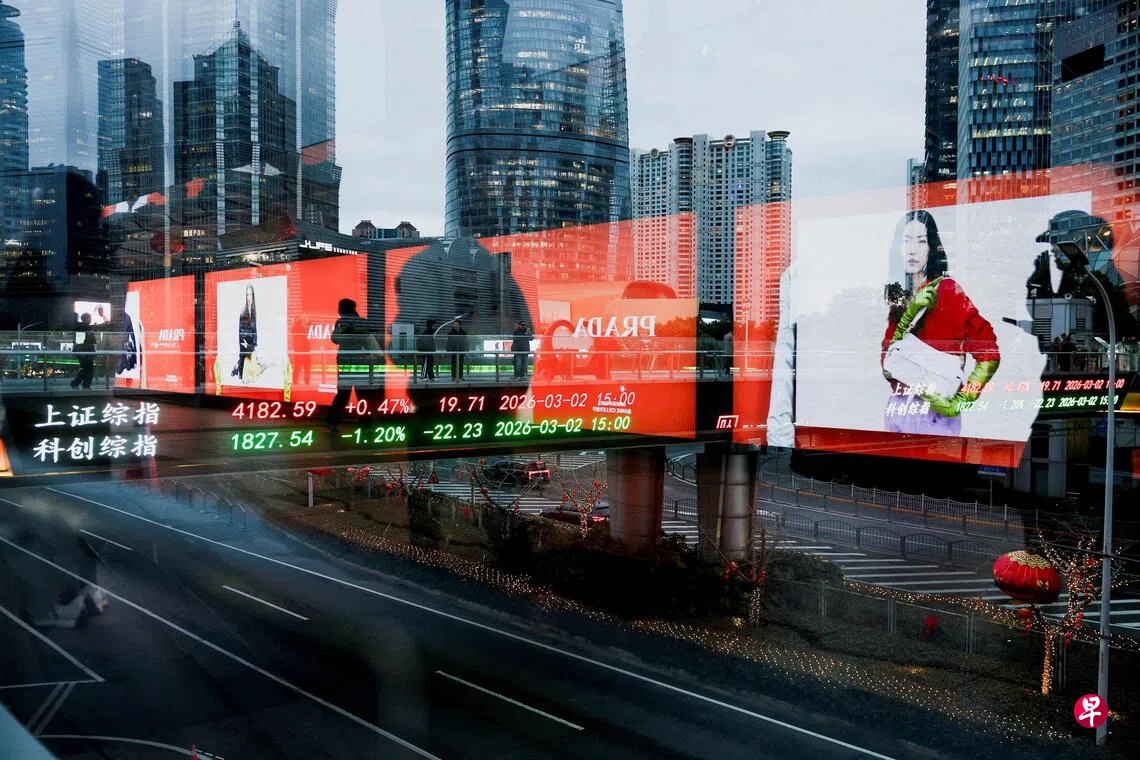
China’s A-shares have fallen again. But this time, they are not alone.
Asian stock markets took a collective plunge on the final trading day of the week. Yet compared with the 6% plunge in Japanese and South Korean stocks on Friday (6 November), China’s benchmark CSI 300 Index fared relatively well, closing down 1.44%.
The market turbulence was triggered by a sell-off in Wall Street technology stocks the previous evening. The Nasdaq fell 5.5% on Thursday (5 November), its biggest one-day decline in 18 months. This was largely driven by investor concerns that the US Democratic Party’s sweeping victory in the midterm elections could lead to tighter regulation of the artificial intelligence (AI) industry, particularly restrictions on data centre expansion. That, in turn, could dampen expectations for demand for advanced chips and related equipment.
The STAR 50 Index, which includes several leading Chinese AI and semiconductor stocks, closed 2.6% lower on Friday. Even before that, it had plunged nearly 30% over the previous three months. In other words, the AI-driven stock market boom had already begun to cool in China.
This AI boom can be traced back to early last year, when Chinese AI company DeepSeek burst onto the scene with its large language model, fuelling a technology stock rally. Global hedge funds poured into the Chinese market at an accelerating pace, adding more than US$1.3 trillion (S$1.67 trillion) to the combined market value of Chinese stocks traded onshore and offshore within a month.
AI quickly became one of the hottest investment themes in China’s capital markets. From large AI models and chips to data centres and humanoid robots, a host of related companies rode the AI boom and became investor favourites.
Ahead of Chinese New Year this year, technology giant ByteDance launched its AI video generation model Seedance 2.0, sparking another AI-led rally in A-shares. Several related stocks hit their daily upper trading limits for consecutive days. Around the same time, large AI model developers Z.AI (previously known as Zhipu AI) and MiniMax listed in Hong Kong to an enthusiastic reception, setting off a rush by AI companies to go public.
Investment bank Goldman Sachs estimates that AI-related stocks now account for 42% of the total market capitalisation of Chinese equities, and an even higher 57% of total turnover in A-shares and Hong Kong-listed H-shares.
In July this year, Chinese memory chip giant ChangXin Memory Technologies surged more than 460% on its trading debut. Its market value rose to 3.27 trillion yuan (S$630 billion), overtaking the Industrial and Commercial Bank of China (ICBC) to become the most valuable A-share company. Less than a month later, Unitree Robotics, billed as the first humanoid robot stock, saw its initial public offering (IPO) oversubscribed by retail investors by as much as 8,000 times, pushing the AI boom to a peak.
By Friday’s close, however, Unitree’s share price had fallen 22% from its debut-day level, while ChangXin’s valuation had shrunk by nearly a quarter over the past month. Chipmaker Moore Threads, which surged 400% on its first day of trading last December, is now trading at just half that level.
Analysts note that against a broader backdrop of growing global scepticism over returns on AI investment, the early cooling of China’s tech stock rally has also been driven by other factors. For example, Chinese AI-related stocks are overvalued overall; even after its steep decline, the STAR 50 still trades at a price-to-earnings ratio of about 100, far above the Nasdaq 100’s 30.
In addition, the US, China’s main competitor in AI, is simultaneously imposing restrictions on Chinese companies on both the supply and demand sides, raising investor concerns about the industry’s prospects.
The weak performance of AI stocks has prompted investors to switch to defensive assets, deepening the technology sector’s rout. To maintain liquidity in the sluggish market, regulators have tightened controls on corporate listings. Under the twin pressures of a cooling market and stricter regulation, a growing number of AI-related companies are shelving their listing plans.
Sources disclosed this week that the China Securities Regulatory Commission had issued informal guidance to investment banks to slow the IPO process for AI and chip companies. Meanwhile, flash memory chipmaker Yangtze Memory Technologies has reportedly suspended its listing plans. Changzhou Micro-intelligence Co., which had been scheduled to begin trading on 28 October and was seeking to become Hong Kong’s first listed industrial embodied AI company, also abruptly announced a delay after its share subscription period had closed.
More AI-related companies can be expected to slow their listing plans in the coming months. Delayed listings mean disrupted fundraising, which will in turn constrain companies’ research, development, innovation and capacity expansion plans.
This cooling of the AI boom, beginning in the stock market, could have two effects. On the one hand, as the previously overinflated bubble subsides, the AI industry could return to a more rational development path. On the other, if the market cools too quickly and financing channels continue to narrow, a vicious cycle could emerge, slowing the overall development of China’s AI industry.
China’s policymakers hope to channel capital market funding into technological innovation and advance AI and related strategic industries. But when AI stocks become a source of market risk, regulators must also guard against valuation bubbles and protect investors’ interests. Striking a balance between supporting innovation and stabilising markets, without allowing short-term market fluctuations to undermine the industry’s long-term development, requires a carefully calibrated approach that avoids overcorrection.
Notably, even as conditions become increasingly difficult, some AI companies are pressing ahead with listings. They include DeepSeek, which is reportedly planning to file a listing application as early as the end of this year and debut on the STAR Market next year, and Moonshot AI, which is rumoured to have confidentially submitted an application to the Hong Kong stock exchange.
The fundraising moves of these two leading companies have long attracted close attention. Whether they can list on schedule will likely serve as a barometer for the next phase of China’s AI development.
