

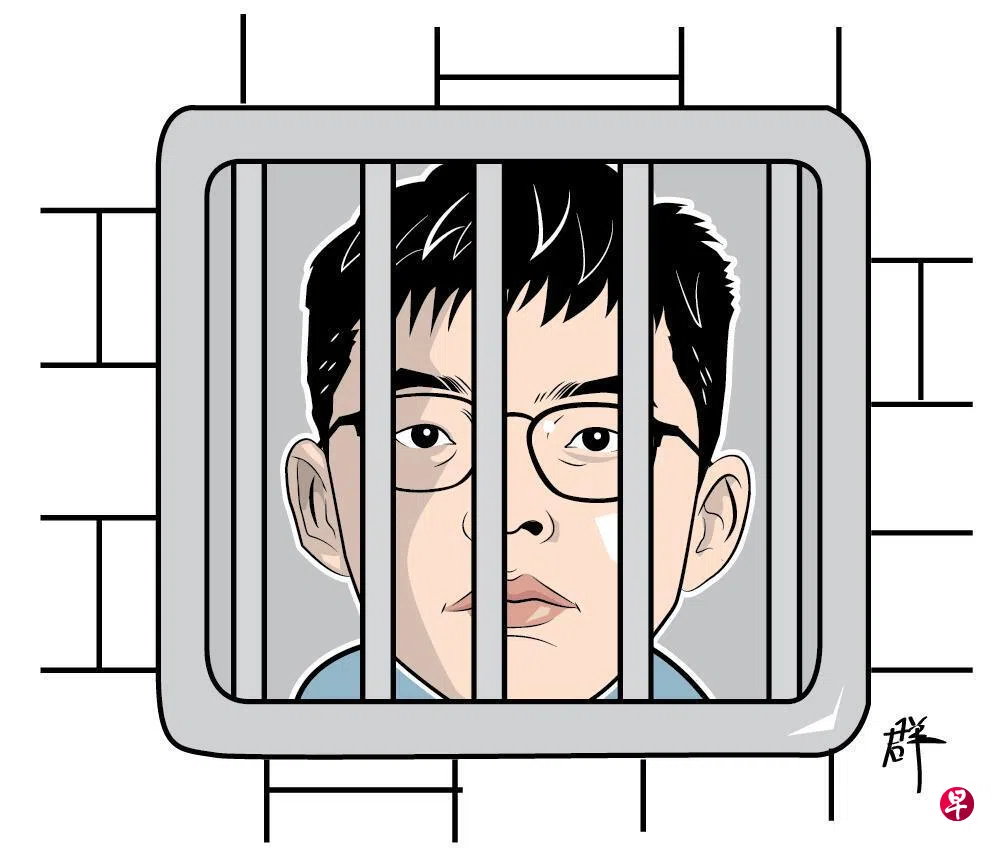
Hong Kong pro-democracy activist Joshua Wong was due to leave prison next January. But with just over two months to go before his release, he received another sentence: on Thursday (5 November), Hong Kong’s High Court jailed him for ten years in his second national security case.
Wong, who spent his 30th birthday behind bars last month, is now expected to remain in prison until November 2036, when he will be 40.
Wong pleaded guilty in September this year to the count of conspiracy to collude with a foreign country or with external elements to endanger national security.
The charge alleged that between July and November 2020, he conspired with former Demosisto chairman Nathan Law Kwun-chung and others to ask foreign countries to impose sanctions and take other action against mainland China and Hong Kong.
Judge William Tam Yiu-ho deemed the offence serious and adopted a starting sentence of 13 years, reducing it to ten years after considering Wong’s guilty plea and mitigation. Two months and two days of the sentence will run concurrently with his existing prison term.
According to Initium Media, Wong remained calm as he heard the sentence, taking notes with his head down. He waved to the public gallery as the court adjourned. For Wong, who entered political activism as a teenager, the ruling appears to mark another dividing line in his political career.
Born in 1996, Wong became involved in social activism at 14. In 2011, he and his fellow activists founded Scholarism to oppose the Hong Kong government’s introduction of Moral and National Education in primary and secondary schools.
Their campaign ultimately prompted the authorities to shelve the plan in 2012 and stop providing prescriptive or official curriculum guidelines for the subject.
In 2014, aged just 17, he became one of the leading figures in the Umbrella Revolution, demanding that the Hong Kong government deliver “genuine universal suffrage”.
Two years later, Scholarism ceased operating. Wong, then 19, founded Demosisto with Law and others and became its secretary-general, gradually moving from student activism into party politics.
Wong was first jailed the year after the party was founded. In 2017, he received a prison sentence for storming the forecourt of the government headquarters’ East Wing, commonly known as Civic Square, in 2014.
The Court of Final Appeal later overturned the prison sentence. In January 2018, he was jailed again for breaching a court injunction during the clearance of the Mong Kok protest site.
At the time, however, imprisonment was more of a brief interruption to Wong’s political career. After his release in June 2019, he quickly joined the protests against the extradition bill and travelled to Germany, the US and elsewhere to lobby for international attention to the situation in Hong Kong.
The turning point came in 2020. After the Hong Kong National Security Law took effect in late June, Wong quit Demosisto, which then disbanded.
In November that year, he pleaded guilty in a case involving the siege of the police headquarters and was remanded in custody. He was subsequently sentenced to 13 and a half months in prison and has remained behind bars ever since.
In early 2021, while in prison, he became embroiled in the pro-democracy camp’s “35+ primary elections” case. Prosecutors said the participants sought to use the primary to secure a majority in the Legislative Council, with plans to then veto the budget to force concessions from the government.
Wong pleaded guilty to the count of conspiracy to subvert state power and was sentenced in 2024 to four years and eight months in prison. He had been due for release in January 2027.
Now, another national security case has pushed his release date back by nearly ten years. But the length of his imprisonment is not the only thing that has changed.
In the past, Wong could resume political activism after his release, despite his repeated jail terms.
Hong Kong’s political environment is now very different. Even if he regains his freedom in 2036, he will probably find it difficult to return to his former path of organising political parties, contesting elections or launching street protests. Whether he will face further prosecutions is equally unpredictable.
Yet just days before the sentencing, the experience of another defendant in a national security case pointed to a different possibility.
Former Next Digital chief executive officer Cheung Kim-hung, whose sentence was due to end in 2028, recently visited Shenzhen as a “rehabilitated person” with a tour organised by the Correctional Services Department. He has reportedly been released early.
Cheung had pleaded guilty to conspiracy to collude with foreign forces and testified for the prosecution, receiving a sentence of six years and nine months. In a recent interview with Phoenix TV, he said he regretted his crimes and was proud of China’s technological development.
Hong Kong authorities have yet to confirm whether Cheung has been released or disclose the arrangements and considerations involved.
Under Hong Kong’s current rules, before prisoners serving sentences for offences endangering national security can receive remission or be referred for consideration for early release, the Commissioner of Correctional Services must be satisfied that doing so “will not be contrary to the interests of national security”.
Some scholars suggest that public expressions of remorse can both demonstrate the effectiveness of national security measures and send a message that repentance may help secure early release.
When Wong was first jailed in 2017, he wrote in the UK’s The Guardian: “Our bodies may be imprisoned, but our pursuit of freedom cannot be confined.”
At the time, he presumably believed he could return to politics after his release. Nine years on, Hong Kong and its political landscape have changed, and the choices before him are entirely different.
The court has handed him a ten-year sentence. But no one can tell him how to navigate the next ten years of his life.
