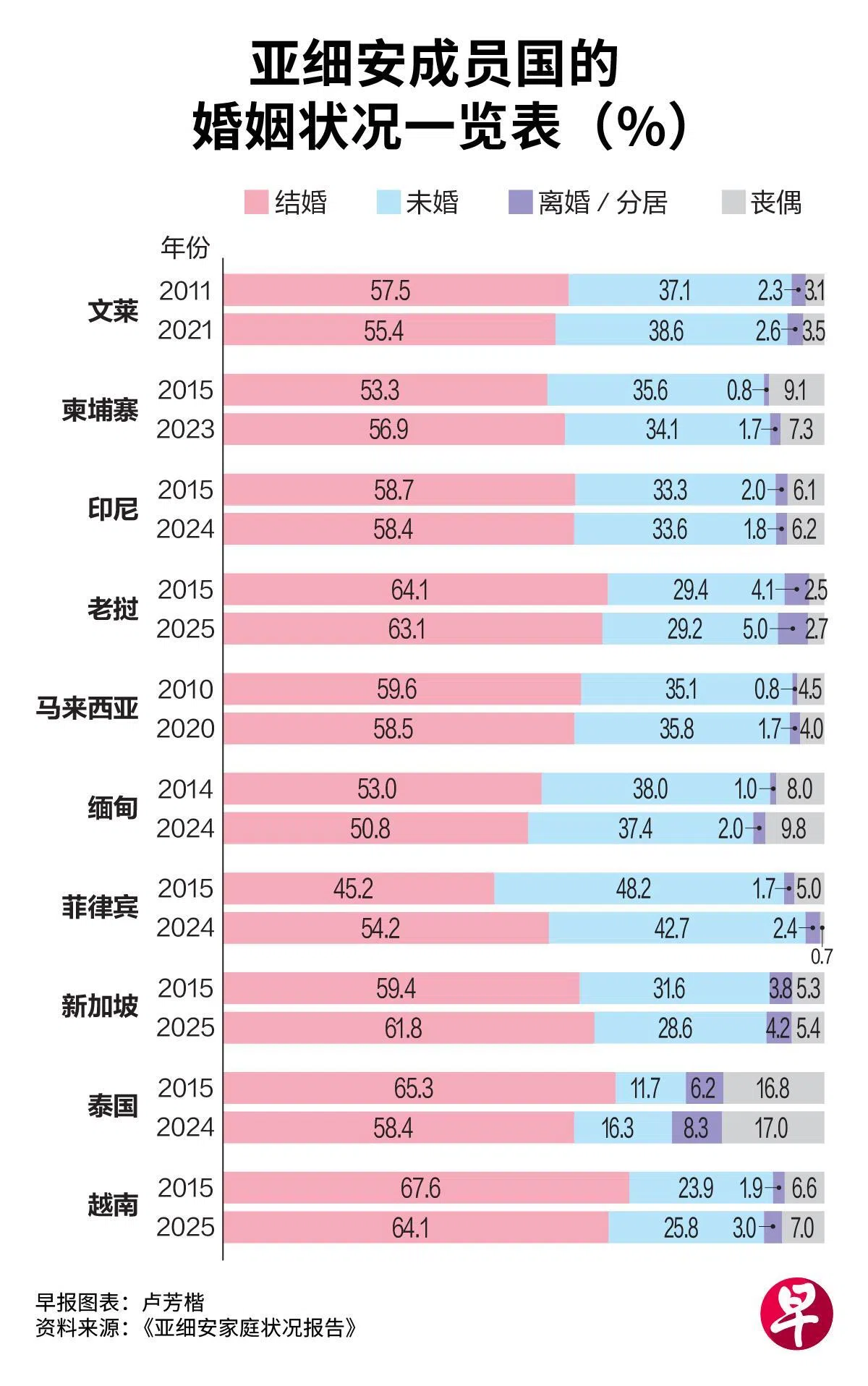
People across ASEAN are generally marrying later and having fewer children, while households are becoming smaller. Even so, most families in the region remain resilient and able to tackle life's challenges together. Nearly nine in 10 married respondents are also satisfied with married life.
The inaugural State of ASEAN Families Report 2026 was released at the Asian Family Conference on Tuesday (17 November). Covering nearly 13,000 households across 10 ASEAN member states, excluding Timor-Leste, the report examines changes in family structure, family resilience and quality of life in the region.
The report found that men and women in most ASEAN countries are marrying later. Based on national data from different years, the median age at first marriage for women rose from a range of 20.5–28.2 years in earlier data to 21.2–29.6 years in the latest figures. For men, the range rose from 23–30.3 years to 24.4–31.1 years. Singapore had the highest age at first marriage for both men and women in the region.
Fertility rates have also generally declined across the region. Only Cambodia, Indonesia and Laos remained at or above the replacement level of 2.1. All other countries were below that level, with Singapore and Thailand recording the lowest rates, at 0.9 and 1.0 respectively.
Speaking at the conference, Minister for Social and Family Development Masagos Zulkifli said changes were taking place worldwide, and ASEAN was no exception. Countries needed a deeper understanding of these changes to develop more effective policies and provide practical support for families.
He noted that ASEAN had committed at the 2024 Asian Family Conference to strengthening family research and building more comprehensive data. As existing research largely focuses on Western societies and may not fully reflect the realities of Asian families, ASEAN member states and academic partners conducted a cross-national survey over the past two years. It provides the first comprehensive regional picture of the circumstances of ASEAN families and the changes they face.
Coordinated by the Ministry of Social and Family Development with support from the ASEAN Secretariat, the survey is the outcome of the member states' joint Collaboration on Understanding the State of ASEAN Families initiative. The Singapore University of Social Sciences is the lead research partner, while the Stephen Riady Group of Foundations contributed S$1 million to support the research.
Over 90% of families surveyed show moderate to high resilience
Masagos noted that despite the general trend towards later marriages and declining fertility rates across ASEAN, the survey still yielded encouraging findings: most families had strong ties and were able to cope with difficulties, while respondents generally felt that they and their families enjoyed a good quality of life.
According to the report, 92.7% of respondents scored in the moderate to high range in the family resilience assessment, indicating that most families could face life's challenges together.
ASEAN families had an average resilience score of 3.87 out of five. By household structure, nuclear families with children scored highest at 3.96, followed by three-generation households at 3.94. Those living alone scored lowest at 3.64.
Nearly nine in 10 married respondents also said they were satisfied with married life.
Masagos said the survey showed that nuclear families with children and three-generation households generally fared better in family resilience, life satisfaction and quality of life. Countries should build on these strengths, while giving greater attention to families who need more support to thrive.
He stressed that the report was not the end of the effort. The research team will continue tracking long-term changes in ASEAN families to ensure that national policies keep pace with families' needs. It will also further examine how parenting and caregiving responsibilities affect family resilience.
He also encouraged governments, researchers and academic institutions to make good use of the survey data, deepen cross-national research collaboration and learn from one another's experience in supporting families.
Separately, as Singapore assumes the chairmanship of the ASEAN Socio-Cultural Community next year, it will host the inaugural high-level forum on technology in April next year. The forum will bring together policymakers, researchers and industry representatives to explore how technology can improve social services and showcase innovative solutions.