

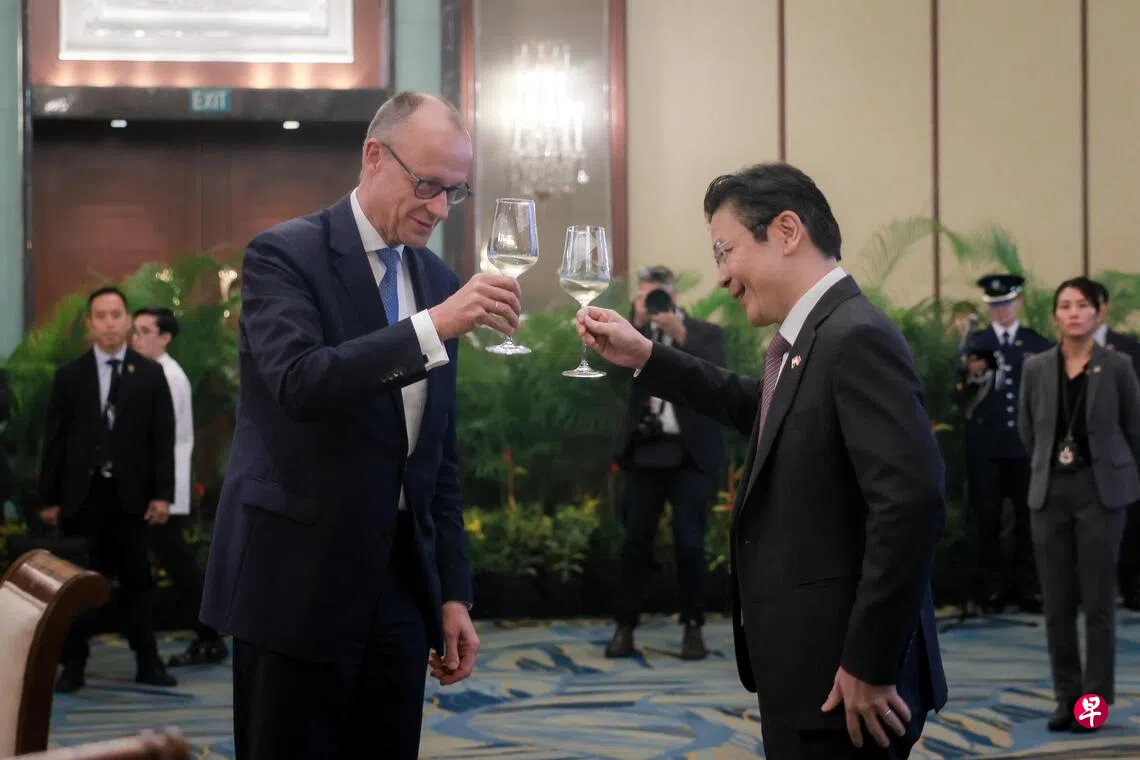
Singapore’s chilli crab and Riesling wine is not the most obvious food pairing, yet the two complement each other surprisingly well.
Singapore Prime Minister Lawrence Wong used the metaphor for Singapore-Germany relations, where any differences between the two countries can even be a source of strength.
PM Wong hosted a dinner for visiting German Chancellor Friedrich Merz on Tuesday (27 October) evening. Guests were served the local crab speciality with glasses of German Riesling.
In his toast, PM Wong elaborated on how the crisp acidity of Riesling wine went well with the rich, spicy flavours of chilli crab. “Perhaps there is a lesson here about our two countries. We do not have to be alike to work well together,” he said. “Indeed, our differences can be a source of strength.”
PM Wong said Germany brought with it its own traditions, capabilities and perspectives, while Singapore also had its own strengths; by working together, the two countries could open up new possibilities that neither might have imagined on its own.
Singapore will chair ASEAN next year, which also marks the 50th anniversary of ASEAN-EU dialogue relations. PM Wong said Singapore would work with Germany to bring the two regions closer together. “At a time when others are putting up walls, we want to build more bridges – between our economies, our businesses and our peoples.”
Complementary strengths can open up new possibilities
PM Wong noted that though Singapore and Germany might seem like two very different countries, they shared a belief that their future depended on their ability to break new ground through ingenuity, enterprise and the skills of their people.
Germany is renowned for its engineering excellence and industrial craftsmanship and “Made in Germany” is a mark of quality and reliability around the world -- strengths that remain important in the digital age, he said. Singapore, meanwhile, offers Germany a highly connected, trusted base in Asia, with a vibrant ecosystem where new ideas can be developed, tested and scaled up.
“Germany brings deep expertise, while Singapore offers connectivity and agility. So together, we can combine our complementary strengths, to open up new possibilities — in industrial artificial intelligence (AI), advanced manufacturing, biomedical sciences and other emerging fields,” PM Wong said.
This year, Singapore and Germany launched the Singapore-Germany Year of Innovation to further connect their innovation ecosystems and promote cooperation in emerging technologies. On Tuesday, the two countries also issued a joint declaration on their strategic partnership and a new joint work plan.
Defence ties built on decades of trust and commitment
Their complementary relationship also extends to defence. PM Wong noted that the Singapore Armed Forces valued its opportunities to train in Germany. The two countries will also expand cooperation into new areas, including defence technology, cybersecurity, space and supply chain resilience.
PM Wong emphasised that “such close cooperation does not happen overnight. They reflect decades of mutual confidence, and a shared commitment to each other’s security”.
He said Singapore and Germany both benefited greatly from an open and interconnected world, and understood that cooperation and trade were not a zero-sum game. Both countries wish to keep their respective regions open, strengthen the rules-based international order and demonstrate that cooperation remained not only possible but all the more necessary in an increasingly divided world.
Merz said the Singapore-Germany partnership was more important than ever in a new era of intensifying competition among major powers.
“We are nations that firmly believe that the international order should be shaped by a fair set of rules and strong institutions. We are both convinced that the challenges of our time are best addressed through cooperation and reliable international partnerships.”
Merz also said Singapore-Germany ties extend beyond high-level political and trade exchanges to concrete cooperation in many areas, with about 2,400 German companies already operating in Singapore. Both countries also firmly believe that innovation is key to boosting economic competitiveness and social resilience.
Merz concluded by echoing Wong’s dinner metaphor, that he enjoyed Asian food and how German Riesling wine was “a perfect match for Asian cuisine”.
