

As Singapore’s energy sources and demand become increasingly diverse, the Energy Market Authority (EMA) has awarded a total of S$14.9 million to four power projects to strengthen the resilience of the country’s grid and ensure a stable electricity supply.
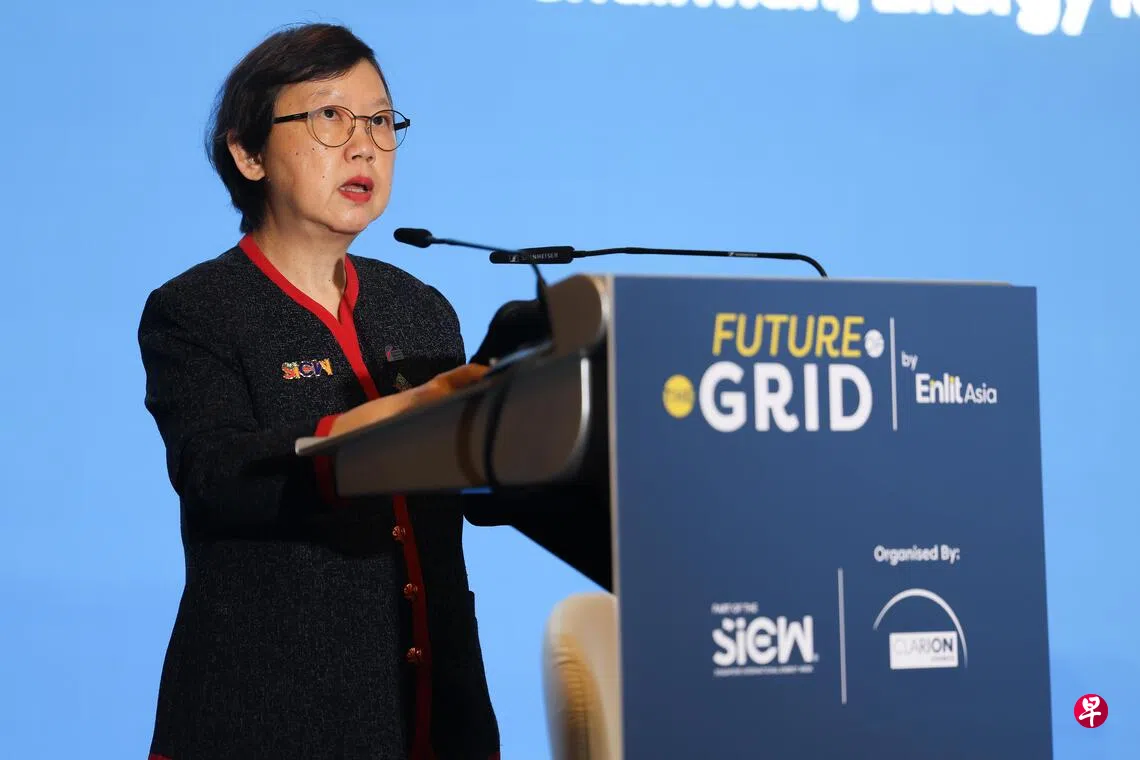
EMA chairman Tan Ching Yee announced the funding on Tuesday (27 October) in her address at the Future of the Grid event on the second day of Singapore International Energy Week.
Tan noted that Singapore’s grid largely transmits electricity in one direction, from power plants to users. The future grid will need to manage many more nodes, including bi-directional nodes — nodes which can be demand nodes at some points in time and supply nodes at other times.
Small electric cars, for example, can draw electricity from the grid to charge their batteries and, in the future, feed surplus electricity back into the grid and sell it.
To orchestrate across these different nodes will require more intelligence, both at the centre and at the nodes. “We will also need new and well-coordinated nodes that play critical roles for power availability, system stability and market stability, thereby giving users better reliability and minimising system-wide costs.”
To this end, EMA is funding four projects to develop practical solutions to improve the maintenance and operation of grid infrastructure, address the impact of growing distributed energy resources and provide new forms of support for system stability. These will enable distributed resources to better support grid operations.
Using AI and data to optimise infrastructure maintenance decisions
Two of the projects, worth a total of S$8.7 million, will be undertaken by the SP Technology Laboratory, set up by SP Group subsidiary SP PowerAssets and EMA. They will use artificial intelligence and data to optimise decisions on maintaining and replacing grid infrastructure.
As more distributed energy resources, such as solar photovoltaic systems and electric vehicle charging points, are connected to the grid, the projects will also test solutions to manage voltage and power quality.
Yokogawa Engineering Asia has been awarded S$4.2 million to explore and develop fast-response services to safeguard grid stability.
Funded under EMA’s Energy Grid 3.0 programme, the project aims to enhance Singapore’s grid planning and operational capabilities while developing solutions to meet new demands on the power system. These include inertia, which helps slow changes in frequency following sudden disturbances in the power system, giving it time to respond.
The project will also study how different types of resources, such as batteries, solar inverters, industrial electricity loads and electric vehicles, can be rapidly coordinated to help keep the grid stable.
Singapore-registered Green Union has also received S$2 million to develop ways to better coordinate distributed energy resources, including solar photovoltaics, battery energy storage systems and electric vehicles. The aim is to strengthen grid resilience and maximise the use of existing infrastructure.
This project will be jointly funded by EMA and the Korea Institute of Energy Technology Evaluation and Planning (KETEP). The two agencies have collaborated on smart grids and energy technologies since 2019, undertaking joint research and development projects.
In 2024, they signed a memorandum of understanding to strengthen cooperation on energy technologies and policies relating to energy efficiency, renewable energy, smart grids, energy storage systems, and carbon capture and storage.
The four projects fall under the Decarbonisation Grand Challenge (DGC) research, development and innovation programme and will be overseen by the Advance Energy and Decarbonisation Office.
EMA chief executive Puah Kok Keong said the grid would need to take on more tasks as Singapore’s power system evolves.
“These projects will help us develop and test practical solutions to improve how we maintain and operate the grid, strengthen system stability, and harness distributed energy resources. This will help us better prepare the grid for future needs.”
