

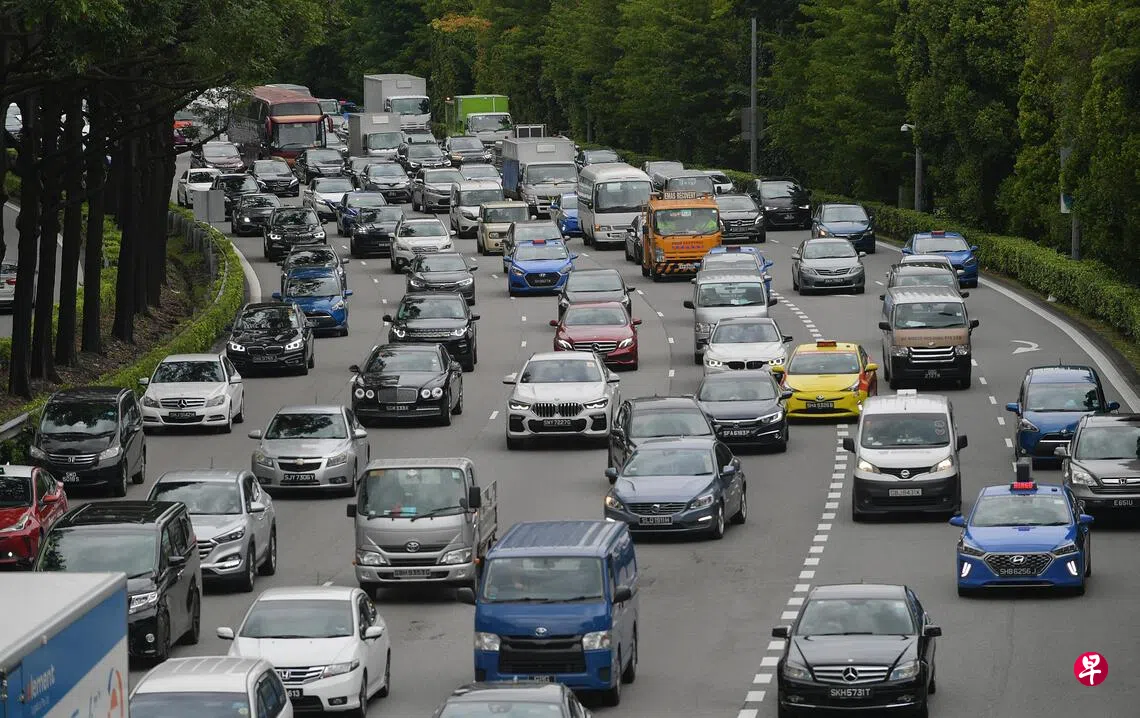
From Friday (30 October), individuals buying cars to be registered as private hire cars (PHCs) will no longer be exempt from limits on loan amounts and repayment periods. Like other private car buyers, they will be able to borrow only up to 60% or 70% of the purchase price, with repayment periods capped at seven years.
The authorities said the rules are being tightened to prevent buyers from using the financing exemption for PHCs to circumvent private car loan restrictions. The new measures also apply to individuals buying cars as sole proprietors. Company-owned PHCs, commercial vehicles and motorcycles will remain exempt from the restrictions.
The Ministry of Transport, Monetary Authority of Singapore, Ministry of Energy, Trade and Industry and Ministry of Law announced the changes in a joint statement on Thursday (29 October). The statement said more individuals had recently been registering their car purchases as PHCs to enjoy the exemption from financing restrictions, despite having no intention of providing private hire services.
PHC registrations under individuals’ names surge to about 500 a month
The authorities said the number of PHCs registered in individuals’ names had recently surged to about 500 a month, suggesting that some buyers may be doing so primarily to secure more generous loan terms.
Under the new rules, loans for cars with an open market value (OMV) of S$20,000 or less will be capped at 70% of the purchase price. For cars with an OMV above S$20,000, the loan limit will be 60%.
This means buyers must make a down payment of at least 30% or 40%. The purchase price used to calculate the loan limit includes the relevant taxes and, where applicable, the Certificate of Entitlement (COE) price.
The limits cover car loans that individuals obtain from financial institutions, licensed moneylenders or lenders exempt from licensing. They also apply to hire-purchase and conditional sale agreements, with all financing tenures capped at seven years.
The new measures apply to individuals’ PHC purchases with sale and purchase agreements signed on or after 30 October. Where there is no sale and purchase agreement, the date the COE is obtained will apply.
Previously, individuals buying cars for private-hire use could qualify for an exemption from the loan amount and repayment limits for ordinary cars on the grounds of “business use”.
The authorities said the PHC fleet had grown and stabilised as the industry developed over the years. Unlike taxis, individually owned PHCs are essentially private cars with the flexibility to be used for hire. “To ensure that PHC purchases cannot be used to circumvent financing restrictions that apply to private car buyers, individual buyers of PHCs will now be subject to the same financing restrictions as private car buyers.”
The authorities said this would also ensure that private-hire drivers entering the industry borrow prudently, just like other private car buyers. The government will continue to monitor market conditions and take further steps to ensure that different financing arrangements, including dealers' in-house loans, are subject to the same limits.
The authorities will also work closely with platform operators to ensure the measures are implemented effectively and consistently. They reminded prospective car buyers to borrow within their means and avoid unregulated financing schemes.
Ron Lim, general manager of Nissan distributor Tan Chong Motor Sales, told Lianhe Zaobao that the practice of using PHC loans to buy cars had been around for some time, with some dealers even openly advertising such loans.
He said persistently high car prices in recent years had prompted more buyers to use this route to bypass private car loan restrictions. Strict enforcement of the new rules would affect demand for cars. To his knowledge, such loans are usually provided by finance companies rather than banks.
Dr Guan Yaohan, an associate professor at the Singapore University of Social Sciences and a former car dealer, said in an interview that tightening financing rules for individuals buying PHCs would help close an existing loophole and could ease COE demand and price pressures.
“I believe when the authorities do this, they must have enough data to show that this loophole has been quite widely tapped into.”
He said the new rules could help bring down COE premiums, but stressed that such purchases were only one of several factors driving premiums higher. Their actual impact would have to be assessed through market trends over the coming months.
The new measures will make it harder for drivers who rely on private hire work for a living to buy their own cars. Dr Guan said that while this was not ideal, drivers could still consider renting or buying older, cheaper used cars to reduce their down payments.
Drivers’ association raises livelihood concerns, urges against higher operating costs
Yeo Wan Ling, assistant secretary-general of the National Trades Union Congress and adviser to the National Private Hire Vehicles Association (NPHVA), said the association recognised the government’s intention to encourage prudent financial management and prevent excessive borrowing. It had also confirmed with the authorities that drivers’ existing loans would not be affected.
But drivers remained concerned, she said. “For many, their car is a means to their livelihood. Any change to how they finance their vehicles directly affects their ability to earn a living.”
She said the association must closely monitor whether the new measures inadvertently make it harder for genuine working drivers to own cars on a financially sustainable basis, increase their reliance on rental fleets or push up operating costs.
“NPHVA will work closely with the Government as the measure is implemented, so that our drivers' concerns can be addressed.”
The Land Transport Authority launched a public consultation earlier this month on changes to the COE car categories. It proposed merging Category A, for small and medium-sized cars, with Category B, for larger and luxury cars, and introducing a system of surcharges and rebates based on car value to better distinguish mass-market cars from higher-priced vehicles. The consultation ends on 2 November.
On the suggestion of a separate COE category for PHCs and car rental companies, the authorities said in the joint statement that they had considered the approach. However, it would very likely raise rental costs for PHC drivers and fares for passengers, disadvantaging those who do not own a car or cannot drive. A separate category would also require more specific rules for PHC drivers and vehicles, reducing the flexibility to meet passengers’ travel needs.
